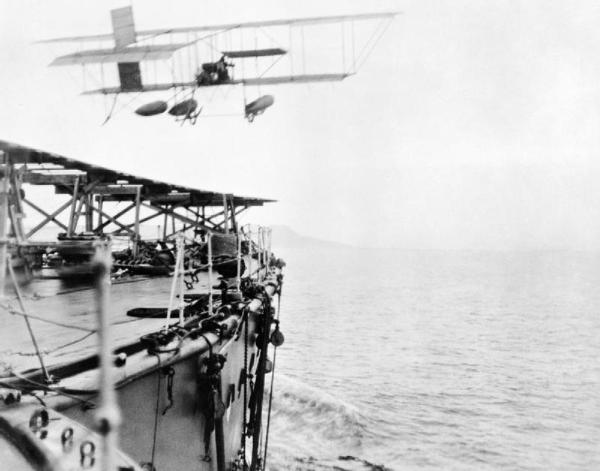
As soon as the Wright brothers took to the skies in 1903, one huge leap forward for mankind was made. Aviation soon became an international obsession, as American and European pioneers risked their lives to further refine the art of flight and secure new records. As with every developing technology at the time, the military also started looking into aviation as a potential asset. In 1910, the U.S. Navy took home the honour of launching, for the first time, a plane from a warship, as Eugene Ely took off from the USS Birmingham. The Royal Navy couldn’t afford to trail behind and initiated its own enquiries into aviation. By the outbreak of World War I, the navy could boast its own Royal Naval Air Service, possessing a respectable fleet of aircraft and airships capable of carrying out a myriad of tasks. It was, however, a long and winding road to get there. This is the story of the humble beginnings of the Royal Naval Air Service during those defining years of the dawning 20th century.
The Pinnacle of Three-Decker Ships of the Line: HMS Duke of Wellington
Armed with 131 guns, she represented the pinnacle of three-decker ships of the line.
Cod, Courage, and Sovereignty: Canada’s Fisheries Protection Before the Navy
In the pre-Navy era of the late 1800s, Canada learned to navigate its own course on the high seas – starting with the protection of fisheries and ending with the birth of the Royal Canadian Navy. The Fisheries Protection Service, though modest in size, was monumental in significance. It was Canada’s first naval force in all but name, forged in response to very real threats to the young nation’s resources and sovereignty. Through bold actions like the seizure of poaching schooners, Canada sent an early message that it would stand up for itself, even on water. These efforts bolstered Canada’s confidence as a sovereign nation and provided practical experience in naval affairs.
The Royal Navy’s War against Slavery
On 25 March 1807, the United Kingdom abolished the slave trade. More than two decades later, slavery was abolished altogether in the British Empire through the Slavery Abolition Act of 1833. More than 800,000 individuals were freed from slavery with immediate effect in Canada, South Africa, and the Caribbean. The United Kingdom used its most valuable instrument, the Royal Navy, to enforce the ban on the slave trade. Between 1807 and 1860, the West Africa Squadron intercepted around 1,600 slave ships and liberated over 150,000 Africans from the grim fate of slavery.
Swiftsure-class HMS Triumph (1870)
HMS Triumph was a broadside ironclad battleship of the Victorian era and the sister ship to HMS Swiftsure. Together, these ships comprised the Swiftsure-class of 1870, specifically designed as flagships for distant stations, primarily to serve in the Pacific squadron.
The Rise of the Submarines
The decades leading up to the First World War saw the Royal Navy, under John Fisher, introduce various new types of weaponry. Among these innovations was the submarine, which became operational in 1901. The speed of its development following its introduction—due in part to Fisher's continued support—was remarkable. What began as an experimental vessel quickly evolved into a powerful weapon, playing a key role in the Royal Navy’s strategy.
A Ship that Redefined Naval Warfare: HMS Devastation (1871)
HMS Devastation was a ship that redefined naval warfare, proving that masts were no longer essential for warships. Her design set a precedent for modern battleships, embodying the transition to steam-powered, turret-armed vessels that would dominate the seas in the decades to come.
How the Royal Navy helped defeat the Boxer Rebellion (1899-1901)
The Boxer Rebellion was a Chinese nationalist movement that aimed to remove all christian and foreign influence from China. This prompted the formation of the Eight-Nation Alliance, with the British Empire as one of its members. The alliance sought to suppress the rebellion and restore the Western-dictated order in China. Britain sent its most lethal weapon to the war zone: the Royal Navy.
Lord Fisher and His Navy (Part 1)
When the Royal Navy went to war with Germany, its fleet was, for the most part, the brainchild of Sir John Fisher. Who was Sir John Fisher, and why was he considered such an influential figure in the Royal Navy at the time?