
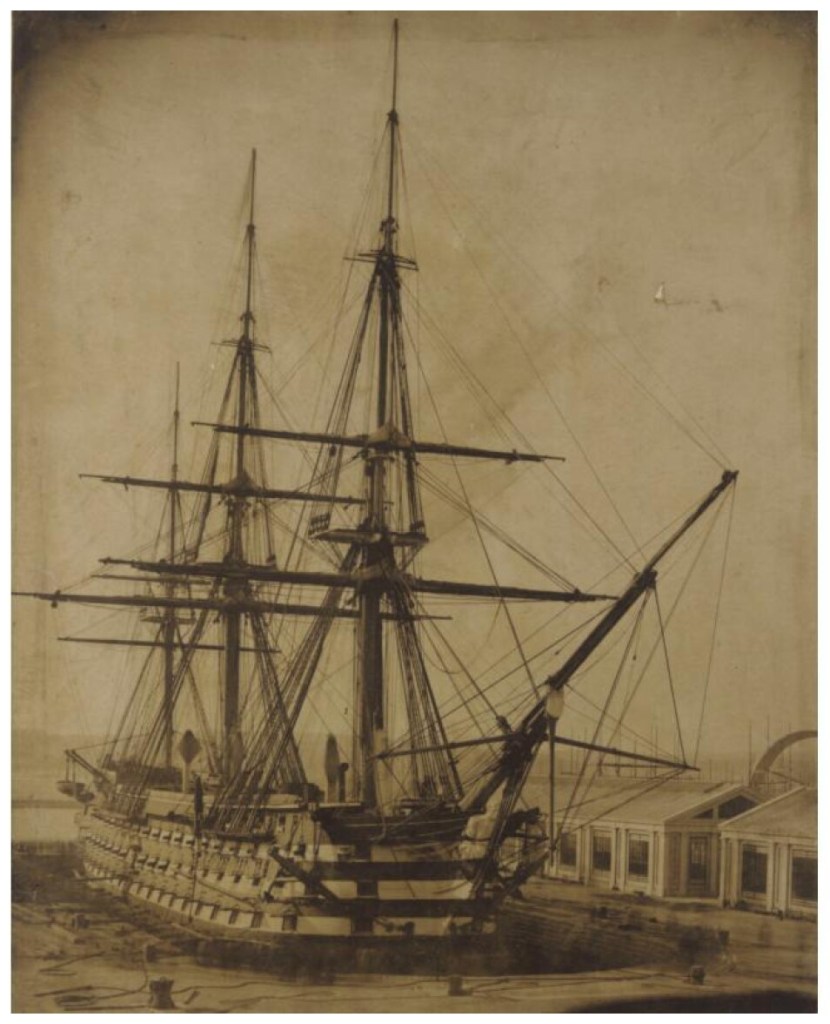
HMS Duke of Wellington was originally christened HMS Windsor Castle and was intended to have three sister ships. Armed with 131 guns, she represented the pinnacle of three-decker ships of the line. This massive warship was the brainchild of William Symonds, Surveyor of the Navy, who designed her lines in 1841. At the time, it was becoming increasingly clear that steam power represented the future, and the wisdom of building solely sail-powered ships was being seriously questioned. Initially, only smaller vessels were equipped with steam engines, as the large paddle boxes required by early systems significantly reduced the number of guns a ship could carry. However, the introduction of the screw propeller in the 1840s resolved this issue, enabling plans to equip the larger units of the fleet with steam propulsion.
“Armed with 131 guns, she represented the pinnacle of three-decker ships of the line.”
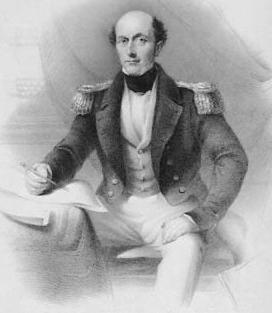
It was not until May 1849 that the ship was finally laid down at Pembroke Royal Dockyard, by which time some modifications had been made by Symonds and Assistant Surveyor John Edye. Later, further alterations were introduced by the new Surveyor of the Navy, Captain Baldwin Walker, as part of his mission to transform the Royal Navy into a steam-powered fleet. While still on the stocks, the ship was cut apart in two places to accommodate steam engines and screw propellers. These 780-horsepower engines were designed and built by Robert Napier and Sons for the iron frigate Simoon, but were reallocated to the 131-gun ship of the line then under construction. During her sea trials, these engines enabled the ship to reach a top speed of 10.15 knots under steam. The ship was finally launched on 14 September. Upon receiving news of the Duke of Wellington’s death on the very day the leviathan was launched at Pembroke, it was deemed fitting to rename Windsor Castle in honor of the great British national hero.
“While still on the stocks, the ship was cut apart in two places to accommodate steam engines and screw propellers.”
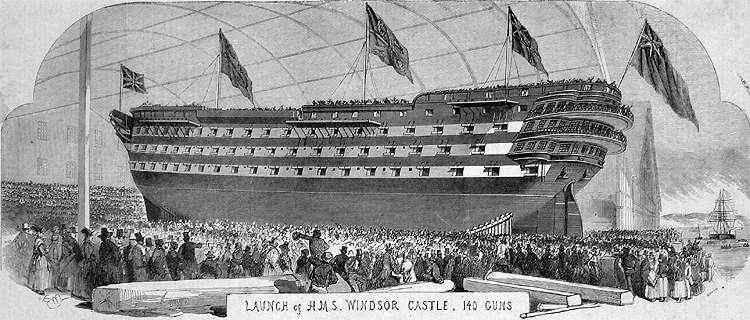
The Duke of Wellington was completed in February 1852. Being twice the size of Nelson’s Victory, she was the largest warship afloat in the world. She was 240 feet (73.1 m) long, and displaced a staggering 5,892 tons (for comparison: Victory weighs 3,556 tonnes).
“After a while, the ship’s second-hand engines proved increasingly unsatisfactory. Following the Crimean War, her days on the frontline were over.”
After a brief period with the Western Squadron of the Channel Fleet, she was reassigned as the flagship of Vice-Admiral Sir Charles Napier’s fleet, which was sent to the Baltic following the outbreak of war with Russia in 1853. She served in the Baltic in 1854 and returned in 1855, by which time Rear-Admiral Richard Saunders Dundas had succeeded Napier as commander-in-chief of the Baltic squadron. A notable event during her deployment was the bombardment of Sveaborg. After a while, the ship’s second-hand engines proved increasingly unsatisfactory. Following the Crimean War, her days on the frontline were over. She was paid off in 1856 and served as a guard ship of sailing ordinary at Devonport from 1860 to 1863. From 1863, she became the receiving ship at Portsmouth. Later in the 1860s, she relieved HMS Victory as the flagship of Portsmouth, a role she continued to fulfill for many years. She was paid off for the last time on 31 March 1888 but nevertheless was present at Queen Victoria’s birthday celebrations and the fleet review at Portsmouth in 1896. She was finally broken up at Charlton in 1904.
Olivier Goossens


Leave a comment