
The Nine Years’ War (1688–1697) is perhaps one of the least known of the great European wars of the early modern period. Much was at stake, nevertheless, with part of the conflict revolving around French King Louis XIV attempting to get his recently ousted Catholic colleague, James Stuart, back onto the English throne after the Glorious Revolution of 1688. Angered at the king’s tyrannical behaviour and his Catholic belief, a handful of prominent Englishmen invited the Dutch stadtholder, William of Orange, to take over the island kingdom. Aided by august winds, William’s invasion force was able to make landfall unopposed, and England fell soon enough back into Protestant hands. James fled to France, seeking aid at the Sun King’s court. Louis, who was preparing a grand offensive eastward against the Holy Roman Empire, acquiesced to James’s request, petrified at the prospect of an alliance between England and his archnemesis, the Dutch Republic. An invasion force, protected by the French navy, was readied to take the war to the British Isles. Striking directly at England would be folly, however, and it was decided to operate from more friendly territory: Catholic Ireland.
The exiled King James II had been preparing his comeback in Ireland through his Lord Deputy, the Earl of Tyrconnell, not long after his embarrassing arrival in France. He first sent financial aid before being able to travel across the stormy northern seas himself, sailing out in March 1689 at the head of a modest force of 2,500 mixed troops aided by 100 French officers. James arrived unscathed and disembarked at Kinsale in southern Ireland. His plan was to secure this Catholic bastion before invading England via Scotland. Although in possession of Dublin, James was still opposed by numerous Protestant strongholds scattered throughout the isle. If he were to cross the Irish Sea to Scotland, he first had to secure his rearguard, subduing whatever forces remained loyal to the new Williamite regime. This required more equipment and supplies, forcing him to turn again to France to fuel his war. Louis XIV agreed to commit himself to the continued support of James, and a maritime supply train was quickly established between Ireland and the continent. Despite the open support of James, no official declaration of war was made, with France remaining formally neutral.
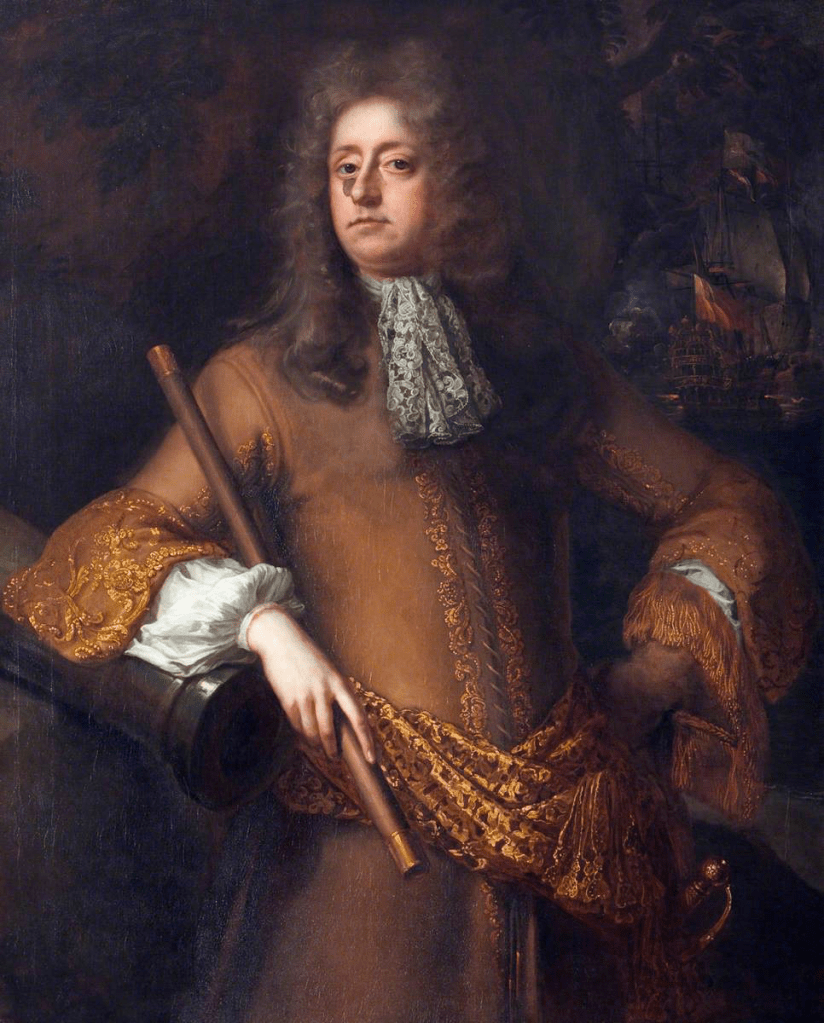
King and Parliament became seriously concerned over the deteriorating situation in Ireland. England’s first line of defence, its wooden wall, the Royal Navy, was therefore tasked with putting a stop to the French support of James’s campaign. The Williamite fleet was headed by one of William’s most loyal subjects, Arthur Herbert. It was Herbert, in fact, who had initially acted as the mediator between King James’s opposition and the stadtholder of the Dutch Republic, inviting and ferrying the new king and his troops across the Channel to Torbay, Devon. The new king had rewarded his servant with the supreme command over the fleet as First Lord of the Admiralty and Senior Naval Lord on the Board of Admiralty in March 1689. It was now Herbert’s mission to prove that his king’s trust was not ill-founded.
Herbert’s force consisted of 19 ships of the line: 8 third-rates, 10 fourth-rates and 1 fifth-rate. The admiral flew his flag aboard 70-gun HMS Elizabeth. Some promising officers were sailing with Herbert, such as Cloudesley Shovell, who captained the Edgar of 72 guns, George Rooke, captain of HMS Deptford (50), and John Leake commanding the bomb vessel, Firedrake (12), two of whom would go on to become First Lord of the Admiralty.
On 9 May, while cruising off Kinsale, South Ireland, Herbert discerned a forest of masts looming to leeward, making for the Irish harbour, which he was trying to enter as well. The French navy had been discovered. The enemy task force consisted of 24 ships of the line, a frigate force of 3 ships commanded by Captain Duquesne-Mosnier, as well as 10 fireships. At the helm of the French fleet stood 52-year-old “Lieutenant-General” François-Louis de Rousselet, Comte de Châteaurenault, one of the Sun King’s most trusted naval commanders during the latter part of his reign, also playing a crucial role in the subsequent War of the Spanish Succession (1701–1714). The French admiral had hoisted his flag in the 1680-built third-rate 66-gun Ardent. Second in command was Jean Gabaret, flying his flag in the 56-gun Saint-Michel, while Job Forant acted as third in command in the 56-gun Courageux. In short, the French fleet consisted of 3 squadrons of 8 ships each. The British were thus outnumbered and outgunned, with their ships of the line having a total broadside power of around 950 guns as opposed to the 1,248 guns under Comte de Châteaurenault. The British nevertheless possessed the heaviest ships individually with HMS Edgar of 72 guns and HMS Elizabeth, Cambridge and Pendennis of 70 guns each, while the French most powerful ship, the flagship Ardent, carried 66 guns.
The next day, however, the enemy had disappeared from sight. The English admiral was informed that Châteaurenault’s warships had sailed to the west toward Baltimore, the main village in the parish of Rathmore and the Islands, the southernmost parish in Ireland. Guided by an opportune easterly, Herbert spotted the French fleet again by the evening off Cape Clear. The French were intent on completing their task of succouring James’s land forces with stores and ammunition. They therefore continued evading the Williamite warships. Châteaurenault was heading this time toward the ria of Bantry Bay, where he dropped anchor to unload the provisions for James’s forces.
“The odds were nevertheless in favour of the numerically superior and favourably positioned French, who could have won a great victory if not for two major problems.”
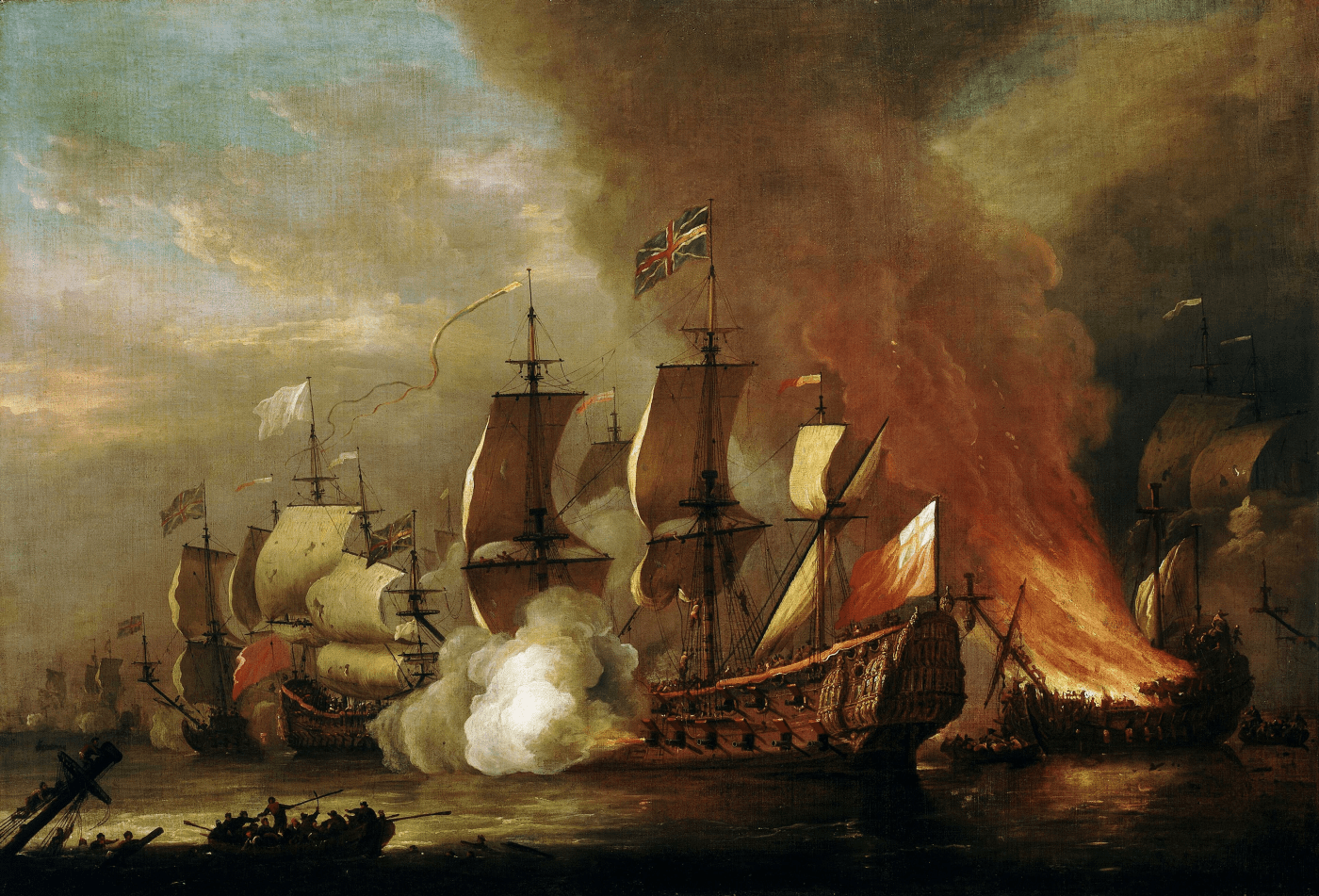
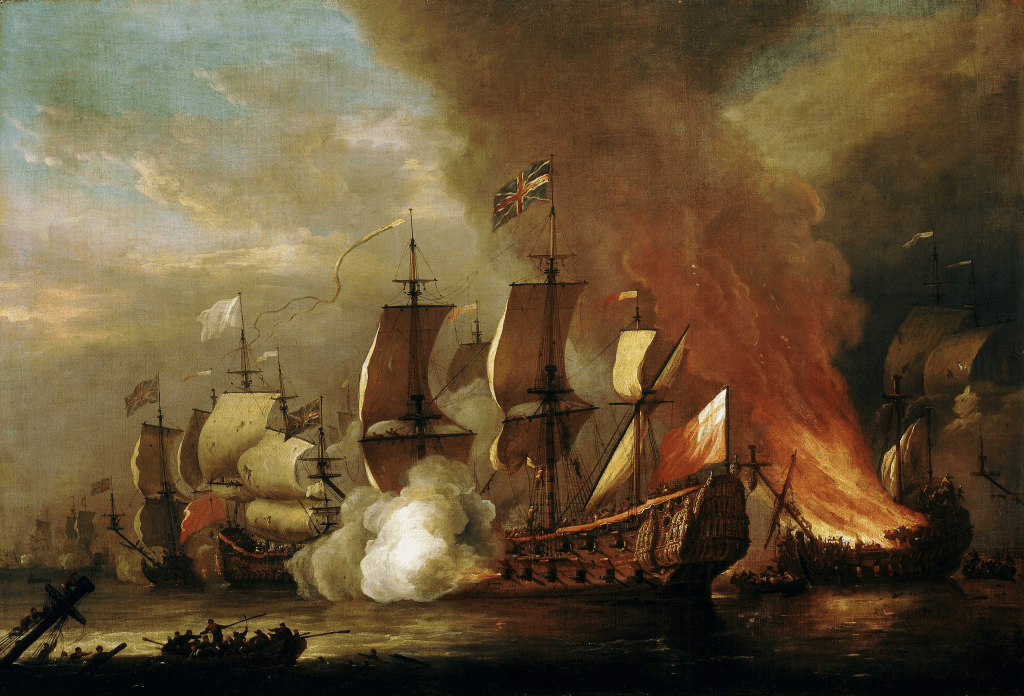
When the English appeared on the horizon again on 11 May, the French tarried in weighing anchor, as Châteaurenault first wanted to ferry as many troops, ammunition and provisions as possible to the shore. He had time, however, as Herbert stood to leeward, having considerable trouble in getting his ships alongside the enemy. He nevertheless finally managed to bear down on the French in an orderly line. The French were the first to open fire around 10:30 AM against Captain Ashby’s leading HMS Defiance. Herbert soon realized his disadvantageous position to leeward of the enemy in narrow waters and consequently altered his course. The English commander was in search of better manoeuvring space while also endeavouring to gain the weather gauge and tighten his line of battle again, which had become dangerously loose. Although Herbert succeeded in bringing his fleet in order again, Châteaurenault’s smart manoeuvring prevented the English from gaining the wind.

Fighting between the two opponents carried on until 5:00 PM. The French Diamant of 54 guns under Marquis de Coëtlogon became severely damaged after an ammunition explosion tore apart the captain’s cabin. The odds were nevertheless in favour of the numerically superior and favourably positioned French, who could have won a great victory if not for two major problems. Firstly, the deployment of their fireships could have wreaked havoc among the English, but these were still occupied with unloading provisions during the battle. Secondly, the French second and third in command, Gabaret and Forant, refrained from pressing the advantage, outraged at their situation of having to serve the junior Châteaurenault. The English disengaged while the French commander tacked back toward the shore to continue his mission. Herbert didn’t press the attack again, and the French sailed back home to Brest on 18 May. The English mourned the loss of Captain Aylmer of the Portland and over 90 seamen, while the French lost 40 men.
“Both sides claimed victory at Bantry Bay.”
Both sides claimed victory at Bantry Bay. Both William III and Louis XIV saw no reason to mourn a defeat off the Irish coast with such a relatively low casualty rate. After Herbert had returned to Portsmouth, he was visited and congratulated by his patron, the king himself. He was elevated to the peerage, becoming the Baron of Torbay and the Earl of Torrington. Furthermore, the two captains who led the vanguard were knighted, John Ashby of HMS Defence (64) and Cloudesley Shovell of HMS Edgar (64). The king likewise rewarded all participating seamen with a gratuity of 10 shillings a head. There was no reason to tarry, however, as the French were still at large. William continued to build up his naval strength by adding Dutch warships to his fleet. Soon enough a powerful armada of 34 English and 20 Dutch ships of the line would be shipshape and Bristol fashion, a worthy response to the Sun King’s powerful navy. This sense of safety and security was soon disturbed, however, by the arrival of the French Mediterranean Fleet under Comte de Tourville in the Channel, thus swelling French numbers to 75 units by the summer of 1689.
Despite being tactically indecisive, the Battle of Bantry Bay was undeniably a strategic victory for the French, who continued to support James’s forces unmolested. King James pressed on with his siege of Derry. Derry would form a key point to open up communications with his forces in Scotland. In this endeavour, the aforementioned French Captain Duquesne continued to support the Catholic counter-king with his frigates.
“The grand centennial naval struggle between the English and the French had begun, culminating over 100 years later in the cataclysmic Battle of Trafalgar in 1805.”
This direct encounter off the Irish coast led to a declaration of war between William III and Louis XIV. The high seas turned into a battleground between two of the mightiest navies in the world at that time. The grand centennial naval struggle between the English and the French had begun, culminating over 100 years later in the cataclysmic Battle of Trafalgar in 1805. In our next articles, however, we shall take a closer look at the struggle which unfolded during the Nine Years’ War on Neptune’s vast plains.
Olivier Goossens


Leave a comment