

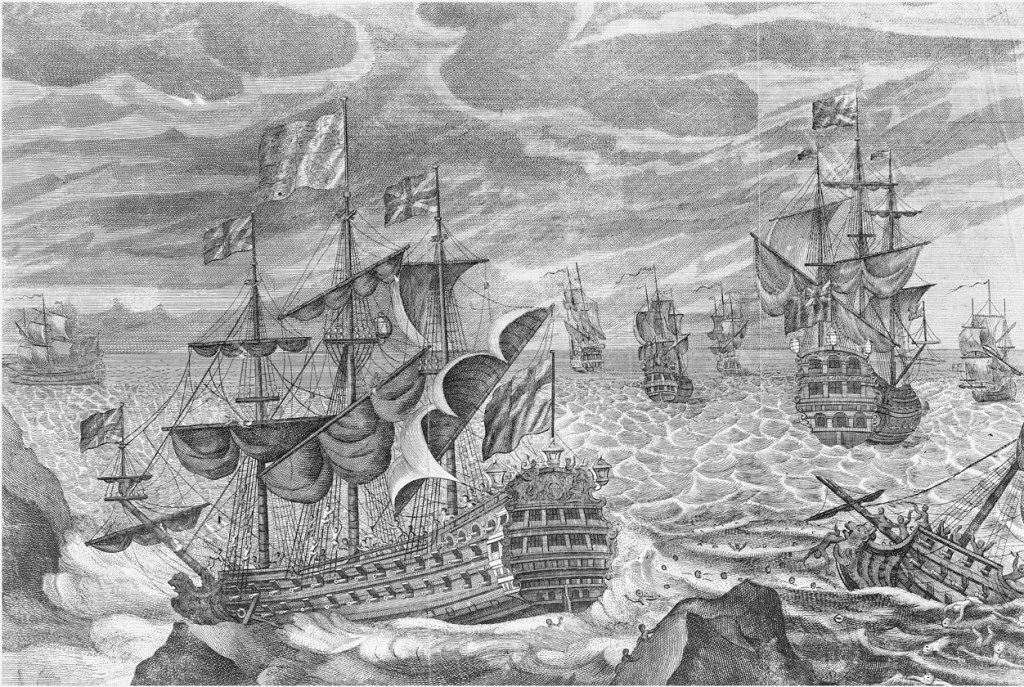
“Of the Association not a Man was sav’d … The Captain and 24 Men of the Firebrand Fire-Shop were saved, as were also all the Crew of the Phoenix. ‘Tis said the Rumney and Eagle, with their Crews, were lost with the Association“
– the Daily Courant reporting the disaster on 1 November –
After the failed Siege of Toulon, which lasted from July to August 1707, Sir Cloudesley Shovell headed back home with his men-of-war. The British admiral was due to make a port call at Portsmouth after leaving Gibraltar with 21 ships on 29 September. On his way to England, storm clouds gathered over the Bay of Biscay, spelling trouble. Typical Atlantic autumnal gales and squalls rocked Shovell’s vessels. The bad weather sometimes made it even impossible for Shovell to determine his latitude. With no friendly port to take refuge in, Shovell pressed on past the hostile French shores.
By 21 October, the sky started to clear up, however. Latitude readings were once again within the realm of possibility, and soundings were taken that suggested Shovell’s fleet was at the edge of the continental shelf. Determining the depth upon approaching the English Channel was, at that time, the common method to calculate the ship’s longitude. When arriving at the shelf, the depth suddenly changes from thousands of meters to about 100 fathoms (180 meters). The exact knowledge of the shape of the continental shelf, combined with the latitude, thus enabled seafarers at the time to ascertain their longitude. Based on these observations, the British admiral believed he was 200 miles west-southwest of the Scilly Isles.
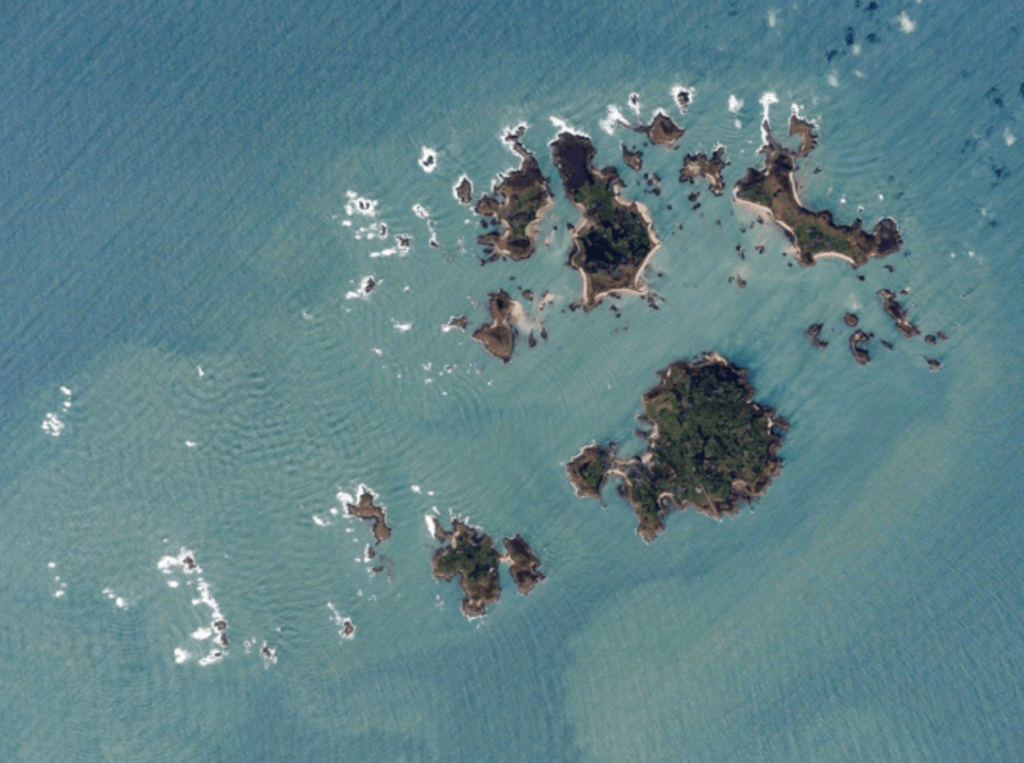
The Isles of Scilly are a small archipelago situated deep into the Atlantic off the southwestern tip of Cornwall, England. The waters around the various islands are festered with treacherous shallows and rocks. It is therefore understandable that, before the advent of modern navigation, Scilly had slowly turned into a graveyard of shipwrecks. Exposed to strong Atlantic winds, a vessel that ventured too closely could easily be smashed against the numerous razor-sharp rocks that lay in wait around the isles, foaming ominously just above the waves.
“Scilly had slowly turned into a graveyard of shipwrecks. Exposed to strong Atlantic winds, a vessel that ventured too closely could easily be smashed against the numerous razor-sharp rocks that lay in wait around the isles, foaming ominously just above the waves.”
The first thing that went wrong during Shovell’s cruise was the failure to spot the reconnoitering frigate. When a larger fleet arrived, a smaller vessel was usually sent out to guide the ships safely to England. This duty fell upon HMS Tartar from Plymouth, which set out on 21 October but never found Shovell’s squadron.
On the 21st, the wind had turned favorably to the southwest, comfortably blowing Shovell into the English harbors along the south coast. The favorable wind persisted the next day, but this time visibility deteriorated as the veil of night slowly crept over the eastern horizon. The fleet steadily steered east-by-north until Shovell finally noticed the death trap he had sailed into. By 8 PM, the British found themselves surrounded by the rocks southwest of St. Agnes Island. A cataclysmic disaster of unseen proportions ensued, shocking Britain to its core.
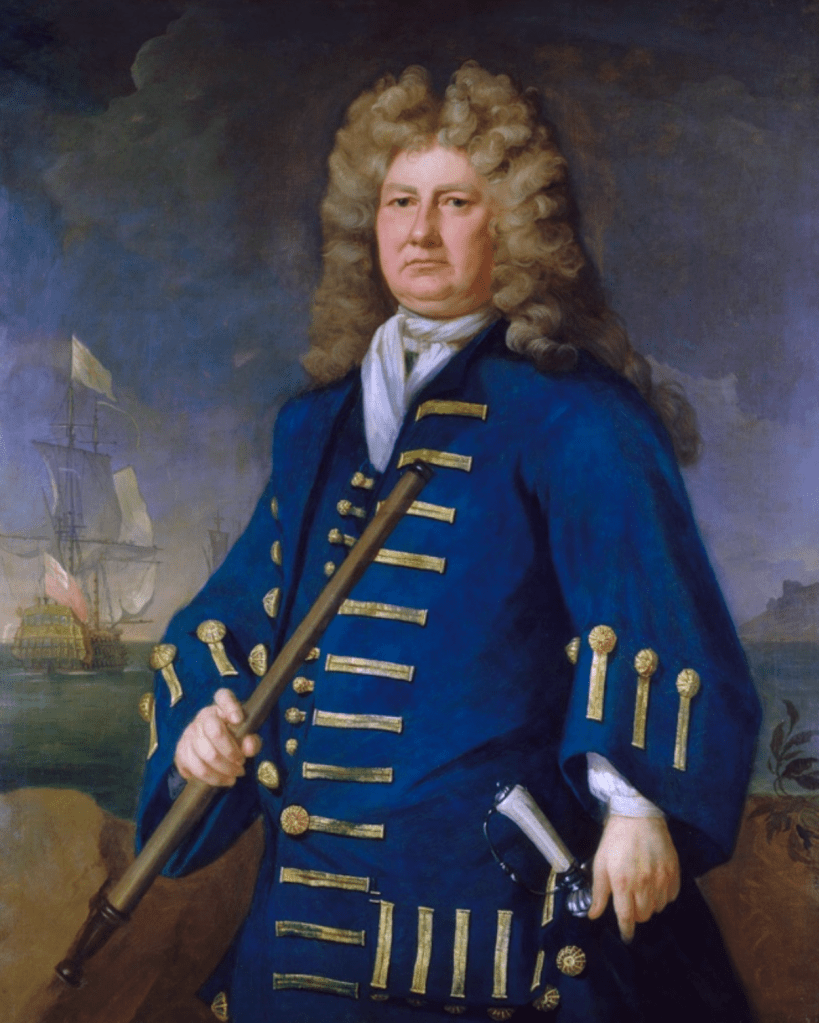
Four ships foundered on that fateful evening. HMS Association, a proud second-rate of 90 guns, met its demise after smashing against the Outer Gilstone Rock off Scilly’s Western Rocks. Her entire crew perished, including Captain Edmund Loades and Admiral Shovell himself. Thus, Sir Cloudesley Shovell, one of Britain’s finest commanders at the time, found a watery grave. He was just one month short of turning 57 years old.
HMS Eagle, a 70-gun ship, was torn open by the Crim Rocks, with all hands lost as well. The fourth-rate HMS Romney, commanded by Captain William Coney, went down after being caught by Bishop Rock. All 290 drowned, save one—quartermaster and former butcher George Lawrence, who lived to tell the tale. Finally, the fireship HMS Firebrand, under the command of Captain Francis Percy, went down after hitting the Outer Gilstone Rock. A wave initially lifted the hull from the rock, but the ship ultimately foundered in Smith Sound. Twenty-eight out of her complement of 40 died.
The exact number of souls lost on that day remains unknown. Estimates range between 1,400 and 2,000 men, making it one of Britain’s worst maritime disasters. Many bodies washed up on the shores of the Scilly Isles over the next few days, including the unfortunate Admiral Shovell. Queen Anne was absolutely abhorred upon receiving the news. She ordered that the admiral be given a proper funeral in Westminster Abbey, where his tomb can still be admired—a fancy marble monument carved by Grinling Gibbons, depicting the stricken admiral reclining on his sarcophagus.
Many myths about the disaster started to surface throughout the 18th century. One such fanciful tale is that of a native from Scilly warning Shovell about their dangerous position. According to the tradition, the admiral had the islander hanged for questioning his authority. Some Scillonians consequently claimed that no grass would ever grow over the original grave of Shovell at Porthellick Cove as retribution for his tyrannical behavior.
Another legend surrounding the demise of Shovell’s squadron is that the commander was still alive when he reached the nearby shore. He was supposedly killed by a local woman, who had caught sight of Shovell’s valuable emerald ring. Overcome by guilt, the woman later confessed to the murder on her deathbed, producing the ring to be returned. This story, as well as the previous one, has no clear historical basis, however, and therefore must be dismissed as a mere figment of the British imagination.
The magnitude of the disaster prompted many Englishmen to inquire into the affair, attempting to discover what had happened. One major challenge in researching the Scilly Disaster is the absence of the logs of HMS Association, meaning we have no idea what navigational information was available to Admiral Shovell. The fact, however, that Shovell headed east-by-north suggests he believed he was at a safe distance to the south of Scilly. In other words, the problem was a miscalculation in latitude, not longitude, as Dava Sobel claims in her 1998 book Longitude: The True Story of a Lone Genius who Solved the Greatest Scientific Problem of his Time.
“In other words, the problem was a miscalculation in latitude, not longitude”
Be that as it may, the Scilly Disaster of 1707 caused significant dissatisfaction with the inadequacy of navigational techniques at the time. One glaring blind spot in navigational knowledge was the inability to determine one’s longitude. In 1714, the Longitude Act was promulgated, establishing the Board of Longitude. A handsome reward was promised to the genius who could devise a method to calculate a ship’s longitude. This led to the development of the lunar distance method and the first true chronometers by the brilliant John Harrison—pieces of unfathomable ingenuity.
Olivier Goossens
Sources:
- Churchill, W., Marlborough his life and times, Vol. 3, 1936.
- Cooke, J., “The Shipwreck of Sir Cloudesley Shovell on the Scilly Islands in 1707”, 1883. Consulted via https://www.hmssurprise.org/shipwreck-sir-cloudesley-shovell on 2 April 2025.
- Damer Powell, J., “Notes: The Wreck of Sir Cloudesley Shovell”, The Mariner’s Mirror, Vol. 43, 1957, pp. 333–336.
- Harris, S., Sir Cloudesley Shovell Stuart Admiral, 2001.
- Kemp, J., “The Cinderella Navigation Aid: The use of the Lead and Line in British ships from the 16th to 20th Century”, Journal of Navigation, Vol. 70, 2017, pp. 671–685.
- Marcus, G., “Sir Clowdisley Shovel’s last passage”, Journal of the Royal United Service Institution, Vol. 102, 1957, pp. 540–548.
- May, W., “The last voyage of Sir Clowdisley Shovell”, Journal of Navigation, Vol. 13, 1960, pp. 324–332.
- May, W., A history of marine navigation, 1973.
- Mitchell, P., “Sir Clowdisley Shovell and The Association”, Submerged, 2007. Consulted via https://www.submerged.co.uk/association/ on 3 April 2025.
- Pickwell, J., “Improbable Legends surrounding Sir Clowdisley Shovell”, The Mariner’s Mirror, Vol. 59, 1973, pp. 221–223.
- S.n., “Sir Clowdisley Shovell”, Westminster Abbey. Consulted via https://www.westminster-abbey.org/abbey-commemorations/commemorations/sir-clowdisley-shovell on 3 April 2025.
- Sobel, D., Longitude: The True Story of a Lone Genius who Solved the Greatest Scientific Problem of his Time, 1998.


Leave a comment