

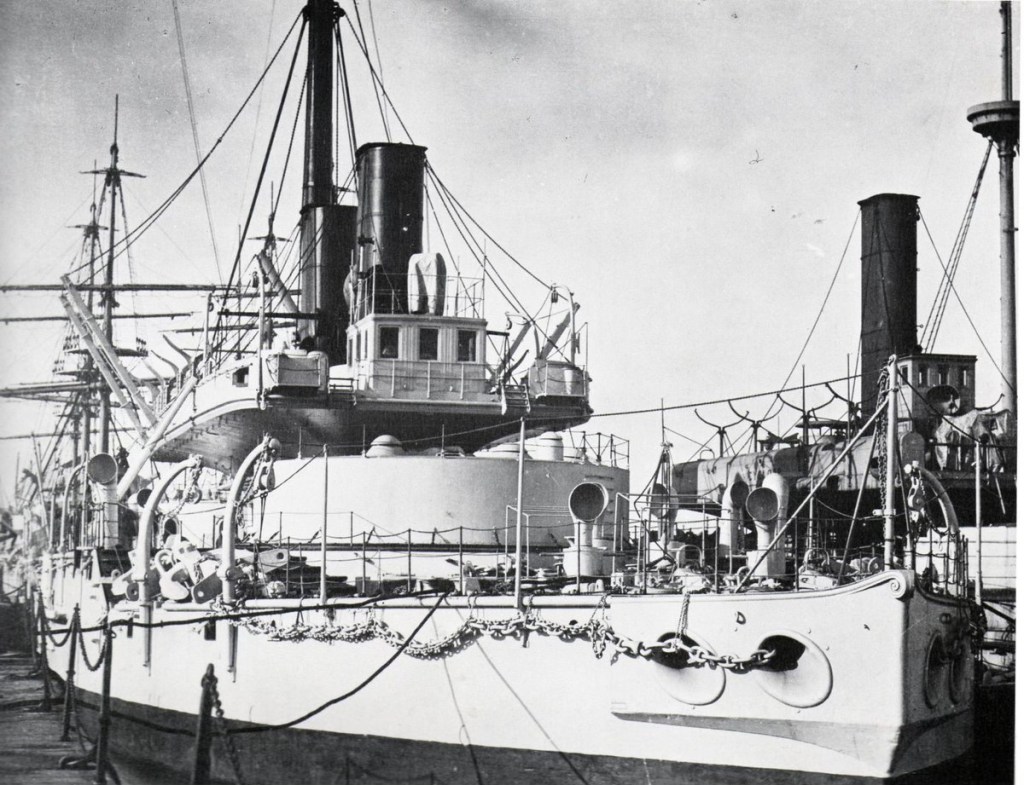
The 19th century marked a transformative era in naval history, as the advent of steam engines heralded the end of the age of sail. The transition from traditional sailing vessels to fully steam-powered warships was, however, a gradual evolution. During the era of ironclads, many steamships retained their sails for auxiliary power, as early engines were not yet reliable enough to bear the full burden of propulsion. This began to change with significant technological advancements, culminating in a pivotal moment in 1871 with the launch of HMS Devastation at Portsmouth Dockyard. She became the first ocean-going capital ship designed to rely solely on steam power, marking a decisive break from the reliance on sail.
Designed by Sir Edward J. Reed, Devastation was the first major warship built without masts, allowing her two turrets, each armed with two 12-inch muzzle-loading guns, to achieve a 280° firing arc. This design represented a significant leap in naval engineering, making Devastation the first warship in history to position all her main armament entirely on top of her hull rather than inside it—a configuration previously impossible due to masts obstructing the placement of gun turrets on deck.
Devastation measured 285 feet (87 m) in length with a beam of 62 feet (18.97 m). Her freeboard, just 4.5 feet (1.37 m), meant she sat low in the water, making her an uncomfortable vessel in heavy seas. She was well-protected with armor ranging from 10 to 14 inches thick, and her double-bottomed hull was divided into watertight compartments for enhanced safety. Driven by two screws, powered by four 2-cylinder Penn & Sons trunk engines with steam from eight boilers, delivering in total 5,600 horsepower, she reached a maximum speed of 12 knots. Carrying 1,350 tons of coal, she had an impressive range of 5,570 nautical miles at 10 knots.Her crew of 329 was supplied with enough water for three weeks and provisions for six weeks at sea.
After the tragic sinking of HMS Captain in 1870, a committee reviewed Devastation’s design. While her stability was deemed sound, safety modifications were made: her freeboard was raised to 10 feet, and bulkheads were reinforced with 4–6 inches of armor for additional protection to the magazines and engines. Her earlier 25-ton guns were replaced with RML 12 inch 35 ton guns.

In 1873, Devastation’s sea trials attracted great public interest. She reached speeds of 13.84 knots and fired 700-pound shells during gunnery tests. Her low forecastle caused some issues with waves, but she outperformed her companions, the ironclads Agincourt and Sultan, in terms of pitch and roll in Atlantic conditions.
HMS Devastation redefined naval warfare, proving that masts were no longer essential for warships. Her design set a precedent for modern battleships, embodying the transition to steam-powered, turret-armed vessels that would dominate the seas in the decades to come.
Olivier Goossens
 Heart of Oak
My wife’s great grandfather was ship’s carpenter on board Devastation in 1877 when she was rammed by HMS Ajax off Portland. He played a significant part in the incident fitting a collision mat. I have copies of the ship’s long and access to newspaper reports but wondered if you knew anything of interest about the boat and the use of collision mats that I could add to the family story.
LikeLike