Over time, growing numbers of Spaniards began expressing their discontent with the new Bourbon monarchy. In Catalonia especially, opposition to the Sun King’s grandson became increasingly vocal. Sensing this unrest in Barcelona and its surrounding countryside, the Allies sought to use it to their advantage. High command became determined to seize this crucial city from the Bourbons, believing that its capture could inspire other regions to rise against the central authority in Madrid. Despite a previous failure to establish a foothold in Barcelona, the Allies were now prepared to make another attempt.
Holding ‘the Rock’: The Siege of Gibraltar (September 1704-May 1705)
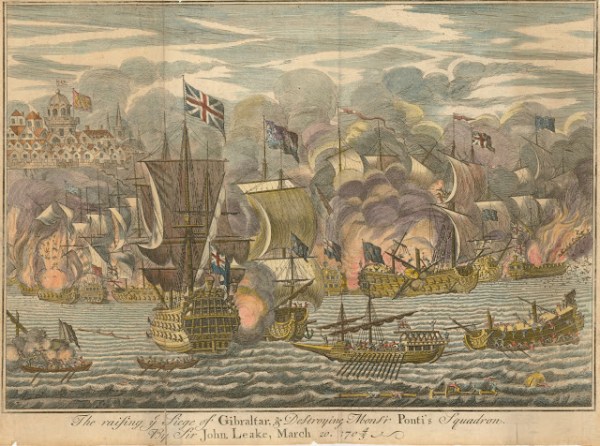
Despite driving away the fleet of Comte de Toulouse at the Battle of Málaga on 24 August 1704, the French and Spanish would not so easily give up Gibraltar. Preparations were promptly made to retake 'the Rock.'
Admiral of the Fleet Sir John Leake (1656-1720)
After the fierce Battle of Málaga on 24 August 1704, Admiral Rooke sailed home with much of his fleet, desperately in need of repairs. Consequently, Sir John Leake assumed command of the Anglo-Dutch naval forces off the Iberian Peninsula. He would go on to make a name for himself, playing a crucial role in the Grand Alliance's subsequent naval operations during the war.
The Biggest Naval Battle of the War of the Spanish Succession: The Battle of Málaga (1704)
The conquest of "the Rock" by Admiral Sir George Rooke and Gerard Callenburgh’s fleet, and Prince George’s marines deeply worried and humiliated King Philip V of Spain and his grandfather, Louis XIV. The Sun King, however, had the means to mount an appropriate response. Shortly after the Siege of Gibraltar, the naval squadrons of Brest and Toulon successfully united to form a single formidable battle fleet, reinforced by the remnants of the Spanish navy. The combined French and Spanish warships set sail toward the Anglo-Dutch squadron with all haste, aiming to challenge its dominance of the Strait of Gibraltar and support a future Spanish counterattack against "the Rock."
The Capture of Gibraltar (1704)
A new naval base needed to be secured along the southern European coastline to establish a permanent presence in the Mediterranean.
Capturing the Spanish Treasure Fleet: The Battle of Vigo Bay (1702)
As Rooke’s vessels slipped past the Portuguese coastline in early October 1702, disappointment and low morale must have gripped the commanders and their men. The failed expedition to Cadiz, which lasted from August to September, had brought nothing but shame and squandered time. However, an opportunity for redemption arose when the English admiral caught wind of the arrival of the Spanish treasure fleet. The Spanish galleons, laden with silver, were escorted by a formidable force of 18 French and Spanish ships of the line, commanded by the Marquis de Châteaurenault. Spurred on by his eager Dutch colleague, Philips van Almonde, Rooke ordered his Anglo-Dutch force to intercept the enemy. At last, England had a chance to open its account of naval victories during the War of the Spanish Succession with a resounding triumph. This is the story of the Battle of Vigo Bay.
Admiral of the Fleet Sir George Rooke (1650-1709)
His legacy lived on as an admiral who helped shape Britain’s future as a superpower, playing a crucial role in securing Gibraltar. In recognition of his significance in the history of Gibraltar, Peter Caruana, Chief Minister of Gibraltar, unveiled a statue in his honor in November 2004 during the festivities celebrating 300 years of British rule over the exclave.
The Anglo-Dutch Expedition to Cádiz in 1702: Off to a Bad Start
One way to win the war was to knock Spain out of the contest, leaving France isolated and surrounded. One strategy for doing so was to cut the Iberian Peninsula off from its precious American trade and silver. With the loss of Portugal as an ally, the Anglo-Dutch naval forces lacked a suitable port in the region from which they could disrupt Spanish colonial commerce. A plan was therefore agreed upon to seize the Spanish harbor of Cádiz, a major gateway for trade with the Americas. The Grand Alliance could concurrently launch an offensive against Madrid from this quarter in order to place Archduke Charles on the throne.
Operation Musketeer: Retaking the Suez Canal, 1956
In July 1956, the anti-imperialist leader Gamal Abdel Nasser ordered the nationalization of the Suez Canal Company, a joint British-French enterprise that had controlled this vital link between East and West since its construction in 1869. Britain had extensively used the canal to build and maintain its vast empire. The Egyptian president, however, sought to completely expel British and French influence from the region. The two European powers, fearing that this move might encourage other anti-imperialist movements in the Middle East, decided to intervene militarily. A vast Anglo-French task force was assembled to counter Nasser.
The Carpenter in the Age of Sail
The ships of the line were true technological marvels of their time. These wooden leviathans, which roamed the seas in protection of the British Empire and trade, were exceedingly complex. Many things could go wrong—not only in battle but also during storms. To keep the vessel shipshape and Bristol fashion, a special officer was appointed by warrant: the carpenter. His job was of the utmost importance, as clearly reflected by the high standards imposed on those eligible for the position. His title, "the wooden artist," sometimes bestowed upon him, demonstrates the reverence the ship’s crew had for him. He was not a mere handyman; he was an artist. This is the story of the carpenter.