
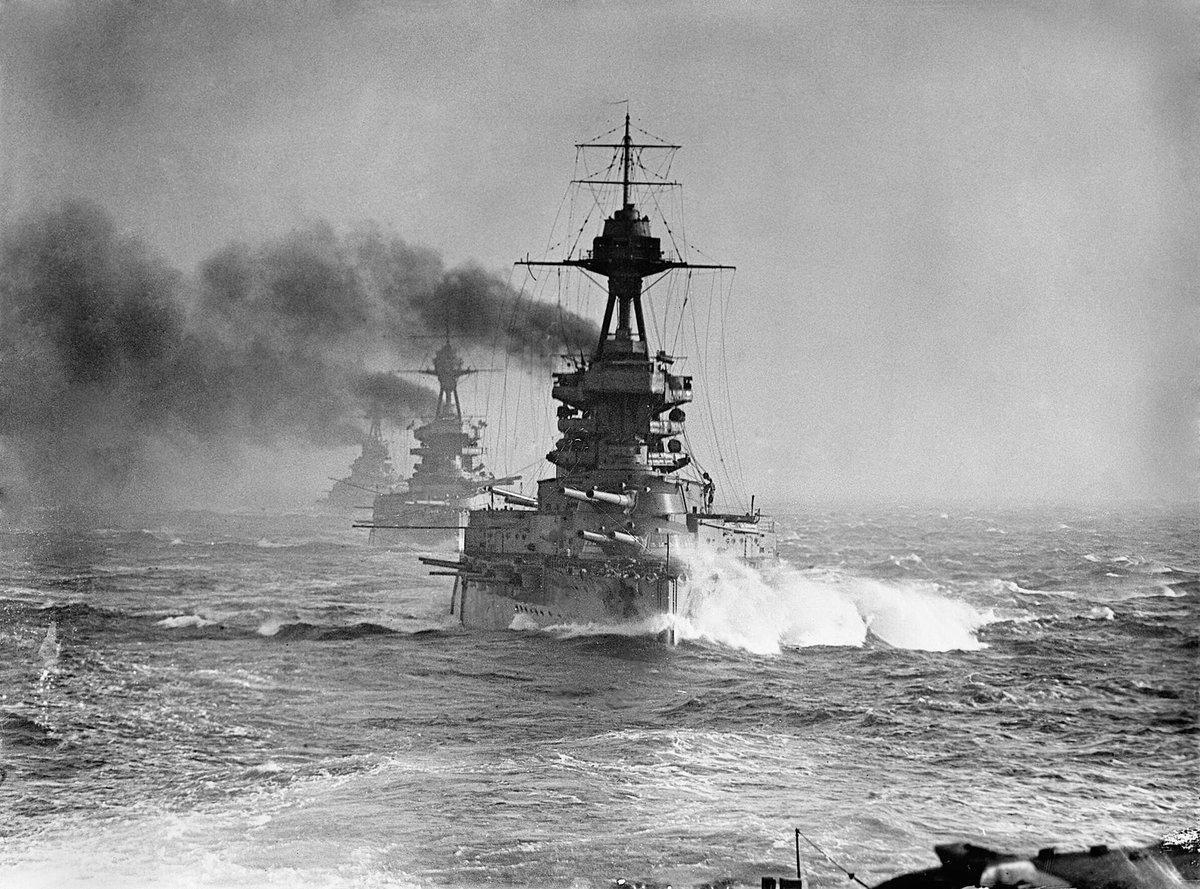
Leading the British Grand Fleet at the titanic clash with the Germans off Jutland between 31 May and 1 June 1916 was HMS Iron Duke. Despite not being the most modern British battleship present, she retained the honour of serving as the flagship of the largest concentration of dreadnoughts the world had ever seen. She could rely on the support of a further 36 capital ships, including her two sisters, Benbow and Marlborough. Their modern design ensured these ships’ survival well into the interwar period, while most of their dreadnought colleagues were discarded immediately after the war. What made the Iron Duke-class so special, and what were her flaws?
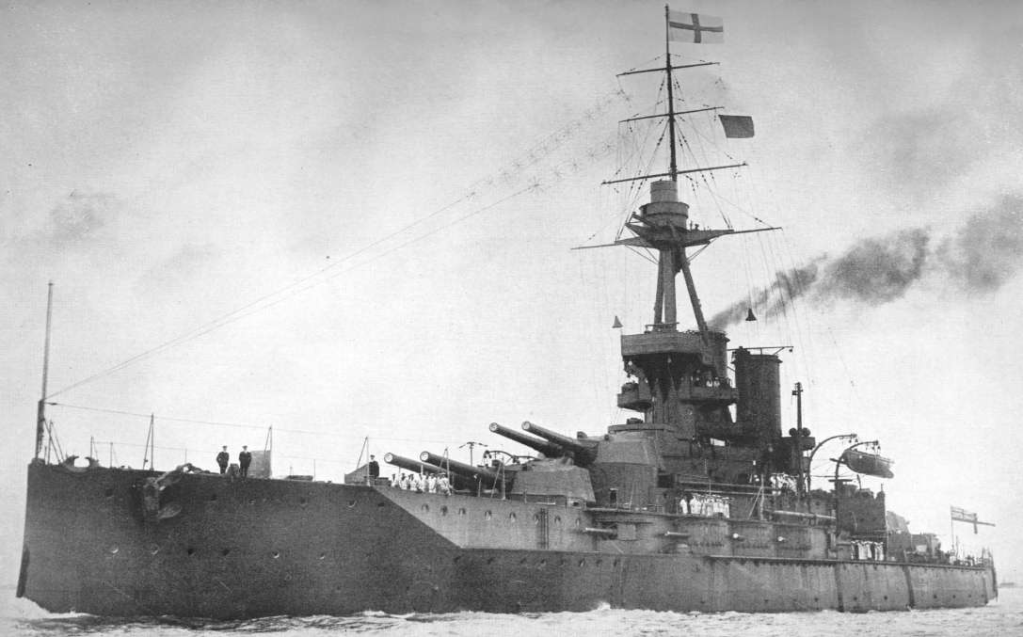
The Iron Duke-class consisted of four super-dreadnought battleships. The lead ship and namesake of the class was named after Arthur Wellesley, the Duke of Wellington, victor of Waterloo in 1815, nicknamed the “Iron Duke.” They were the Royal Navy’s eighth line of modern battleships since HMS Dreadnought had revolutionized naval warfare in 1906, and the third line of the so-called super-dreadnoughts. They succeeded the King George V-class battleships, whose design heavily influenced the lines of the Iron Dukes. The eventual design (M1V) was chosen from the five layouts drawn by the Director of Naval Construction Philip Watts.
Like the King George V-class, the Iron Dukes possessed ten 13.5 inch (343 mm) Mk V guns as their main armament. They were mounted in five twin turrets along the centreline of the ship. Two (A and B) were situated in a superfiring position forward of the superstructure, another (Q) amidships directly aft of the two funnels, and the final two (X and Y) in a superfiring position at the stern. They were mounted in 600-ton Mk II turrets which allowed for a theoretical elevation of up to 20°. These guns fired a variety of rounds, including high explosive and armour-piercing shells. At the practical maximum elevation of 15°, these shells could reach targets up to 19 km (12 mi) away. They travelled at a muzzle velocity of 759 m/s (2,491 ft/s), roughly equivalent to the top speed of a McDonnell Douglas F-4 Phantom II (Mach 2.2). The 13.5-inch guns were remarkably powerful, capable of piercing 12.5 inches (318 mm) of armour, making them formidable opponents for German battleships and battlecruisers.
A significant upgrade over the King George V-class was the Iron Dukes’ secondary armament, which increased the calibre from 4 inches (102 mm) to 6 inches (152 mm). This was considered necessary, as the older 4-inch guns were too weak and had insufficient range. Their twelve 6-inch guns could fire up to 7 rounds per minute and were mounted in casemates around the forward superstructure. These casemates provided protection for the gun crews against enemy fire and the elements, though ironically the hinged plates sealing them often became detached in heavy weather. As the secondary armament was relatively close to the waterline, this sometimes caused severe flooding aboard the ships. The issue was later mitigated with dwarf bulkheads compartmentalizing the gun houses and rubber seals for the hinged plates.
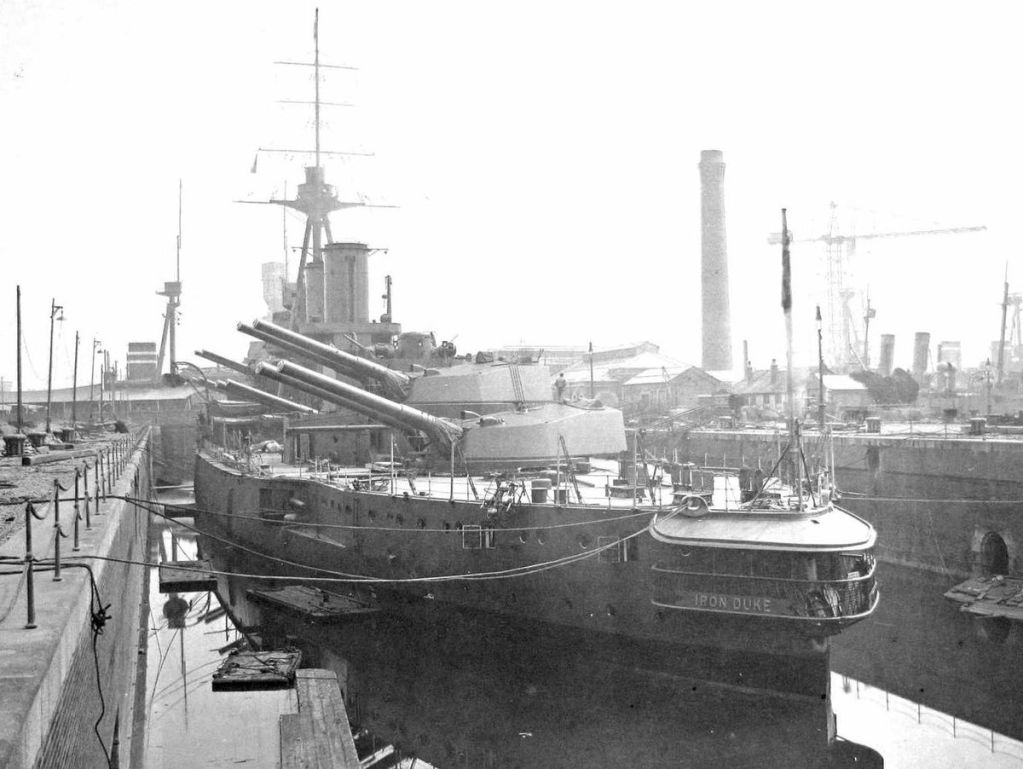
An important advancement in battleship design was the introduction of anti-aircraft guns, intended to counter Germany’s growing airship fleet. Two 76 mm (3 inch) QF guns were installed on the aft superstructure, capable of firing 14 rounds per minute. These early AA guns required maintenance or replacement after approximately 1,250 shells had been fired. Their maximum effective ceiling was 7,160 m (23,500 ft), sufficient to engage most expected aerial threats.
Another typical armament feature for the period was the ships’ submerged torpedo tubes—two on each beam. They fired 533 mm (21 inch) Mk II torpedoes, which had two speed settings: 31 and 45 knots, with the higher speed offering a shorter range.
The Iron Dukes had armour comparable to their predecessors. The centre of the body, which contained vital components such as machinery and ammunition magazines, was protected by 305 mm (12 inch) of armour plating. The belt, the outer hull protection, tapered to 102 mm (4 inch) toward the bow and stern. The main gun barbettes were heavily protected to prevent penetrating hits from reaching the magazines, with 254 mm (10 inch) on the sides and front, and 76 mm (3 inch) on the less-exposed rear. Deck protection ranged between 25 mm and 64 mm (1–2.5 inches). After the Battle of Jutland, in which many British capital ships were lost due to poor ammunition handling and design flaws, the Iron Duke-class received an additional 820 tons (834 tonnes) of armour, reinforcing the magazine bulkheads and main gun deck protection. Despite the similar armour scheme, the Iron Dukes weighed about 2,032 tonnes (2,000 tons) more than the King George V-class due to the upgraded secondary armament and an increase in length of about 7,62 to 7,93 meters (25-26 ft), giving the ship an overall length of 189.81 m (622 ft 9 in). The lenghtening was allocated to both the stem and stern, in the first case to give extra buoyancy to offset the increased weight caused by the installation of the 6 inch guns.
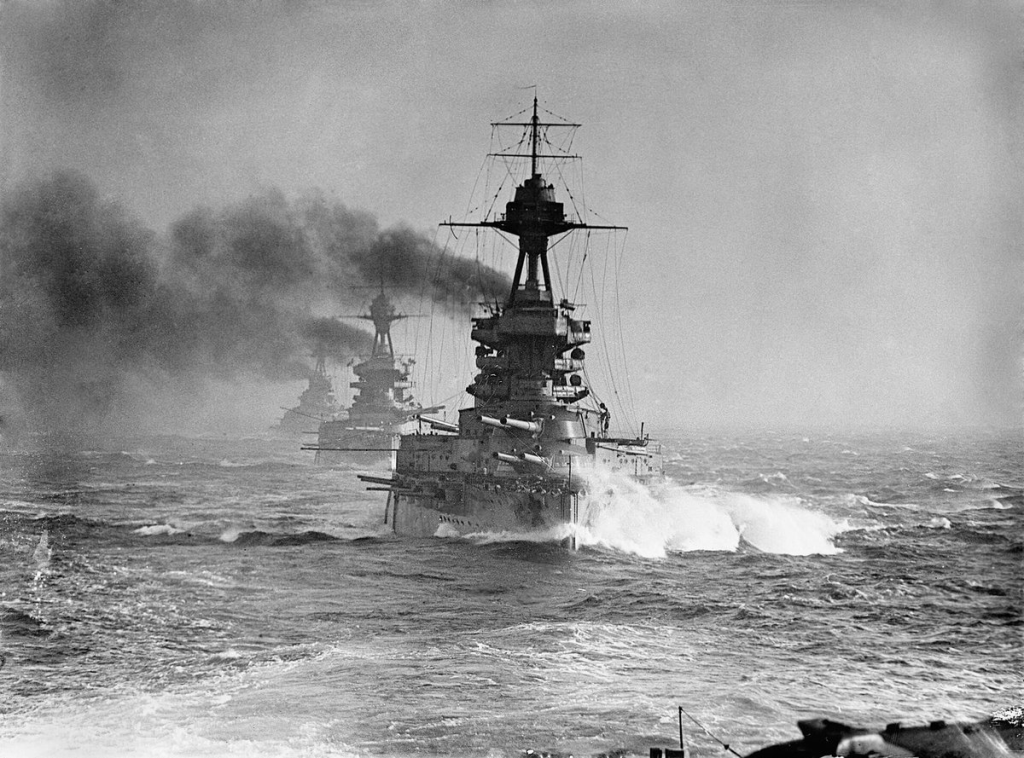
Despite the added weight, the Iron Duke-class could reach 21.5 knots (39.8 km/h; 24.7 mph), similar to the King George V-class. They were powered by improved Parsons turbines fed by 18 Babcock & Wilcox or Yarrow boilers, rated at 29,000 hp, compared to 27,000 hp on the King George V-class. Their cruising range was approximately 7,800 nautical miles (14,446 km; 8,976 mi) at a speed of 10 knots (19 km/h; 12 mph). A total of 995 officers and ratings were required to operate each ship, increasing to 1,022 in wartime. Iron Duke, Marlborough, Emperor of India, and Benbow proved exceptionally powerful ships, justifying their classification as super-dreadnoughts.
Olivier Goossens
 Heart of Oak
Leave a comment