

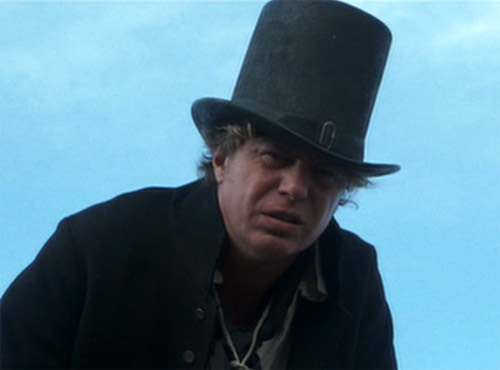
The warrant officer with perhaps the most notorious reputation was the boatswain. The boatswain is perhaps one of the oldest attested ranks in the Royal Navy, with its history dating back to the days of the Anglo-Saxon ruler Edward the Confessor (r. 1042–1066 CE). The word derives from the Old English compound batswegen, consisting of the elements bat (‘boat’) and swain (‘apprentice, follower, servant, young man’).
Just like other warrant officers, the boatswain was appointed by a paper warrant from the Navy Board, instead of a commission on parchment issued by the Board of Admiralty and reserved for higher-ranking officers. In the time of Nelson, the boatswain was in charge of the boats, sails, colours, anchors, cables, and cordage. Having risen from the ranks of seamen, he was usually a man of respectable age, sourcing his vast knowledge on these matters from years of experience. Before receiving the warrant of boatswain, however, a one-year trial with the captain as a petty officer was obligatory. Another requirement was that he be literate, as per Admiralty Regulations, a rule obligatory for all warrant officers.
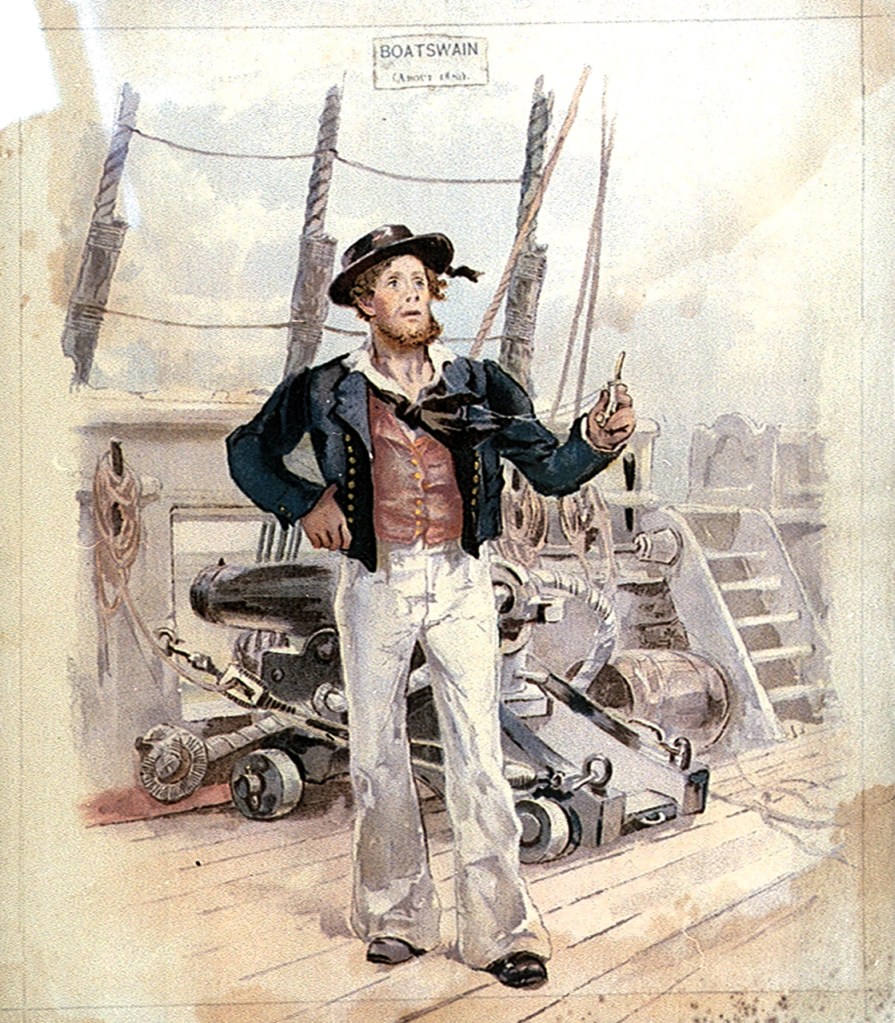
If a man was finally appointed boatswain, he immediately sprang into action, checking on a daily basis the ship’s rigging, chains for repairing the rigging, and the sails. He had the ropemaker under his command, as well as the sailmaker, making sure he stored the sails in the locker correctly to keep them dry. He was responsible for general order upon deck. He made sure the sailors did not hang their clothes to dry in the rigging or use the ship’s fresh water supply to wash them. When in port, he was entrusted to keep the yards square and prevent ropes from trailing overboard. If weather permitted, he would haul down one of his boats and row around the ship to make sure the outward trim was in good order. During battle, the boatswain took command of the forecastle.
Back at home, when the vessel was laid up “in ordinary,” meaning the ship was not in commission, the boatswain and his mates and yeomen remained on board to ensure discipline and to see that the re-rigging or dismantling of the masts was done properly by the dockyard workers.
“His main instrument and the symbol of his power was his cane, waxed at the end and fitted with a simple twine rope.”
The boatswain was furthermore responsible for discipline, hence his feared reputation. His main instrument and the symbol of his power was his cane, waxed at the end and fitted with a simple twine rope. If he encountered any laggards refraining from work and impeding the efficiency of the ship, he was allowed to whip them back on their feet. Their strictness was infamous. For example, when a tar had not stowed away his hammock by eight bells, i.e. 8 a.m., the boatswain was to confiscate his hammock for a month, meaning the sailor was bereft of a proper sleeping place for that period. Their privilege to cane the men was—as one can imagine—often abused, and many sailors bore the scars of service with tyrannical boatswains who thrashed away at the simplest of misdemeanours, or upon the least suspicion of laziness. Ironically, the boatswains were often themselves “colourful” characters—as Brian Lavery puts it—with fifty-five of them being court-martialled between 1807 and 1814, mostly for drunkenness and stealing stores.
The boatswain was quartered either in a cabin in the fore cockpit on the orlop deck, across from the carpenter’s cabin, or he was granted a special spot on the lower deck amid the other tars, getting double the swinging space for his hammock. The boatswain did not partake in the watch system, meaning he was given the privilege of an “all night in,” being allowed to sleep continuously through the night. He took his meal in the cabin of the fore cockpit and could have a ship’s boy to wait on him, whom he sometimes shared with the carpenter.
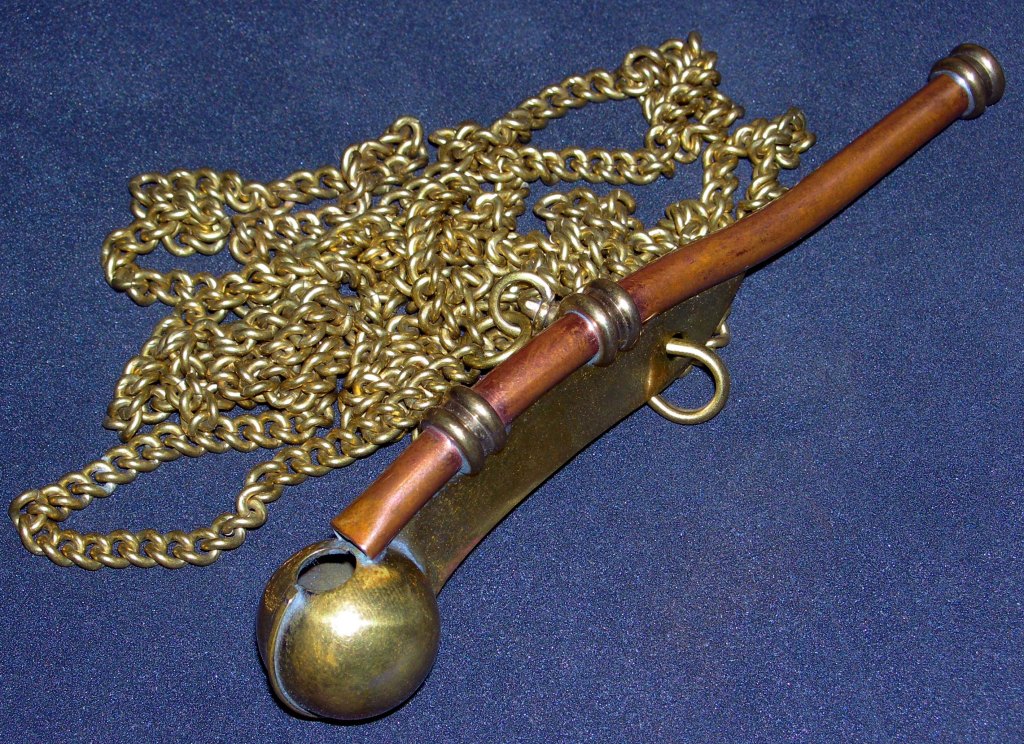
In the day and age of Nelson, the boatswain wore a distinctive blue coat with blue lapels and collar, gold anchor buttons embellishing the cuffs and pockets. Whether he wore blue or white trousers was entirely up to him. For headgear, he wore a typical low top-hat, sometimes adorned with a cockade on the side. He was also at liberty to choose what type of shirt he wore, whether woollen or linen. Around his neck he flung the famed silver bosun’s whistle, at the tone of which the captain or a flag-rank officer was piped aboard. The sharp sound of the whistle also made the instrument suited for passing down orders when the mayhem of battle prevented the officers from doing so vocally.
For his services, the boatswain was compensated with a varying pay of about £4 16s. a month aboard a first-rate, and £3 1s. aboard a sixth-rate.
Olivier Goossens
 Heart of Oak
Leave a comment