Unlike many other European wars throughout history, the Anglo-Dutch wars of the seventeenth century were conspicuously lacking in serious attempts by one of the protagonist nations to invade the other, or even to mount large amphibious raids on each other’s coasts. The notable exceptions occurred in 1667 with a series of audacious Dutch raids, the most famous of which was the raid on the Medway that culminated in the towing away of the flagship Royal Charles; the attacks also included a major landing on the Suffolk coast leading to an attack on Landguard Fort at Felixstowe. These incidents are all well chronicled, but in 1673 another expeditionary force put to sea, its objective nothing less than the destruction of the Netherlands as an independent nation and the transformation of at least one of the country’s two principal maritime provinces into a puppet state under English control. This naval expedition, and the invasion it was meant to launch, has been almost entirely forgotten by history.
The third Anglo-Dutch war began in 1672 with a vast French army smashing into the United Provinces. This was the key element of a strategy which had been agreed by Charles II of Britain and Louis XIV of France in the secret Treaty of Dover of 1670, but the naval element of the plan was derailed by Michiel de Ruyter’s bold and successful pre-emptive attack on the combined Anglo-French fleet as it lay in Solebay (28 May / 6 June 1672). This setback did not deter Charles and his ministers, who began to develop a plan for an invasion of Zeeland as part of a longer-term strategy aimed at obtaining some or all of that province in any peace settlement. Indeed, there seemed to be some grounds for believing that Zeeland might choose voluntarily to place itself under English rule (if only as the lesser of two evils, if the alternative was succumbing to the tender mercies of Louis XIV): after all, two of the province’s most prominent towns, Brielle and Vlissingen, had been ‘English’ before, having been held as cautionary towns under the treaty of alliance of 1585 between England and the Dutch, and had only been handed back in 1616 – potentially within living memory of old people on both sides of the North Sea. Charles now demanded their permanent cession, along with Sluis, and magnanimously planned to offer the Zeelanders the supposedly unmissable opportunities to send MPs to Westminster and pay taxes to his exchequer. Failing a voluntary handover of the towns, they were to be taken for England by an invading army which would be landed in the Netherlands, potentially opening up a second front supporting the main French invasion.
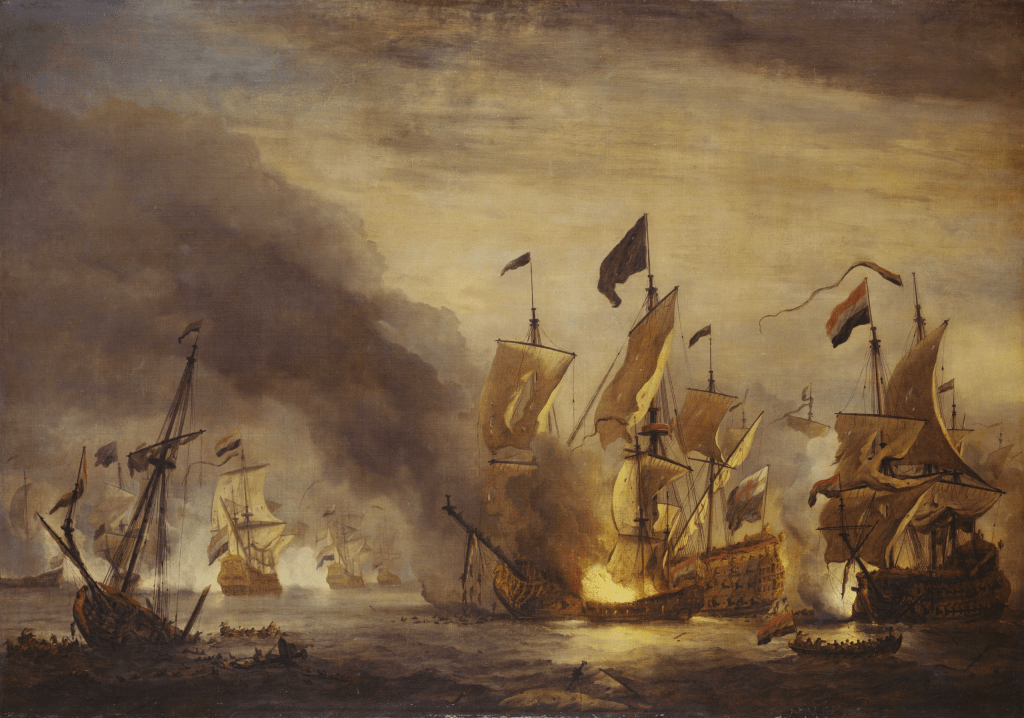
The Burning of the Royal James at the Battle of Solebay, 28 May 1672, by Willem van de Velde the Younger. NMM(ID: BHC0302)
After a succession of false starts and disputes over the command, a ramshackle army of some 8-10,000 men was assembled at Blackheath, south-east of London, in the spring and early summer of 1673, and an amphibious flotilla of sorts was assembled in the Thames – twenty transports, five storeships, five so-called ‘horseships’, one coal ship, one ship carrying hay, nine so-called ‘vessels for landing’, and eight barges. Samuel Pepys, the secretary of the Admiralty, undertook a detailed breakdown of the cost of transporting 10,000 troops and one hundred horse to the Netherlands and maintaining them there for two months (the estimated total came to £48,827). The actual strategic plan was vague and had been altered several times since 1672. There had been schemes for a landing in Zeeland itself, at Goeree or elsewhere, but by May 1673 the favoured option was a landing near Scheveningen, which, it was hoped, would allow the invasion force to effect a conjunction with the prince of Condé’s French army, advancing from Utrecht. Meanwhile, the combined Anglo-French fleet sought in vain to achieve the triumph over de Ruyter’s numerically inferior force which had eluded it in the previous year. Two indecisive battles off the main Dutch anchorage, the Schooneveld, in May and June, failed to give the allies anything like the advantage which they craved, and the main fleet retired to the Thames to await a decision on its next move.
‘A more formidable fleet has at no time sailed out of England’,
Between 6 and 16 July, King Charles II, his brother and Lord High Admiral James, Duke of York, and their cousin Prince Rupert of the Rhine, the admiral commanding the fleet, presided over a series of three important councils of war. Rupert’s view, that without defeating the Dutch fleet it would be little short of folly to make a serious attempt at landing in Zeeland, won the day; it was decided that, after an appearance off the Schooneveld to alert the Dutch to his presence, Rupert should cruise off the Texel in the hope that de Ruyter would be drawn out to defend against the expected landing and to escort home the valuable incoming fleet of the Dutch East Indies Company, the VOC. Although an actual landing at the Texel was approved at the council on 6 July, the final meeting on the sixteenth only approved the diversion of the invasion flotilla to Yarmouth, where the army was to be landed to await the outcome of the anticipated victorious battle at sea. This, therefore, was the rather nebulous strategic ‘plan’ which the combined Anglo-French fleet under Rupert possessed when it sailed out of the Thames on 17 July, accompanied by the army from Blackheath on board its flotilla in the rear of the fleet. ‘A more formidable fleet has at no time sailed out of England’, Sir Robert Southwell reported to the earl of Essex; ‘such a fleet as I never yet saw’, wrote Sir Edward Spragge, Admiral of the Blue (the rear squadron of the allied fleet). After seeing the invasion flotilla safe into Yarmouth, the main fleet sailed for the Dutch coast. It consisted of approximately ninety major warships, the French under the comte d’Estrées forming the white (van) squadron and Prince Rupert and Spragge commanding the red and blue squadrons respectively and flying their flags in the mighty Sovereign and Prince.
Edward Spragge, in command of the blue squadron during the early stages of the operation until his death at the Texel, flying his flag aboard HMS Prince, by Peter Cross, c. 1665. NMM (ID: MNT0190)
Unfortunately, the optimism of both Southwell and Spragge was distinctly misplaced. Even before the July councils of war, the actual role of both the fleet and the army had been called into serious question. Several commentators, notably the French and Venetian ambassadors, realised that Charles and his ministers needed a successful landing for their own domestic political agenda; there were hopes that naval victories and conquests of Dutch territory would reconcile a hostile public and parliament to an unpopular war. However, the Venetian ambassador claimed that the actual reaction to the proposed invasion, from some quarters at least, had been to condemn ‘the design to hold strong places overseas, which commit the country, involve great expense, yield no profit and scant honour and are incapable of bridling the Dutch, as is boastfully pretended’. Moreover, the invasion scheme was very much a purely English brainchild in what was supposed to be a jointly-run war. Louis and at least some of his ministers were opposed to the scheme, partly because the English demands for territory in Zeeland were threatening to sabotage the progress of the peace talks at the congress of Cologne (the Swedish mediator there, Count Tott, was particularly hostile to the notion of England being established as a power on both sides of the North Sea). In addition, Charles and his ministers had deliberately kept their invasion plans as secret as possible from their French allies, so that Colbert de Croissy, Louis’ ambassador in London, had little idea of what the English were actually up to. Faced with so many different pressures, English policy fluctuated confusingly, but by the last weeks of July, with the combined fleet already at sea and the army encamped at Yarmouth ready to descend on the Dutch coast once it was called for, Charles finally abandoned his demands for Dutch towns and inclined towards a more moderate peace settlement. The rationale underpinning Rupert’s cruise had effectively disappeared, and on 3 August Charles wrote to the prince to inform him that he now considered the invasion scheme ‘less advisable than it was at first’, and that, because of the progress of the Cologne negotiations, he should seek only to keep the sea – the assumption being that de Ruyter was unlikely to emerge from behind his sheltering sandbanks. In fact he did exactly that, leading to the battle of Kijkduin / the Texel on 11/21 August where the success of the Dutch fleet, together with dissension among their opponents caused by English outrage at what was perceived as French misconduct during the action, decisively ended any prospect of an invasion of Dutch territory.
“the invasion scheme was very much a purely English brainchild in what was supposed to be a jointly-run war”
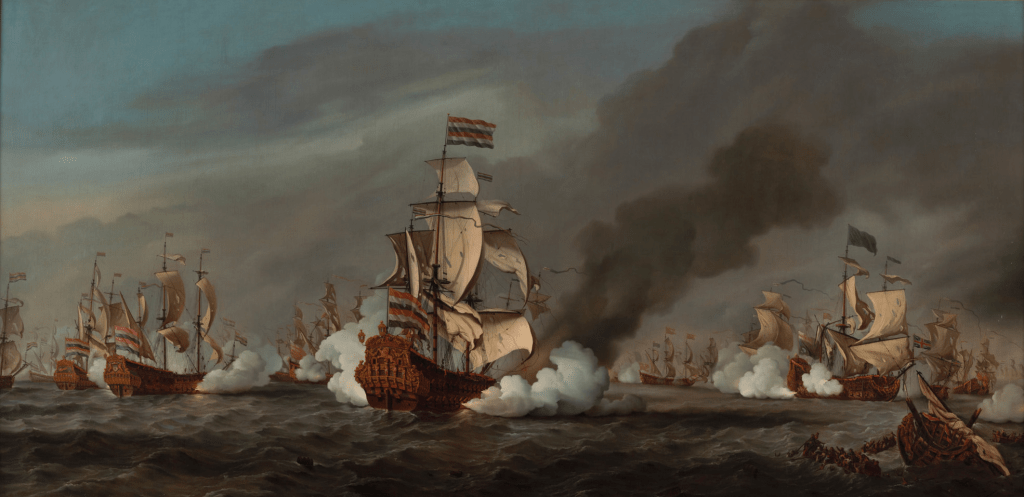
The Battle of the Texel, 21 August 1673, which ended all prospects of launching the planned English invasion of the Netherlands, by Willem van de Velde the Younger. Het Scheepvaartmuseum
The rather pathetic demise of the Zeeland invasion plan led to some caustic comment, even in a parliament where many had suspected the potential for absolutism inherent in the king’s new army – as Henry Powle MP commented a few months later, ‘the army has done nothing but the famous expedition from Blackheath to Yarmouth’, and the prominent opposition MP Sir Thomas Meres quipped that ‘some said it was to land to beat the Dutch, but it turned off, it seems, to take Harwich’. Both contemporaries and historians took the view that it was just as well the army had not got beyond Yarmouth: the camp at Blackheath had been a shambles, with raw, drunken recruits marshalled unsuccessfully by raw, drunken officers under a widely detested foreign general, Count Schomberg. Indeed, a landing in Zeeland might well have been disastrous. The Dutch had major garrisons to the south of the province, and the main Dutch field army was drawn up only about forty miles to the east, between Geertruidenberg and Huisden, with William of Orange’s headquarters situated at Raamsdonk. Although Condé proclaimed his readiness to assist an English landing as well as he could, his ability to do so would have been limited by the fact that much of the land between his army and the coast was under water because the Dutch had cut the dykes, the desperate strategy that had saved their nation from complete annihilation in 1672. On the other hand, the Dutch defences were not necessarily as formidable as Charles claimed they were in his letter to Rupert, nor as some recent historians have assumed they were. The appearance of the prince’s fleet off the Dutch coast on 24 July caused panic from Brill to The Hague; the coastal towns themselves were poorly fortified, largely because William had decided to entrust his coastal defence almost exclusively to de Ruyter’s fleet in order to maximise the size of his field army, which was itself largely raw and untried. Three regiments were hastily despatched from Geertruidenberg to Scheveningen, but otherwise, the only real force which could have immediately confronted an English invasion would have been a ‘home guard’ drawn from the burghers of The Hague, Delft, Leiden, Dort and Rotterdam. Even Schomberg’s shambolic army might have stood a realistic chance of defeating such a force.
‘the army has done nothing but the famous expedition from Blackheath to Yarmouth’
Moreover, the hastily-conceived last-minute switch to the strategy of attempting a landing at the Texel and/or Den Helder might have caused the Dutch even greater problems. Although it would have been more difficult to support such a landing force from England, it would have taken far longer for William to deploy regular units against it (and it might have been easier for Condé to threaten any such move north by the Dutch), and even a short-lived presence at the entrance to the Zuiderzee would certainly have created real problems for Dutch commerce, especially for the returning VOC fleet which traditionally trans-shipped its cargoes into barges at the Texel to allow it to make a more lightly-laden transit of the Pampus shoals leading to the river Ij at Amsterdam. Above all, even as brief and disastrous an invasion as any carried out by Schomberg’s army threatened to be might well have forced William at least to postpone his switch to the offensive in September 1673, when he captured Naarden and subsequently pressurised Louis in the Rhineland by taking Bonn. In the light of these considerations, it is at least possible that Charles II abandoned his invasion project too early and too easily.
“In the light of these considerations, it is at least possible that Charles II abandoned his invasion project too early and too easily.”
Even if the invasion plan of 1673 ended in farce, it contributed to the development of a fearful mindset in both Britain and the Netherlands which seems out of proportion to the actual threat of landings and outright invasions. One of the peculiarities of the Anglo-Dutch wars is that most of the principal actions of all three wars took place in the North Sea, often close to one shore or the other; this meant, for example, that the sounds of gunfire from these battles could often be heard far inland, not just in coastal communities like Huisduinen in north Holland where on 11/21 August 1673 the congregation of the village church cowered inside it as the last battle of the war raged just offshore, aware that a defeat for de Ruyter might mean the imminent arrival of an invading army in their midst. As a result, when in 1688 William III of Orange’s invasion preparations became common knowledge in both Britain and the Netherlands, many in both countries were convinced that they were witnessing the beginnings of a fourth Anglo-Dutch war. William carried out his invasion strategy with far more success than his uncle Charles II had done in 1673 – so successfully, in fact, that very few ever think of the events of 1688 as an invasion at all.



 Heart of Oak
Leave a comment