

HMS Rothesay was the lead ship of her class of anti-submarine frigates (Type 12M). Rothesay and her 20 sister ships were an improved version of the earlier Whitby-class (Type 12). The Whitbys were originally designed as specialized ocean-going escorts; however, their design proved so successful that they were extensively employed as fast fleet anti-submarine warfare escorts. As a result, an updated version—the Rothesay-class (Type 12M)—was ordered to bolster their numbers.

“The combined output of the system was 30,000 shaft horsepower (22,000 kW), allowing Rothesay to reach speeds of up to 29.5 knots (54.6 km/h), making her highly suitable for anti-submarine warfare in open seas.”
HMS Rothesay measured 370 feet in overall length, with a beam of 41 feet and a draught of 13.5 feet. Like her Whitby-class predecessors, she was powered by Y-100 machinery. This meant she featured two Babcock & Wilcox boilers producing steam at 550 psi and 850 °F. This steam drove two geared steam turbines connected to a pair of slow-turning propeller shafts, each fitted with large 12-foot diameter propellers. The combined output of the system was 30,000 shaft horsepower (22,000 kW), allowing Rothesay to reach speeds of up to 29.5 knots (54.6 km/h), making her highly suitable for anti-submarine warfare in open seas. She carried a crew complement of approximately 212 officers and men.
Forward of her superstructure, a 4.5-inch gun provided her with conventional naval gunfire capabilities. She was intended to be equipped with the new Seacat anti-aircraft missile system; however, by the time of her completion, the missile system was not yet ready, and she was instead fitted with older, more conventional 40 mm Bofors guns. Her anti-submarine armament included two quadruple mounts of 21-inch torpedo tubes, which operated the Mark 20E Bidder homing anti-submarine torpedoes. Rothesay also featured two Limbo anti-submarine mortars aft. The torpedo tubes were later removed, as the Mark 20E Bidder torpedoes proved too slow to effectively engage modern submarines.
Original radar configuration: Mounted on her foremast was a Type 293Q surface/air search radar, equipped with an AUR antenna measuring approximately 12 feet (3.7 m) in diameter. A Type 277 height-finding radar—though a World War II-era system—was still considered reliable enough and was installed on a short mast positioned just forward of the foremast. For gunfire control, the ship was fitted with a Mark 6M fire control system, which included a Type 275 radar, located on the bridge alongside a Type 974 navigation radar. Her sonar suite comprised a Type 174 search sonar, a Type 170 fire control sonar for the Limbo mortar, and a Type 162 sonar used to classify targets on the seabed.
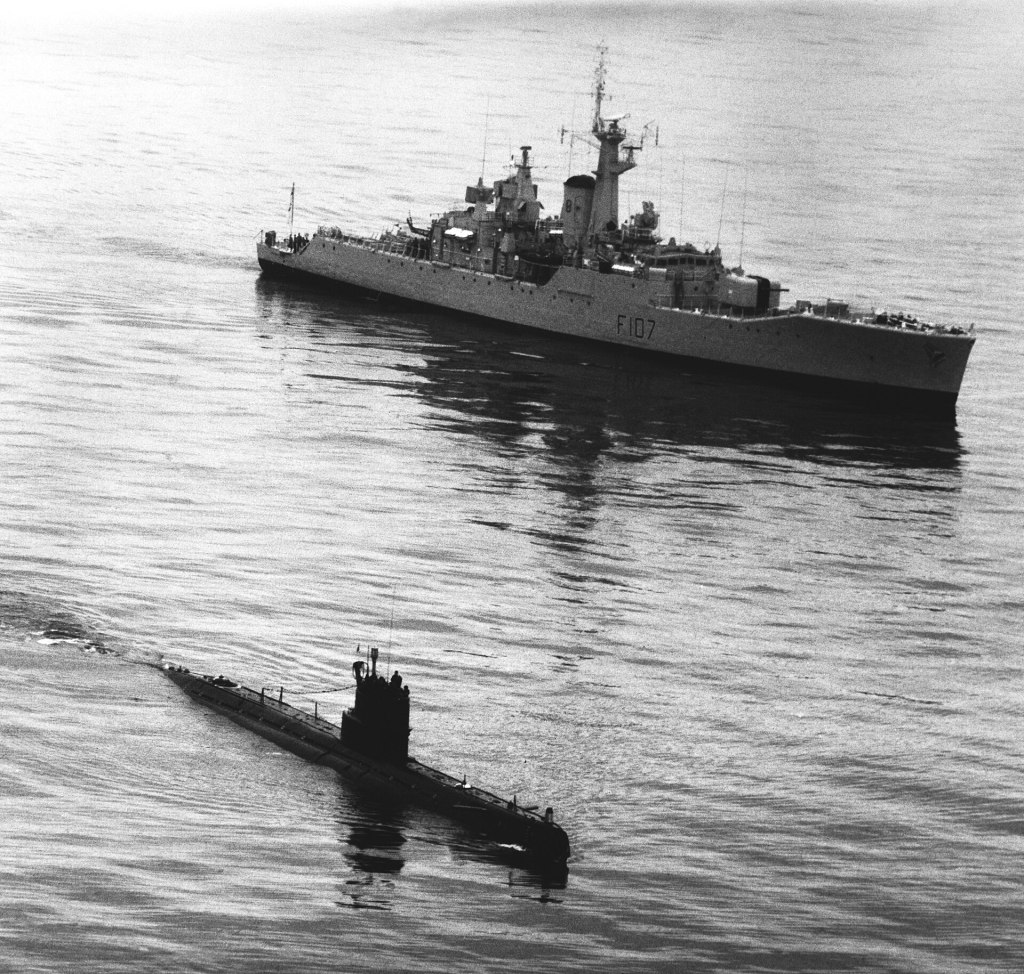
Rothesay was laid down at Yarrow’s Scotstoun dockyard on 6 November 1956, launched on 9 December 1957 by Audrey Douglas-Hamilton—wife of George Douglas-Hamilton, the First Lord of the Admiralty—and completed on 23 April 1960.
“Just six years into her service, Rothesay underwent major modifications at Rosyth that brought her up to date and closer in capability to the newer Leander-class frigates.”
Just six years into her service, Rothesay underwent major modifications at Rosyth that brought her up to date and closer in capability to the newer Leander-class frigates. A hangar and flight deck were added to accommodate and operate a Westland Wasp helicopter, though this addition came at the expense of one of the two Limbo mortars. Rothesay’s anti-aircraft defenses were enhanced with the installation of a Seacat launcher and its associated GWS20 director on the hangar roof. Two 20 mm guns were also added, one on each side of the bridge. The aging Mark 6M fire control system was replaced with the more modern MRS3 system, improving the performance of the 4.5-inch gun. The MRS3 featured an integrated Type 903 radar, which rendered the older Type 277 height-finder radar redundant, leading to its removal. Finally, a Type 993 surface/air-search radar replaced the outdated Type 293Q, altering completely the appearance of the main mast.
After being commissioned into service, Rothesay sailed to Halifax, Nova Scotia, from where she was to commence a series of port calls along the American East Coast. However, she was recalled to the Bermuda Naval Station to protect British interests in the region amid rising tensions with Cuba. On 21 March 1962, she accidentally rammed the Turkish submarine Gür during a NATO exercise in the Western Mediterranean. Between 1962 and 1963, a notable figure appeared on her bridge as commander: Victoria Cross recipient Captain Godfrey Place.
During one of her visits to the West Indies, Rothesay briefly became a Hollywood star when she appeared for 30 seconds in the James Bond film Thunderball. Alongside the U.S. Coast Guard, Rothesay is seen attempting to stop the villain Emilio Largo (Adolfo Celi) from escaping aboard his yacht-turned-hydrofoil.
In 1969, Rothesay transported 315 men of The Parachute Regiment to Anguilla to help preserve peace after local resistance arose against the decision to place the island under the control of the government of Saint Kitts. In 1970, she operated off the coast of Brazil to assist in the recovery of the failed Apollo 13 capsule following its splashdown.
Rothesay took part in the Cod War fishery patrols in 1973 and later attended the 1977 Silver Jubilee Fleet Review at Spithead, alongside her sister ships Plymouth, Berwick, and Brighton. When the Falklands War broke out, Rothesay was undergoing a refit at Rosyth and was subsequently deployed to the Caribbean during the conflict. Plans to retire the ship in 1983 were postponed, and in 1985 she was converted into a training vessel for the Dartmouth Training Squadron. She was finally decommissioned on 13 March 1988 and sold for scrap to a company in Santander, Spain.
Olivier Goossens
 Heart of Oak
Leave a comment