
Launched down the slipway at Palmer’s Jarrow on 17 July 1928, and commissioned on 1 May 1930, HMS York was the first of a class of two heavy cruisers built in accordance with the naval treaties of the Interwar Period. Neither would survive the war, as her sister ship, HMS Exeter—after gaining fame for her role in the Battle of the River Plate (13 December 1939)—was sunk on 1 March 1942 during the Japanese onslaught at the Second Battle of the Java Sea.
The York-class weighed around 8,250 long tons (8,380 t) at standard load, measured 575 ft 1 in (175.3 m) in length, 58 ft (17.7 m) in beam, and had a draught of 20 ft 3 in (6.2 m) at deep load. Their eight Admiralty 3-drum boilers supplied steam to four geared steam turbine sets producing 80,000 shp (60,000 kW), allowing the ships to reach a top speed of around 32 knots (59 km/h; 37 mph). With such excellent velocity, they were perfectly suited to carry out their intended role: protecting the commerce of the British Empire against any sudden threat. Her means of safeguarding trade to and from Britain consisted of 3 × twin 8 in (203 mm) guns, 4 × single 4 in (102 mm) anti-aircraft guns, 2 × single 2 pdr (40 mm) AA guns, and 2 × triple 21 in (533 mm) torpedo tubes.
“With such excellent velocity, they were perfectly suited to carry out their intended role: protecting the commerce of the British Empire against any sudden threat.”
When Britain declared war on Germany on 3 September 1939, York was stationed at her base in Bermuda and was quickly transferred to Halifax, Nova Scotia later that month for convoy escort duties. She became part of the local Force F, dedicated to hunting down German commerce raiders. A period of refits followed shortly thereafter, during November and December. Upon completion in February 1940, she was assigned to the 1st Cruiser Squadron of the Home Fleet, under the command of Vice-Admiral John Cunningham. She experienced her first enemy encounter a month later, when she sighted the German blockade runner Arucas, which was scuttled by her crew to prevent capture.

York became actively involved in the Battle for Norway, which broke out following the German invasion in early April. She assisted in the evacuation of Allied troops when it became clear to high command that the Norway Campaign was a lost cause. After her time in the stormy waters off Scandinavia, York exchanged the ice-cold north for the more agreeable climate of the Mediterranean.
“After her time in the stormy waters off Scandinavia, York exchanged the ice-cold north for the more agreeable climate of the Mediterranean.”
She joined the 3rd Cruiser Squadron in Alexandria in late September 1940. It was in the Mediterranean that York claimed her first victory during the Battle off Cape Passaro on 13 October, when she finished off a crippled Italian straggler, the destroyer Artigliere. She later provided cover for the aircraft carrier HMS Illustrious during her famed surprise attack against the Italian fleet, anchored at Taranto (Operation Judgement).
She spent the remainder of her time protecting troop transports, covering the supply of Malta, and striking Italian shore based targets and shipping. York then provided protection for supplies and soldiers going from Egypt to the front in Greece during Operation Lustre in March.
It was at the presumed safety at the anchorage in the natural harbor of Suda Bay, Crete, that York became the target of relentless AXIS attacks. On 26 March 1941, HMS York was severely damaged by two Italian explosive motorboats launched by the Regia Marina’s Decima Flottiglia MAS, an elite naval assault unit. The boats had been deployed from the destroyers Francesco Crispi and Quintino Sella, both of which had been modified with cranes to handle the launch of such craft.
“It was at the presumed safety at the anchorage in the natural harbor of Suda Bay, Crete, that York became the target of relentless AXIS attacks.”
Under the command of Tenente di vascello Luigi Faggioni, six motorboats infiltrated the bay and approached three designated targets in pairs: York, the tanker Pericles, and a third ship at anchor. Though three of the boats were rendered ineffective due to mechanical issues or the extreme heat, the remaining three reached their objectives. Two of the boats, each loaded with 330 kilograms (728 lbs) of explosives in their bows, struck York amidships. The resulting explosions flooded both boiler rooms and one of her engine rooms, killing two British sailors. To prevent sinking, York was deliberately run aground. All the Italian crew members involved survived and were taken prisoner.
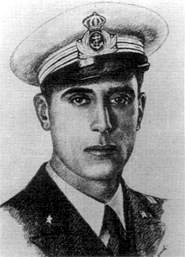
For a time, the damaged cruiser was kept in action with electrical power supplied by the submarine HMS Rover, allowing her anti-aircraft guns to remain operational. However, Rover was soon badly damaged in an air raid and had to be withdrawn for repairs. On 18 May, York suffered further damage from German bombers and was deemed beyond repair. Just days later, on 22 May—amid the Allied evacuation of Crete—her main guns were destroyed with demolition charges to prevent their capture.

More than a decade later, in February 1952, the wreck of York was salvaged by an Italian shipbreaking company and towed to Bari, where dismantling began on 3 March.
 Heart of Oak
Leave a comment