

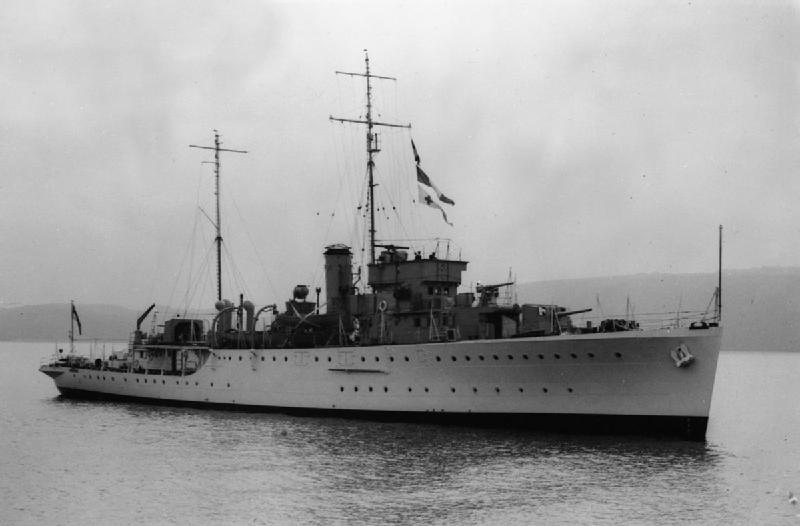
HMS Grimsby (U16) was the lead ship of the Grimsby-class sloops, a class of 13 vessels built between 1933 and 1940. The small, 990-ton ship measured 266 ft 3 in (81.15 m) in length, 36 ft (11.0 m) in beam, and had a draught of 9 ft 6 in (2.90 m) at full load. Her two Admiralty 3-drum water-tube boilers fed steam to Parsons geared steam turbines, which drove two shafts and provided enough power for a top speed of 16.5 knots. She required a crew of 100 men to operate. Her armament included two 4.7-inch (120 mm) Mark IX guns, one QF 3-inch 20 cwt anti-aircraft gun, and four 3-pounder guns.
HMS Grimsby was laid down on 23 January 1933, launched on 19 July the same year, and commissioned on 17 May 1934. Prior to the war, she primarily served in the Far East, based in Hong Kong. While stationed there, she patrolled the Chinese coastline to combat piracy. She underwent a refit in Singapore between February and July 1939, after which she continued her service in Asia with the East Indies Station.
At the outbreak of World War II, she was relocated to the United Kingdom, where she served with the Rosyth Escort Force, conducting convoy escort duties between the Firth of Forth and the Thames Estuary. She later joined the Red Sea Force, safeguarding convoys between Suez and Aden from Italian air and naval threats in East Africa, a role she fulfilled until March 1941.
After her deployment in the scorching Red Sea, HMS Grimsby was transferred to the Mediterranean, where the Royal Navy was severely stretched and under constant pressure. She took part in escorting convoys to Greece, which was valiantly defending its freedom against relentless German and Italian forces. However, the Allied defense of Greece soon collapsed, leading to a decision to evacuate British troops. Grimsby, along with many other vessels, participated in the evacuation effort known as Operation Demon.
During Operation Demon, HMS Grimsby came to the aid of the steamer Scottish Prince, which had been bombed by the Luftwaffe. Together with the destroyer HMAS Vampire, she towed the vessel to Suda Bay, Crete. The small sloop once again brought a stricken ship to safety when she towed the damaged transport HMS Glenearn from Kissamo Bay, Crete, to Alexandria.
The sloop was then assigned to assist in the relief of the besieged Commonwealth, Czech, and Polish soldiers at Tobruk, becoming part of the legendary and brave “Tobruk Ferry.” On 25 May 1941, Grimsby and the trawler Southern Main were escorting the tanker Helka along the North African coast when seven Junkers Ju 87 dive bombers of the Italian 239a Squadriglia spotted the small convoy. The RAF couldn’t provide fighter cover that day, and the sloop was left to fend for herself. The Italian bombers sank the Helka and damaged the Grimsby during their attack. Later that day, Ju 87s of the German I/StG 1 found the straggling Grimsby and dealt the decisive blow. The ship sank, taking 11 crewmembers with her to the bottom of the sea. The valiant little ship didn’t go down without a fight, shooting down one Ju 87 before she herself made her final bow and disappeared below the waves.
Olivier Goossens
 Heart of Oak
Leave a comment