

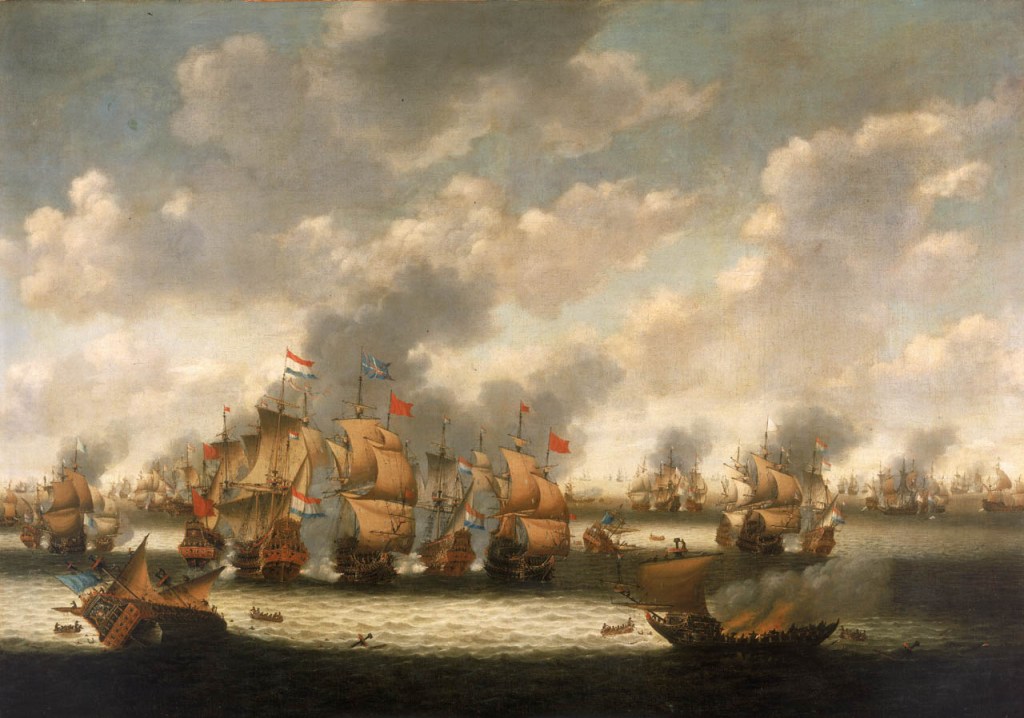
The year was 1666, and the Second Anglo-Dutch War was in its second year. Between 11 and 14 June, the southern North Sea became the stage for an epic encounter between two of the greatest naval powers of the time: England and the Dutch Republic. Over four days, a fleet of 60 ships under George Monck clashed with 86 vessels commanded by Michiel de Ruyter, the scourge of Stuart England. Around 7,000 men were killed, wounded, or captured in the aftermath. Twenty-four warships were lost, multiple admirals perished, and one was even taken prisoner. This is the story of the longest battle ever fought by the Royal Navy.
By the time England declared war on the Dutch in March 1665, conflict had already been looming on the horizon for quite some time. The capture of New Amsterdam—renamed New York afterwards—and commercial rivalry had steered England and the Dutch Republic on a collision course. The conflict at sea started out favourably for the English, as they inflicted a defeat on the Dutch fleet off Lowestoft in June 1665. London, for now, controlled the North Sea, but the swift and decisive action by Vice Admiral Cornelis Tromp prevented their defeat from spiralling out of control and halted the English momentum.
In the meantime, the unwavering Dutch continued to expand their fleet, adding a further 16 heavy ships of the line to their ranks. As if the Dutch naval expansion weren’t troubling enough, news arrived that King Louis XIV had decided to side with the Republic in their struggle against the noisy islanders to the north. The prospect of the Dutch and French joining forces at sea frightened London, and it became clear that the Royal Navy had to make a decisive move fast. The Sun King, in fact, had a large fleet under the Duc de Beaufort in the Mediterranean, which could come and reinforce the Republic. King Charles II also received the worrying intelligence that his foes were planning to land troops in Ireland.
It was therefore decided on 8 June to split up the fleet. One squadron of 20 ships under Prince Rupert was sent westward to deal with the incoming French and thwart any landing attempts in Ireland, while the bulk of the navy—some 56 ships—was allocated to the command of George Monck, the Duke of Albemarle. Monck had previously been brought in by Charles II to even out the boldness—and perhaps even recklessness—of Prince Rupert. Despite their different characters, a cordial relationship and good cooperation developed between the two commanders. In any case, Monck remained in the Downs, keeping a watchful eye on the Dutch. He commanded three squadrons: the red under his own command, the white squadron under George Ayscue, and the blue under Thomas Allin.
On 10 June, Monck gave the order to weigh anchor. Intelligence had been received that Michiel de Ruyter had sailed out in full force. It was glaringly obvious that the opposing side was superior to Monck’s force, and King Charles II ordered Prince Rupert to head back to the Downs to reinforce the main battlefleet. On 11 June, however, when Monck perceived a forest of masts on the distant eastern horizon, to leeward, he decided to engage the enemy without waiting for Prince Rupert.
Due to inferior ship designs, the English went into the battle at a disadvantage. The strong breeze made the men-o’-war under Monck heel so much that their lower-deck gunports could not be opened. The Dutch vessels, meanwhile, had a higher freeboard and were generally more stable. Monck was also heading for the most powerful fleet the Dutch had ever fielded. The Grand Pensionary Johan de Witt had finally abandoned his opposition to the construction of larger warships. De Ruyter now had more ships of 70 guns or more at his disposal, including his flagship De Zeven Provinciën (80).
“And then began the most terrible, obstinate and bloodiest battle that ever was fought on the seas.”
-Lieutenant Jeremy Roch, HMS Antelope (52), Red Squadron (Monck), Main Division-
The first day of the engagement witnessed a lot of bloodshed. It was a conventional battle between opposing lines sailing parallel to each other on a southerly course, nearing the Flemish coast by nightfall. The Dutch then tacked to the north, and the English van (White Squadron) was left behind and became isolated. Vice-Admiral Sir William Berkeley was killed, and his flagship, HMS Swiftsure (64), was taken as a prize by the Dutch. The Dutch clearly came out victorious, capturing four English ships in total.
The defeat of the first of June was offset for the English, however, by the heroism displayed by Rear-Admiral John Harman in his straggling HMS Henry (64). As the sun was setting, Henry suddenly found itself at the centre of Dutch attention. First, two fireships approached. Initially, the crew started panicking, with some men even jumping overboard. Harman, however, unsheathed his sword and charismatically hurried the remaining men back to their stations. The attack cost HMS Henry two masts, the crashing down of which injured the English admiral’s leg. Vice-Admiral Cornelis Evertsen then bore down on the Henry with his squadron, flying his flag in the Walcheren of 70 guns. The Dutchman demanded the English surrender, to which Harman famously replied: “I’m not up to it yet!” Henry successfully made a run for it, cutting through Evertsen’s Dutch squadron and fending off three Dutch fireship attacks. Vice-Admiral Cornelis Evertsen was cut in half by a cannonball from the fleeing Henry. Harman successfully retreated to Harwich, where he made quick repairs and, almost miraculously, rejoined the fleet the very next day.
On 12 June, each side again formed a sturdy line of battle. The English now had fifty ships against the Dutch seventy-seven. Monck first set sail toward the enemy in line abreast before forming a line ahead at close range to firmly engage De Ruyter. This was a new type of manoeuvre devised by Sandwich one year prior. The English and Dutch both maintained their lines throughout the whole day and brushed past each other on opposing tacks several times, with individual ships or squadrons sometimes breaking through the adversary’s formation. At one point, disaster almost struck the Dutch, with Cornelis Tromp being left in a perilous and isolated position. De Ruyter, however, quickly rescued the admiral through excellent communication, cutting with his squadron through the English line while the rest of the Dutch fleet covered him to windward. By nightfall, no decision had been reached, and both fleets disengaged, exhausted, before nightfall.
The English found themselves heavily outmatched on the third day, with only half of Monck’s original fleet still battle-ready. The rest had been either captured, destroyed, or simply blown out of action. Monck, realizing the severity of the situation, held his ground, hoping Prince Rupert would arrive swiftly. He formed a line abreast with his fifteen strongest vessels in order to cover a potential full retreat. In the afternoon, like a deus ex machina, a welcome sight dawned on the horizon: Prince Rupert with his twenty sails.
The two English forces subsequently headed toward each other with all haste. However, a grave danger lurked between Prince Rupert and Monck: the Galloper Shoal. These shallows off Harwich caught the English completely off guard, and three vessels became stuck on the sandbar around five o’clock—HMS Royal Katherine, Royal Charles, and Prince Royal. In the end, the Royal Katherine and Royal Charles managed to free themselves, but the lofty Prince Royal, flagship of Vice-Admiral George Ayscue, remained firmly grounded in the shoal. The Dutch were nearing, and panic took hold of Ayscue’s men. The admiral had no other choice but to surrender to De Ruyter, who subsequently ordered the vessel to be burnt—much to the frustration of Tromp, who had wanted to press her into Dutch service. The loss of the Prince Royal, a veteran from the age of King Charles I and the second-largest vessel in commission, was a huge blow to English morale. Ayscue’s name was tainted forever, as he became the first and only English admiral of his rank to surrender to the enemy. He subsequently spent the rest of his wartime days as a prisoner at Loevestein Castle (for more about prisoners-of-war during the Anglo-Dutch Wars).
On the fourth and final day, intense fighting broke out again, as Monck and Rupert both managed to cut through the Dutch line with their fifty-two ships from the leeward. Both divisions were beaten back, however, by a strong counterattack from De Ruyter. At one point, the Royal James, flagship of Prince Rupert, became completely dismasted and had to be towed away under the protection of his squadron, leaving Monck to fend for himself. The English fleet was completely battered after four days of heavy fighting and had spent nearly all its ammunition. The writer John Evelyn, beholding the spectacle from Sheerness, expressed his sadness on seeing “more than half of that gallant bulwark of the kingdom miserably shattered.”
England had lost ten ships and about one-fifth of its sailors, including three admirals and ten captains. The Four Days’ Battle was a significant tactical defeat by any standard. The rest of the fleet managed to escape thanks to the crews’ outstanding discipline during the retreat and a thickening fog that beset the mouth of the Thames.
The Dutch, now in command of the North Sea, were preparing their next move: to strike the rest of the enemy fleet at Chatham. In a show of outstanding resilience, however, the hastily repaired fleet of Monck managed to rout the Dutch about two months after the Four Days’ Battle during the St James’s Day Battle on 4 August. The English miraculously regained the initiative and struck the Dutch anchorage at the Vlie, the seaway between the islands of Vlieland and Terschelling. English success was cut short, however, by one of the worst disasters in the island’s history: the Great Fire of London in 1666. The already strained English finances collapsed, and further naval operations became impossible. To make matters worse, in June 1667, Michiel de Ruyter snuck up the River Medway, surprised the English fleet at Chatham, destroyed thirteen ships, and took away the pride of the navy, HMS Royal Charles. The fate of England was sealed, and a peace favourable to the Dutch was signed by King Charles II.
Olivier Goossens
 Heart of Oak
Leave a comment