

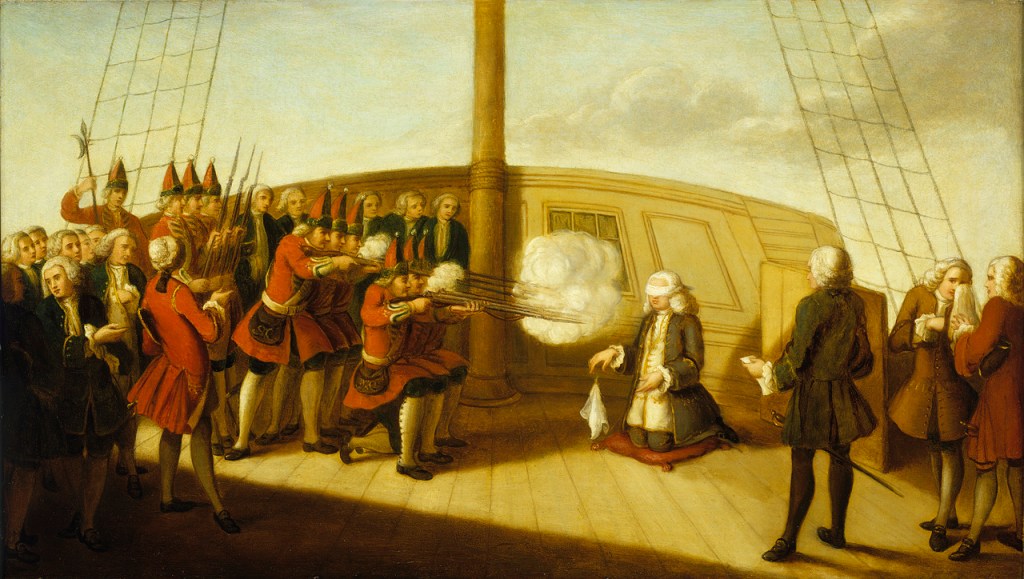
“In this country it is considered useful now and again to shoot an admiral, to encourage the others”
– Voltaire –
The French philosopher Voltaire famously wrote these words when news of Admiral Byng’s execution in 1757 arrived from across the Channel. The event highlighted Britain’s relentless expectations of its naval personnel. Not even a man of aristocratic stock like Byng was spared the ultimate punishment when he failed to fulfill his duty. By the time of Byng’s demise, an ethos of invincibility on the seas had become ingrained in the British spirit. When Vice Admiral Nelson raised the signal “England expects that every man will do his duty” at Trafalgar, he meant that he expected nothing less than absolute victory. Unwavering discipline was considered a central pillar upon which this naval success rested. The downside of such a mentality was that severe punishment awaited those who failed to perform their duty. This article aims to briefly address the topic of discipline and punishment in the Royal Navy during the 18th century.
The 18th century was a harsh society. According to English law, over 200 offenses were punishable by death. Harsh punishment was regarded as the most effective deterrent to crime, often favored over policing. Humanist views—such as those expressed in Thomas More’s Utopia, which emphasized addressing the root causes of societal problems—remained marginal. By 18th-century standards, punishments in the Royal Navy were not as severe as they might seem to us today, but were consistent with the prevailing mentality of the time.
The Navy’s disciplinary measures trace their origins to the Articles of War, first adopted by the Republicans in 1652 and later passed on—largely unaltered—to the Restoration Navy in 1661. Interestingly, many of the original articles were directed at captains. This focus can be explained by the politically unstable climate of the time, when the loyalty of aristocratic captains was often uncertain. The possibility of captains holding back in battle for political reasons was a genuine concern. As a result, keeping them in check was considered of the utmost importance.
In 1749, a new Act was passed in Parliament that superseded the previous Articles of War. Discipline and punishments had clearly become more severe, as 7 out of the 57 clauses mandated the death penalty. One of the captain’s responsibilities was to ensure that the crew was aware of what was permitted and what was not. Each month, he reminded his men of the boundaries of their behavior by reading the Articles aloud. The biblical language likely had its intended effect on the crew, aiming to evoke the same dread that early modern Christians felt at the thought of transgressing God’s laws. The Articles addressed offenses such as cowardice, negligence, desertion, mutiny, and “the detestable sin of buggery or sodomy,” all punishable by death.
The source material presents a somewhat distorted picture, as punishments for minor offenses often went unrecorded. Sanctions for petty crimes typically included beatings with the boatswain’s rattan or the imposition of extra duties. More serious offenses were punished with the infamous cat o’ nine tails—a multi-tailed whip made by unwinding rope strands and knotting the ends. Captains were permitted to order up to a dozen strokes, and the flogging was carried out in full view of the crew. Midshipmen were subject to the same punishments as other crew members, although they were spared the humiliation of public flogging in keeping with their rank and social status. Instead, they were privately tied to the barrel of a gun and beaten—a punishment famously known as “kissing the gunner’s daughter.” Another common sanction for unruly midshipmen was mastheading, which required them to remain aloft in the mast, often during foul weather or cold conditions.
The treatment of British tars often depended largely on the character of their captain. Some commanders were tyrannical by nature, while others held the virtue of clemency in high regard—though corporal punishment was generally regarded as a necessary evil. Army paymaster Durant expressed his dismay upon witnessing the flogging of two marines aboard HMS St. George, “whose crimes were by no means equal to the severity of their punishment.” Each received a dozen lashes—one for selling his allowance of wine, the other for defrauding the purser of a few ounces of tobacco. A logbook that is nearly devoid of flogging entries does not necessarily indicate a lenient captain. Many punishments simply went unrecorded, or were vaguely noted as “received punishment,” without specifying the nature of the sanction.
Boys were often more vulnerable to the whims of their dictatorial superiors, as evidenced by the memoirs of William Chandler, who recalled that his master “would sometimes kick me with such violence, as he would force me through the cabin.” Some captains held stricter moral standards than others, even punishing profanity aboard their ships. Captain Cummings, for example, made a man who swore wear a wooden collar, according to William Spavens. Cummings required the man to wear the collar until someone else was caught cursing. As a result, the man began deliberately stepping on the toes of his fellow sailors to provoke them into swearing and thus relieve himself of the punishment.
More serious offenses were handled by a court martial, whose proceedings were meticulously outlined in the Articles of War. Court martials could only be convened with the permission of an admiral or a commander-in-chief on an overseas station. The board of judges was required to consist of at least five captains, but could include up to thirteen members. Admirals could also sit on the court martial if the severity of the case or the status of the accused warranted it. Admiral Byng, for example, was court-martialed before a panel of four admirals and nine captains. Court martials usually took place aboard the flagship or guardship at a port or station.
When an ordinary rating was summoned before a court martial, it usually meant he had committed a serious offense and could at least expect several hundred lashes if found guilty. When a ship’s commander was called before a court martial following the loss of his vessel, it was not necessarily an accusation but rather a customary inquiry. Admirals and captains sometimes even requested a court martial themselves to dispel rumors about their conduct during an engagement. Sir Robert Calder, for example, asked the Admiralty to convene a court martial after the controversial Battle of Cape Finisterre in 1805, where he was accused of cowardice. Although Calder was acquitted of cowardice, he was formally reprimanded for not having done his utmost to engage the enemy. He was never given a command again.
In some cases, the neglect of duty by a commander was glaringly obvious. At the Battle of Camperdown in 1797, Captain John Williamson of HMS Agincourt (64) was the only commander who failed to engage the enemy, while the rest of the fleet played a crucial role in securing Britain’s victory. Not a single casualty was reported aboard his ship by the end of the battle. Captain Williamson, already known for his indecisiveness, was found guilty and prohibited from further naval service.
Many captains and admirals were exonerated, however, and continued their careers. Sir Thomas Thompson, for example, lost his ship, HMS Leander (50), during an intense engagement with a superior French third-rate ship of 74 guns on 18 August 1798. It was beyond question that Thompson had acted with valor. As a result, he was swiftly and honorably acquitted during his court martial and returned to service without any stain on his reputation. The court’s decision read: “His gallant and almost unprecedented defense of the Leander against the superior force of le Généreux was deserving of every praise his country and the assembled court could offer.”
Some court martials were extremely divisive, and the public took an active interest in them, sometimes even pressuring the board of judges for a particular outcome. The famous case of Admiral Lestock vs. Admiral Mathews was held aboard HMS London off Chatham Dockyard, following the indecisive and controversial Battle of Toulon in 1744. Mathews accused his second-in-command, Lestock, of failing to secure a victory. Mathews enjoyed tremendous popular support, and several hundred men gathered at the gate of the dockyard to intimidate Lestock’s supporters. As a result, the case had to be moved to Deptford. Lestock was eventually acquitted, and Mathews was sensationally found guilty and banned from further naval service.
One of the most famous cases was the trial of Admiral John Byng, whose attempt to relieve Minorca was thwarted by the French in May 1756. This defeat led to the infamous loss of the Mediterranean island, sparking public outcry in Britain. Although the court martial board was initially inclined to spare Byng, public pressure forced them to find the admiral guilty and use him as a scapegoat. He was executed by a firing squad of Marines on the quarterdeck of HMS Monarch (74) in Portsmouth on 14 March.
The court martial of a rating or warrant officer typically lasted only a few hours, while the trial of a high-profile figure could take several days to reach a verdict. In the momentous case of Admiral Byng, evidence was heard over six days, and deliberation lasted five days. The admiral was executed exactly one month later. The sensational case of Lestock vs. Mathews even took over a year to be finalized!
The most severe court martials were those related to mutinies. In July 1798, several men in the fleet swore an oath of allegiance to the dissident and anti-British United Irishmen, which was seen as a prelude to insurrection. The court martial aboard HMS Defiance—a fitting name—sentenced eleven men to hang. The most infamous mutinies were, without a doubt, the Spithead and Nore Mutinies of 1797. Although the mutiny at Spithead was, in reality, a peaceful strike, the Nore Mutiny was far more radical and violent. The rebellious ships even blockaded the Thames River, preventing merchant vessels from leaving or entering London. The Nore uprising is generally regarded as one of the darkest chapters in British naval history. Its instigator, Richard Parker, was found guilty of treason and piracy during his court martial and was subsequently hanged from the yardarm of HMS Sandwich (90) on 30 June 1797.
An immensely cruel punishment that awaited ratings and warrant officers found guilty in a court martial was “flogging round the fleet.” The man was placed in a boat and bound to a grating, after which he was rowed alongside each ship in the fleet while in harbor. The boatswain’s mate aboard each ship would whip the man twelve times with his cat-o’-nine-tails. He was then rowed to the next ship to receive another round of punishment, and could thus receive several hundred lashes. A doctor was always present in the boat to determine if the man was fit to endure further punishment. During the flogging, the crews of the ships were assembled on deck and in the rigging to witness the penalty, while drums aboard beat out the “Rogue’s March.” William Spavens recorded in his autobiography that once a man was sentenced to 600 strokes by Sir William Burnaby (c. 1710-1776), who ignored the man’s pleas for mercy, with the man even exclaiming he preferred to be hanged.
The usual sentence for capital offenses was death by hanging from the yardarm. This punishment was reserved for ratings and warrant officers who committed desertion, mutiny, piracy, and other severe crimes. For example, three mutineers from the famous Bounty mutiny were hanged on 29 October 1792, including Able Seaman Thomas Ellison, who was just 16 or 17 at the time of the insurrection aboard Bligh’s ship. Capital punishment could never be executed without a court martial. Like “flogging round the fleet,” the entire crew had to be present to witness the execution, serving as an effective deterrent. The last hanging in the Royal Navy occurred in 1860 during the Second China War. For commissioned officers and admirals, however, like Admiral Byng, the more “gentlemanly” execution was by firing squad.
Overall, discipline in the Royal Navy was of the highest standard. However, it is misleading to attribute this solely to the fear of severe punishments. Most sailors pressed into service, in fact, came from the merchant navy, which was widely known for its excellent discipline. As Henry Fielding put it during his passage to Lisbon in 1754: “In their own element, there are no persons near the level of their degree who live in the constant practice of so many good qualities. They are… perfect masters of their business, always extremely alert and ready to execute it, regardless of fatigue or hazard… they submit to every difficulty that attends their calling with cheerfulness, and no less virtues of patience and fortitude are exercised by them every day of their lives.”It is no surprise then that the British tar was, in general, a vigilant man, ready to execute his orders at a moment’s notice. The trade of a sailor required such a demeanor, as swiftness of action and sharpness of mind could often make the difference between life and death at sea. When these sailors went to war for king and country, their experience and discipline made all the difference. It was on the backs of British tars, with their incredible character and determination, that the success and future of the British Empire were built.
Olivier Goossens
 Heart of Oak
Leave a comment