

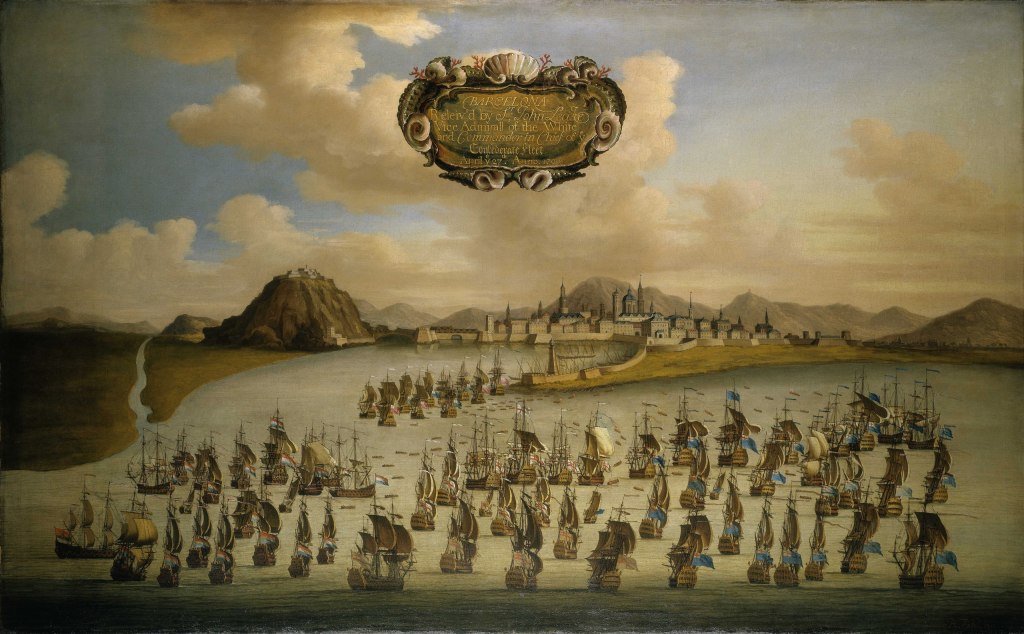
Now, with Gibraltar secured, the Allied naval forces could finally enter the Mediterranean in full strength to support the Grand Alliance’s interests. One of the navy’s top priorities was assisting in the effort to place Archduke Charles on the Spanish throne. Over time, growing numbers of Spaniards began expressing their discontent with the new Bourbon monarchy. In Catalonia especially, opposition to the Sun King’s grandson became increasingly vocal. Sensing this unrest in Barcelona and its surrounding countryside, the Allies sought to use it to their advantage. High command became determined to seize this crucial city from the Bourbons, believing that its capture could inspire other regions to rise against the central authority in Madrid. Despite a previous failure to establish a foothold in Barcelona, the Allies were now prepared to make another attempt.
The Duke of Berwick sensed that something was brewing against the Catalonian capital. However, the Bourbons dismissed his advice to reinforce the city, believing an Allied strike on the southern French harbor of Nice to be more likely.Meanwhile, a fresh Anglo-Dutch expeditionary force was being assembled in Lisbon. Command of the ground troops was given to the English General Lord Peterborough, with James Stanhope acting as his second-in-command. Accompanying them was the Allied pretender to the Spanish throne, Archduke Charles. In total, approximately 11,000 soldiers were dispatched to Catalonia.
The escorting naval squadron was commanded by the seasoned Admiral Sir Cloudesley Shovell. On 26 July, Shovell and his convoy set sail from the River Tagus. The expedition first stopped at Gibraltar to pick up Prince George of Hesse-Darmstadt—by now a familiar figure—along with some of his veteran troops, who had recently defended “the Rock” against an overwhelming Bourbon force. Shovell and Lord Peterborough arrived off the coast of Barcelona on 16 August, catching the local defenses, led by Viceroy Francisco de Velasco, completely by surprise.
Lord Peterborough’s troops landed about a week later, three miles east of the port city. This time, Prince George’s instincts proved correct, as thousands of Catalans eagerly flocked to Archduke Charles, proclaiming their loyalty to his cause. However, a significant amount of time passed before the Allies took action, as endless discussions over their next steps dominated the first weeks of their presence off Barcelona.
It became clear that the fortress of Montjuïc had to be subdued first. As the focal point of Barcelona’s defenses, it sat atop a hill to the west, overlooking the city. At the time, the stronghold was occupied by a Neapolitan garrison, as the Bourbon commanders did not even trust the Spaniards with the protection of such a vital strategic position. Peterborough agreed to launch an assault on Montjuïc.
Leading a column of 1,000 men, Lord Peterborough and Prince George took the garrison completely by surprise after a grueling nighttime march around Barcelona. During the initial assault, however, the Allies suffered the loss of one of their most capable and important commanders, Prince George. He fell while leading an attack against a Spanish detachment hiding in a local redoubt. Encouraged by their successful repulse of Prince George’s charge, the Spaniards counterattacked, but Lord Peterborough managed to bring the situation under control. The attackers then firmly established themselves around Montjuïc, preparing to besiege the Neapolitan troops inside.
Several guns from Shovell’s squadron were brought ashore to aid Peterborough. Two days later, a salvo from a 7-inch mortar, directed by Dutch Colonel Schellundt, brought the siege to a decisive end. A shell struck Montjuïc’s magazine, killing the garrison’s commander, Colonel Carraccioli, along with several of his officers as they dined nearby. Seeing no further reason to resist, the remaining defenders surrendered and handed over the keys of Montjuïc to Peterborough.
Focus now shifted to Barcelona itself. Around 58 naval guns were positioned to bombard the city’s defenses. Despite their lack of experience operating cannons ashore, the naval gun crews once again proved to be a valuable addition to Peterborough’s besieging force. A breach was eventually made in the bastion of St. Anthony.
Recognizing that the battle was lost, Viceroy Velasco surrendered Barcelona to the Allies. He negotiated favorable terms, securing safe passage for his remaining troops to Rosas aboard Shovell’s warships. Meanwhile, in Barcelona’s main square, Archduke Charles was officially proclaimed King Carlos III of Spain. The majority of Catalonia rallied to his cause, swearing allegiance to the Habsburg monarch.
For the first time, the Allies had firmly established themselves in the Western Mediterranean. However, Barcelona was still not the naval base the Royal Navy had been seeking. Though an important commercial port, the city lacked the infrastructure needed for sustained naval operations. The search for a suitable base remained unresolved.
With the campaigning season drawing to a close, Shovell and Leake weighed anchor and set sail for Lisbon and England via Gibraltar. This departure left Catalonia particularly vulnerable from the sea, as large numbers of French warships continued to patrol the Mediterranean from their stronghold at Toulon.
From Barcelona, Lord Peterborough continued the Allied march through Spain, with Valencia to the south as their next major target. However, this advance left Barcelona in a vulnerable position, with only a small garrison of about 3,000 troops under Count Uhlfeld left to defend it. Uhlfeld could also call upon 5,000 Catalan militias, who, despite their fervor and enthusiasm, were poorly equipped and trained.
King Philip V and his commanders quickly seized this opportunity. On 1 April 1706, the French Mediterranean Fleet appeared off the coast of Barcelona. The French warships were commanded by a familiar figure—the Comte de Toulouse, the illegitimate son of Louis XIV, who had been repulsed from Gibraltar nearly two years earlier at the Battle of Málaga.
Over the next few days, French and Spanish ground forces began arriving, swelling to an overwhelming 21,000 troops, the majority of whom were seasoned French soldiers. Marshal Tessé was placed in overall command of the attacking forces, though King Philip V took an active role in the siege—much to Tessé’s frustration, as he feared the king’s presence would undermine his authority. Meanwhile, to Count Uhlfeld’s relief, Hamilton’s English Regiment of Foot arrived just in time to reinforce the defenses. They would prove to be a valuable addition to the Allied cause.
The Franco-Spanish forces seemed well positioned to retake Barcelona—until the Royal Navy, aided by the Dutch, arrived to turn the tide. Just at the right moment, Vice-Admiral Sir John Leake appeared on the horizon on 7 May, bringing with him numerous reinforcements to relieve the besieged English, Dutch, and Catalan soldiers in the encircled city. However, the Comte de Toulouse managed to escape with his fleet unscathed. In fact, he had strict orders not to engage the Anglo-Dutch fleet and had been warned in time about the approaching ships by a Genoese merchant.
As Leake arrived, he could see the topsails of the Comte de Toulouse’s fleet retreating from the siege. Among the many troops Leake had brought, one familiar face disembarked: Lord Peterborough had joined Leake’s flagship as the English admiral passed the coastline of Valencia.
With an overwhelming Allied force now poised to defend Barcelona and Catalan guerillas sabotaging the enemy’s lines of communication in the rear, Marshal Tessé had only one option left: to order a retreat. Barcelona was saved.
The relief of Barcelona only added to the growing list of defeats for the Bourbon camp. Further north, the military genius Duke of Marlborough had dealt yet another crushing blow to Louis XIV near the Belgian town of Ramillies, forcing the French army to retreat from the Spanish Netherlands. The situation for the Bourbon kings looked increasingly dire.
As if the harsh reality of their military setbacks wasn’t enough, fate seemed to pile on with a full solar eclipse that enveloped Europe in darkness. Many saw this as a divine sign that the Sun King’s days were numbered. Despite these superstitions, the Allied armies and navies still had a job to do. Weakened as they were, the Bourbon kings were far from defeated and showed no signs of surrendering.
During this lengthy episode off Barcelona, the Dutch and Royal Navy once again proved their vital role. With Louis XIV fearing direct confrontation, the fleets of England and the Dutch Republic enjoyed nearly complete freedom of movement, able to strike wherever and whenever they wished. Yet another successful seaborne attack was mounted during the War of the Spanish Succession, thanks to Shovell’s escorting force. It was also Leake’s timely arrival that ensured Barcelona remained in Allied hands.
Although the navy helped achieve one of the Allies’ chief war aims—establishing Archduke Charles (now King Carlos III) in Spain—one of its own objectives had yet to be fulfilled. Barcelona simply was not suited as a naval base. The absence of a proper naval base in the Mediterranean was keenly felt when Shovell was forced to return west after the capture of Barcelona. This left the French and Spanish an opportunity to attempt to reverse the situation in Catalonia, had it not been for the timely response of Leake. The naval commanders of the English and Dutch fleets recognized, however, that such close calls should be avoided in the future, and that a real naval base must be secured.
Olivier Goossens
Sources:
- Doedens, A. & Mulder, L., Spaanse Successieoorlog, 1701-1714, 2021.
- Falkner, J., The War of the Spanish Succession: 1701-1714, 2015.
- Hugill, J., No Peace Without Spain, 1991.
- Pericay, Alcoberro i, The War of the Spanish Succession in the Catalan-speaking Lands, 1958.
- Rodger, N., The Command of the Ocean: A Naval History of Britain, 1649-1815, 2004.
- Williams, B., Stanhope: A Study in Eighteenth-Century War and Diplomacy, 1932.
 Heart of Oak
Leave a comment