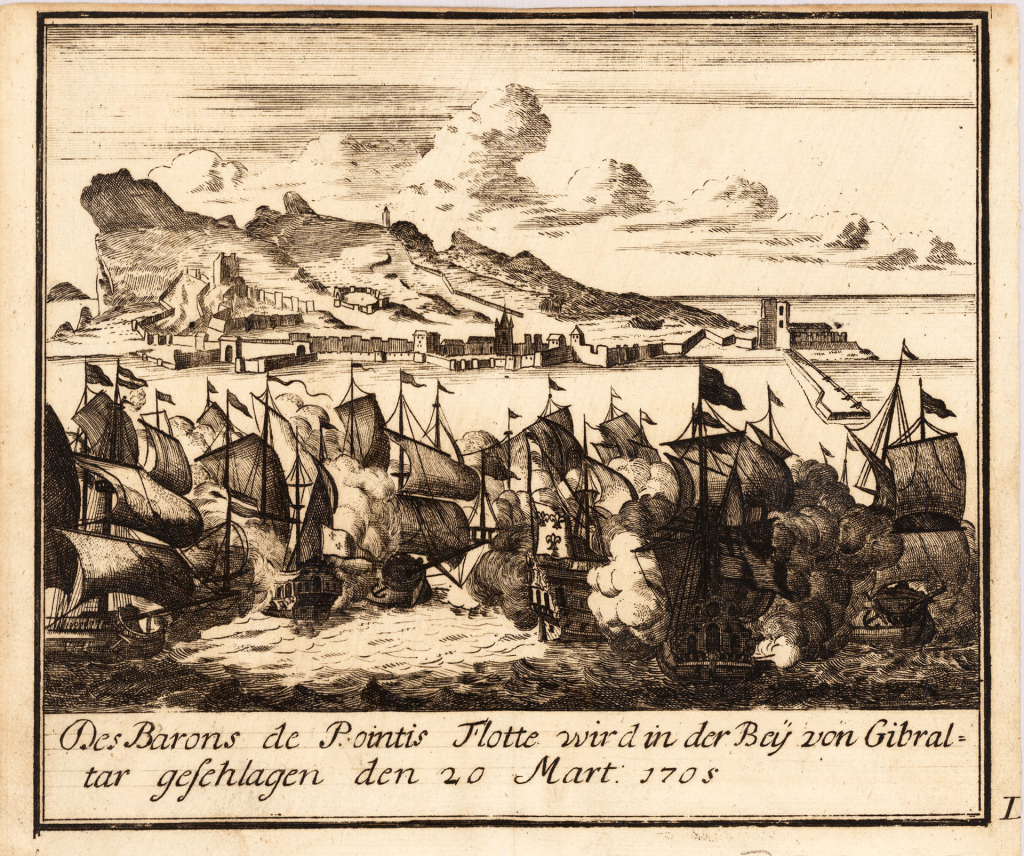
Copper engravingdepicting the Battle of Cabrita Point. Antique Maps of Spain
“the French and Spanish would not so easily give up Gibraltar”
Despite the Comte de Toulouse’s fleet being routed at the Battle of Málaga on 24 August 1704, the French and Spanish would not so easily give up Gibraltar. Preparations were promptly made to retake ‘the Rock’.
After the intense shelling by the Anglo-Dutch fleet in early August 1704, Gibraltar was left in a ruinous state. The Allies immediately sprang into action to repair and strengthen their new conquest, anticipating a strong Franco-Spanish response. A garrison was stationed at the stronghold under the command of Prince George of Hesse-Darmstadt. This force consisted of 2,300 English and Dutch marines, 70 volunteer seamen to man the guns, and a detachment of Catalan irregulars who had joined a few months earlier after the failed Siege of Barcelona. The local governor was the Irish-born Colonel Henry Nugent, who received the honorary Spanish title Count de Val de Soto upon assuming office.
With the help of English trader Mr. Warren, Sir George Rooke, before leaving this theater of war, organized a re-supply for the new base. From several North African ports, a considerable number of goods were shipped to Gibraltar. Rooke received the cooperation of the Moorish governor of Tangier, Alcayde Ali Benabdulla, who eagerly supported the Allied efforts against Spain, as he detested the Spanish violation of Moroccan territorial integrity through their possession of Ceuta.
“It did not take long for the main force of 8,000 troops under Marquis de Villadarias to arrive in early September.”
In the meantime, a Spanish advance force of 600 men had arrived at the walls of Gibraltar. It did not take long for the main force of 8,000 troops under Marquis de Villadarias to arrive in early September. Marquis de Villadarias had been entrusted with this command after successfully repelling the English and Dutch from the region of Cádiz two years earlier. The siege began without too much action, with the Spaniards, for the moment, contenting themselves with a patient land blockade of ‘the Rock’ until further reinforcements arrived.
Vice Admiral Sir John Leake, by Godfrey Kneller. NMM (ID: BHC2835)
After Rooke’s departure, a relatively small squadron under Vice-Admiral Sir John Leake, Rooke’s former second-in-command, was left in place to protect Gibraltar. Leake, however, was forced to retire to Lisbon for repairs. This provided an excellent opportunity for the French to reinforce the Spanish at Gibraltar from the sea.
On 4 October, an escorting squadron of 20 warships, led by Admiral Jean Pointis, arrived off the besieged stronghold with transports carrying about 4,000 French soldiers. Part of Pointis’ force remained in the Strait of Gibraltar to block any Allied attempt to reinforce or resupply the besieged fortress. ‘The Rock’ was now effectively surrounded. More trenches and batteries were set up, and at the end of October, a fierce bombardment of Prince George’s beleaguered forces began.
“More trenches and batteries were set up, and at the end of October, a fierce bombardment of Prince George’s beleaguered forces began.”
After Admiral Leake got wind of the enemy reinforcements, he immediately weighed anchor and set sail for Gibraltar. Leake’s squadron managed to slip past the French warships at Cádiz unnoticed. He then took the French warships in the Bay of Gibraltar completely by surprise. Several enemy vessels were driven ashore and incinerated. One frigate, the Étoile (24), was captured after being boarded by HMS Swallow. Sir John Leake, beginning to grasp the severity of the situation, landed a detachment of men from his ships to aid the heavily outnumbered troops of Prince George. The besieging force became more aggressive over time, and the English mourned the loss of Major-General Nugent, who died from an exploding shell. Leake was forced to embark his troops again and depart, fearing a naval counterattack by the numerically superior French squadron at Cádiz.
Morale among the French and Spanish soldiers wavered due to a spell of bad weather, which exacerbated living conditions in the trenches. However, the arrival of powerful 36-pounder guns briefly boosted their fighting spirit, as the new battery wreaked havoc among the defending forces on the Old Mole. Fortunately for the Allies, a convoy carrying reinforcements arrived on 19 December, bringing 1,700 fresh soldiers. Just days later, on 23 December, the Dutch and English launched a successful sally aimed at destroying as much of the siege works as possible. Meanwhile, sickness began to ravage the ranks of Villadarias’ forces, further undermining the already dwindling Franco-Spanish morale.
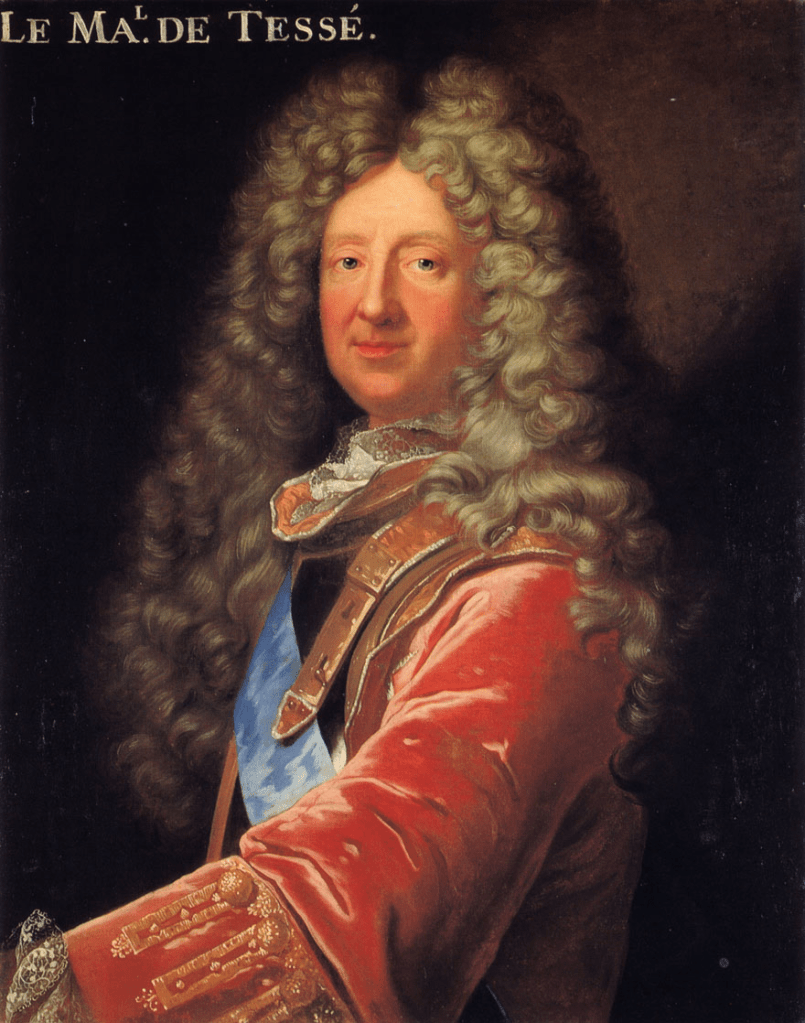
Due to a lack of progress, Villadarias was relieved of command and replaced by Marshal Tessé, the newly appointed commander-in-chief of Bourbon troops in Spain. However, the change in command did not alter the worsening situation of the besieging forces. A failed attack on 5 February was soon followed by a devastating defeat at sea…
Marshal Tessé by Hyacinthe Rigaud. Musée des Beaux-arts du Mans
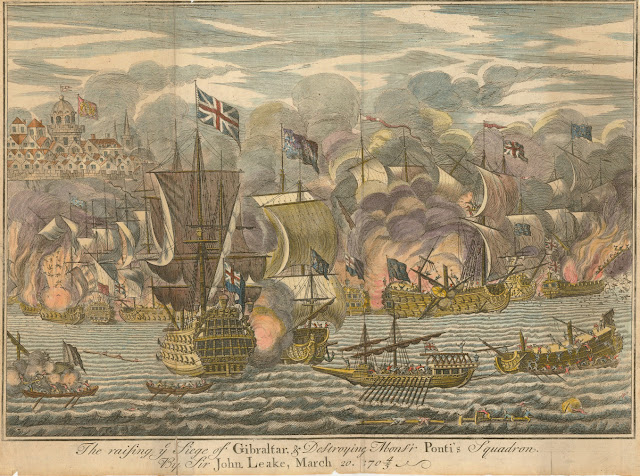
During these months, Admiral Pointis had been cruising off Gibraltar, waiting for an opportunity to attack the Anglo-Dutch naval forces. Leake, however, had successfully avoided any confrontation until he had strengthened his fleet’s numbers to the point where he could eventually overwhelm the enemy. After departing Gibraltar, he arrived off Lisbon, where he was met by four third-rate ships of the line under the command of Rear-Admiral Sir Thomas Dilkes. Additional detachments of warships were added to Leake’s fleet over time. Finally, confident at the head of a force of 35 warships, the English admiral decided to engage the enemy. The squadron consisted of 23 English, eight Portuguese, and four Dutch warships.
“The Battle of Cabrita Point, as the encounter came to be known, marked the end of French naval operations off Gibraltar.”
Leake arrived in the Strait of Gibraltar on 21 March and spotted five French sails leaving the Bay. These vessels were identified as Magnanime (74), Fleur-de-Lys (86), Ardent (66), Arrogant (60), and Marquis (66). The French, heavily outnumbered, made for the Barbary Coast before changing course toward the Iberian Peninsula upon realizing that Leake’s ships were significantly faster. Rear-Admiral Dilkes, aboard HMS Revenge (70), led the chase, accompanied by the Newcastle (54), Antelope (54), Expedition (70), and one Dutch vessel, with Leake trailing at a distance.
By 9 A.M., Dilkes’ ships caught up with the Arrogant, which struck her colors. The flagship Magnanime (74) and Fleur-de-Lys (86) turned around to engage the Allied ships. They put up a good fight but were eventually driven ashore and completely destroyed. De Pointis’ flagship ran aground so violently that her masts collapsed from the shock. The remaining two vessels, Ardent (66) and Marquis (66), were captured by Dutch Captain Mathias Bodaan aboard his ship Overijssel. The Battle of Cabrita Point, as the encounter came to be known, marked the end of French naval operations off Gibraltar.
“Due to the lack of naval assistance, it dawned on Marshal Tessé that the siege of Gibraltar was a lost cause. “
Due to the lack of naval assistance, it dawned on Marshal Tessé that the siege of Gibraltar was a lost cause. He loosened his grip on the Allied fortress and resigned himself to a mere blockade on land. The majority of the Franco-Spanish troops withdrew on 31 March. Leake’s arrival off ‘the Rock,’ coupled with the brave resistance of Prince George’s troops, had saved Gibraltar from Franco-Spanish recapture. The siege had been costly for the Bourbon forces, with reports indicating that 10,000 troops had been killed, captured, or wounded. The Allied casualty rate, however, was relatively light, with only 400 casualties. After securing ‘the Rock,’ the Allied naval forces could finally shift their focus toward the Mediterranean itself. A new phase in the naval theater of war was about to begin.
Olivier Goossens
The Battle of Cabrita Point, 21 March 1705.
Sources:
Alexander, M., Gibraltar: Conquered by No Enemy, 2008.
Allen, J. Battles of the British Navy, Vol. 1, 1852.
Doedens, A. & Mulder, L., Spaanse Successieoorlog, 1701-1714, 2021.
Falkner, J., The War of the Spanish Succession: 1701-1714, 2015.
Francis, D., The First Peninsular War, 1702-1713, 1975.
Hills, G., Rock of Contention: A history of Gibraltar, 1974.
Jackson, W., The Rock of the Gibraltarians, 1986.
Kenyon, E., Gibraltar under Moor, Spaniard, and Briton, 1938.
Le Fevre & Harding, Precursors of Nelson: British Admirals of the Eighteenth Century, 2000.
Rodger, N.A.M., The Command of the Ocean: 1649-1815, 2004.
Stanhope, P., History of the War of the Succession in Spain, 1836.
Trevelyan, G., England under Queen Anne: Blenheim, 1930.


 Heart of Oak
Leave a comment