

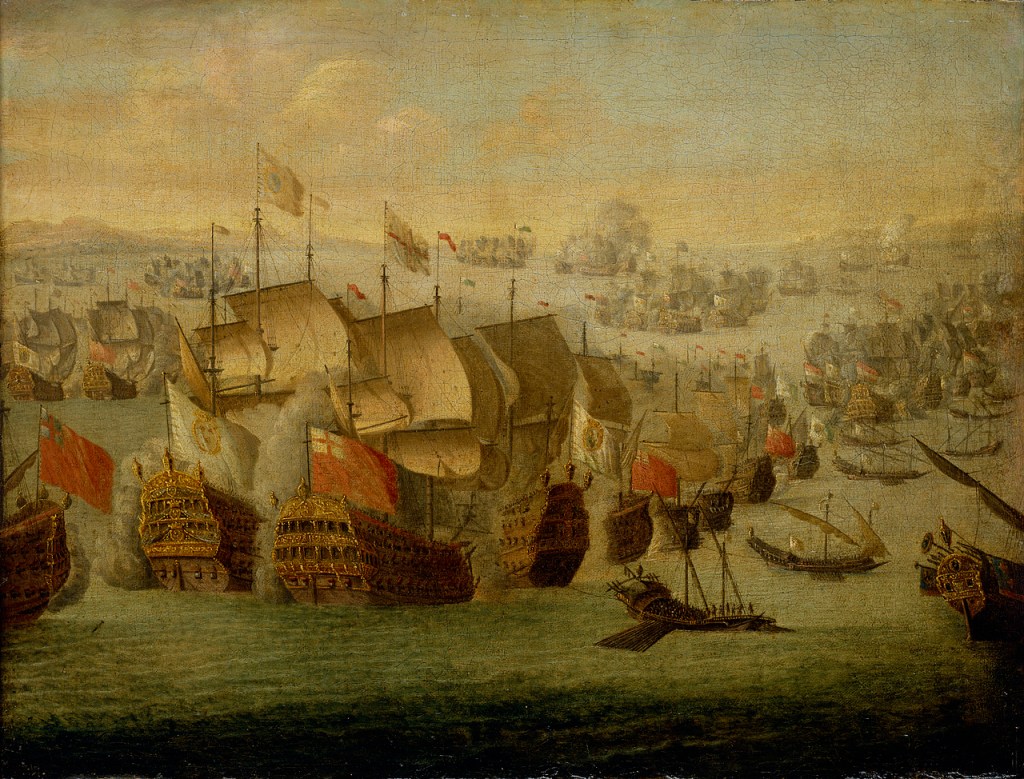
The conquest of “the Rock” by Admiral Sir George Rooke and Gerard Callenburgh’s fleet, and Prince George’s marines deeply worried and humiliated King Philip V of Spain and his grandfather, Louis XIV. The Sun King, however, had the means to mount an appropriate response. Shortly after the Siege of Gibraltar, the naval squadrons of Brest and Toulon successfully united to form a single formidable battle fleet, reinforced by the remnants of the Spanish navy. The combined French and Spanish warships set sail toward the Anglo-Dutch squadron with all haste, aiming to challenge its dominance of the Strait of Gibraltar and support a future Spanish counterattack against “the Rock.”
The combined fleet was commanded by the Sun King’s naturalized bastard son, the Comte de Toulouse, with the guidance of his mentor, Victor-Marie d’Estrées. As the illegitimate son of the French monarch, the Comte de Toulouse likely endured considerable scorn from the traditional aristocracy — a burden that may have fueled his desire to prove himself. Now, he had his chance.
The French admiral raised his flag aboard the massive Foudroyant, a 104-gun ship, and commanded about 50 ships of the line, carrying a total of 3,543 guns. In addition to the Foudroyant, the fleet included two other powerful warships of 104 guns, as well as four ships of the line with 90 to 92 guns. The remainder of Toulouse’s ships varied in size, ranging from 88-gun to 52-gun vessels. The Franco-Spanish force was further reinforced by 8 frigates, 9 fireships, and 2 transports. In general, the ships of the Sun King were better built, better armed, and had superior sailing qualities.
Meanwhile, Rooke’s fleet had initially shrunk after some Dutch warships were sent back home to embark reinforcements for the Iberian campaign. However, Vice-Admiral Sir Cloudesley Shovell had joined Rooke and Gerard Callenburgh off Gibraltar. Together, the Anglo-Dutch admirals could field a numerically superior force of 41 English and 12 Dutch ships of the line, totaling about 3,700 guns. Rooke was still flying his flag aboard HMS Royal Katherine, which mounted 90 guns. Three massive battleships of 96 guns bolstered Rooke’s fleet: HMS Namur, St. George, and Barfleur. In addition to the Royal Katherine, there was another 90-gun ship of the line present: HMS Prince George. One major problem for the allied fleet was a shortage of ammunition. After the fierce bombardment of Gibraltar, most vessels lacked sufficient shot for the upcoming engagement. However, Rooke could not leave his station, as it was vital to keep Gibraltar in Allied hands.
On the 20th of August, Captain John Horne aboard HMS Centurion (50) signaled the approach of enemy warships to windward. After a council of war, the admirals agreed to keep the French to the east of Gibraltar at all costs. A line of battle was formed, with the vanguard led by Shovell and Vice-Admiral Sir John Leake, while the center was assigned to Rooke, with George Byng and Thomas Dilkes as his rear admirals. Finally, the rearguard was made up of the Dutch ships, commanded by Vice-Admiral Callenburgh and Rear-Admiral Vanderdussen.
On 24 August, off the Andalusian city of Málaga, the two sides finally met and opened fire on each other. An intense engagement ensued, with both sides suffering considerable damage and casualties. Rooke, having the weather gauge and thus the initiative, ordered his ships to bear down on the enemy. Some naval historians suspect he may have attempted to cut the French line. However, Comte de Toulouse edged off the wind and began sailing parallel to the English and Dutch fleets. The Allied warships tried to close in on the enemy as much as possible, seeking to compensate for their shortage of cannonballs with fierce close-quarter broadsides. A classic naval battle of line versus line developed.
Sir John Leake’s center fought fiercely, firing broadside after broadside into the enemy hulls. However, by 2 P.M., several English ships had run out of ammunition and ceased firing. HMS Monke (60), under Captain James Mighells, was hard-pressed, with a French 70-gun ship attempting to board the vessel three times. Each attempt was repulsed successfully, though at the cost of many casualties on both sides. Meanwhile, the Dutch rear, with extraordinary valor and determination, prolonged the fight well into the night. Having better managed their magazines, Callenburgh was able to sustain the battle until after sunset.
If not for the enemy’s reluctance to engage closely, several ships of Rooke’s fleet would likely have been taken. As it stood, however, no ships were destroyed or captured by either side that day. A heavy toll in human lives was paid, though. Of the 19,385 English and Dutch crewmembers, approximately 2,719 men perished or were wounded — about 1/8 of the entire fleet. This represented an unusually high death rate in English naval history. Some prominent officers were among the casualties, including Captain Leake of HMS Grafton (70), Captain Cow of HMS Ranelagh (80), four lieutenants, and two warrant officers, who paid the highest price. Many other officers later returned home bearing the marks of battle. French records are less precise regarding their casualties, but an estimate of 1,500 killed and another 1,500 wounded is generally accepted.
The high number of dead and wounded on both sides must have dissuaded the admirals from renewing the engagement the following day. Despite having the weather gauge after a shift in the wind, the French sailed back into the Mediterranean during the night. The Comte de Toulouse had failed to drive Rooke away from Gibraltar to assist the Spanish counterattack. It was a strategic Anglo-Dutch victory and was celebrated as such. Queen Anne honored Rear-Admirals Byng and Dilkes with a knighthood. The Battle of Málaga cemented Allied dominance off the southern Spanish coast.
Admiral Leake assumed command of the fleet protecting the new English stronghold of Gibraltar, while Sir George Rooke returned home with the bulk of his force for a refit. However, King Philip V and Louis XIV defiantly refused to give up on Gibraltar and began making plans to reconquer “the Rock.” Despite the victory off Málaga, Admiral Leake and his colleagues faced several challenging months ahead.
Olivier Goossens
Sources:
· Allen, J. Battles of the British Navy, Vol. 1.
· Doedens, A. & Mulder, L. Spaanse Successieoorlog, 1701-1714, 2021.
· Falkner, J. The War of the Spanish Succession: 1701-1714, 2015.
· Nolan, C. Wars of the Age of Louis XIV, 1650-1715: An Encyclopedia of Global Warfare and Civilization, 2008.
· Rodger, N.A.M. The Command of the Ocean: 1649-1815, 2004.
· Wilson, B. Empire of the Deep, 2013.
 Heart of Oak
Leave a comment