

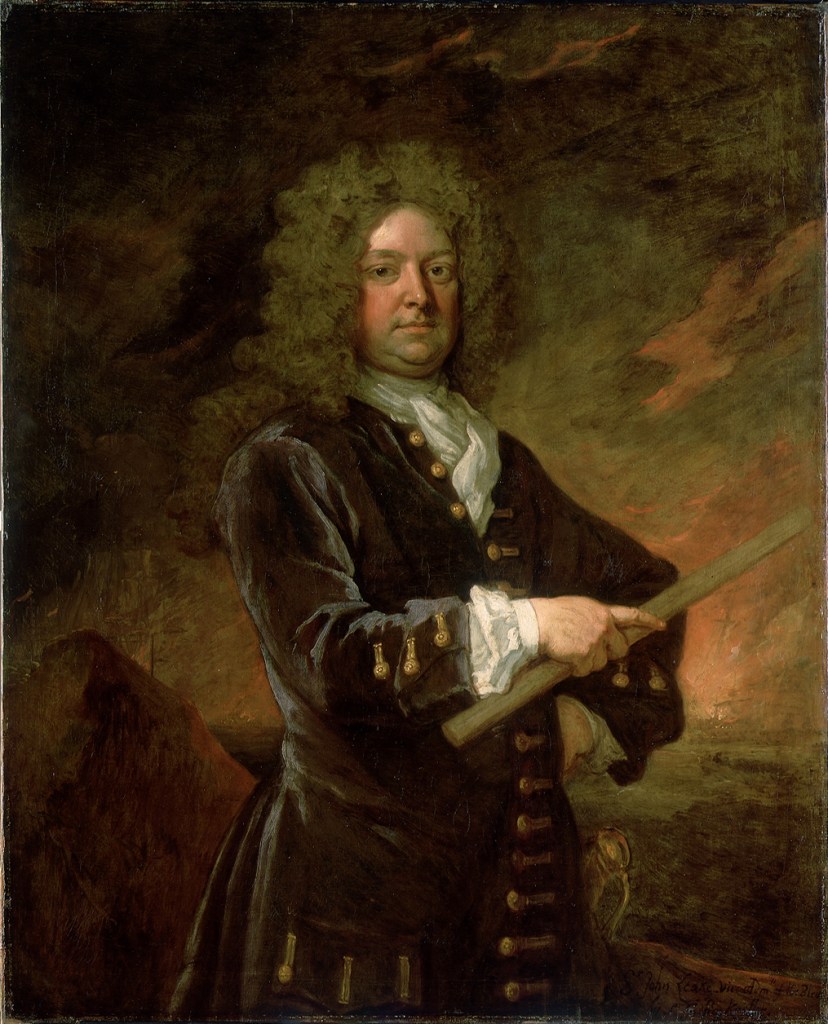
After the fierce Battle of Málaga on 24 August 1704, Admiral Rooke sailed home with much of his fleet, desperately in need of repairs. Consequently, Sir John Leake assumed command of the Anglo-Dutch naval forces off the Iberian Peninsula. He would go on to make a name for himself, playing a crucial role in the Grand Alliance’s subsequent naval operations during the war.
John Leake was born in 1656 into a family with ties to the navy. His father, Richard, served as a master gunner. Envisioning a future for his son in His Majesty’s navy, Richard instructed John in mathematics and the art of gunnery. The Third Anglo-Dutch War (1672–74) soon called Leake to put his life on the line for king and country, and it didn’t take long for the young lad to experience the mayhem of battle. In August 1673, he served aboard Spragge’s flagship, the legendary HMS Royal Prince (100), during the Battle of the Texel, alongside his father. While aboard this first-rater, he became acquainted with a man whose career would repeatedly intertwine with his: Sir George Rooke.
After peace was concluded with the Dutch Republic, John enjoyed a brief spell in the merchant navy before reentering naval service in 1676. Following in his father’s footsteps, he became master gunner aboard the second-rate HMS Neptune in 1683. His first command came during the Glorious Revolution when he assumed responsibility over the bomb vessel HMS Firedrake. Like Rooke, he went with the current and sided with King William III, fighting shortly thereafter at the Battle of Bantry on 11 May 1689. As captain of HMS Dartmouth(28), he played a pivotal role in lifting the Siege of Derry (April–August 1689), breaking the barricading boom at Culmore Fort. At the Battle of Barfleur (May 1690), Rooke, commanding the third-rate HMS Eagle (70), found himself in the thick of battle, with 70 of his men perishing.
By the time the War of the Spanish Succession broke out, Leake was Commander-in-Chief of Newfoundland. He proved his worth during the opening months of the conflict, capturing 51 enemy vessels during his attacks on French fishing harbors and shipping in North America. Throughout the war, he secured several significant victories for the Royal Navy, helping cement British naval supremacy by the end of the conflict. In 1709, he was appointed the honorary post of Rear-Admiral of Great Britain in recognition of his services and joined the Board of Admiralty, led by the Earl of Orford. In 1710, he succeeded Orford as First Lord of the Admiralty, holding that position until 1712.
Leake, like many of his colleagues, also pursued a political career, becoming MP for Rochester in 1708. After serving as First Lord of the Admiralty under the Harley Ministry, Leake feared he might be perceived as a Tory, something he wished to avoid. He withdrew from politics in 1715 and retired to his townhouse in Greenwich. Sir John Leake passed away in the comfort of his home on 21 August 1720 and was buried at St. Dunstan’s, Stepney. He was survived by one son, born from his marriage to Christiane Hill, daughter of Captain Richard Hill. His biographer, John Campbell, described him as “a virtuous, humane, and gallant man, and one of the greatest admirals of his time.”
Olivier Goossens
Sources:
- Campbell, J., Lives of the British Admirals: Containing Also a New and Accurate Naval History, from the Earliest Periods, ed. C. J. Barrington, Vol. 6, 1812.
- Godfrey, M., “John Leake,” Dictionary of Canadian Biography, ed. D. Hayne, Vol. 2, 1979 (1969).
- Hattendorf, J., “Leake, Sir John,” Oxford Dictionary of National Biography (online ed.), 2011.
- Laughton, J., “Leake, John (1656–1720),” Dictionary of National Biography, ed. S. Lee, Vol. 32, 1892, pp. 317–320.
- Rodger, N., The Admiralty. Offices of State, 1979.
Further reading:
- Callender, G., The Life of Sir John Leake, Vols. 52 & 53 (Navy Records Society), 2007.
- Martin-Leake, S., The Life of Admiral Sir John Leake, ed. G. Callender, 2 Vols. (Navy Records Society), 1918.
 Heart of Oak
Leave a comment