

After the Battle of Vigo Bay, Portuguese King Pedro II defected to the Allied cause, recognizing that aligning with the side controlling the seas would better protect Portugal’s overseas trade. Although the French fleet at Brest still loomed large in the background, the destruction of Châteaurenault’s squadron had indeed cemented English and Dutch naval dominance in the Atlantic. In exchange for naval and military support against a likely Franco-Spanish invasion, Pedro agreed to open Portuguese ports to English and Dutch warships. His betrayal of Louis XIV marked a significant strategic shift for the Allies, who aimed to project their power into the Mediterranean. Gaining access to Lisbon brought them closer to achieving that goal. The Allies believed that a strengthened naval presence in the Mediterranean could help sway local Italian princes to join their cause against the Bourbon kings.
The Allies’ calculations proved correct in 1703 when Admiral Cloudesley Shovell and his squadron persuaded the strategically important Duchy of Savoy to join their cause with their mere presence. This, however, placed additional pressure on the Anglo-Dutch fleet to maintain the support of their newly found allies. Lisbon, though a step forward, was insufficient. A new naval base needed to be secured along the southern European coastline to establish a permanent presence in the Mediterranean.
At the same time, concerns mounted over the possibility of the French fleets from Brest and Toulon uniting — a dreaded scenario due to the sheer size of the combined force. The responsibility to prevent this junction and secure a new Allied foothold in the Mediterranean fell to Admiral Sir George Rooke. He commanded a formidable Anglo-Dutch fleet, with the Dutch contingent under Admiral Gerard Callenburgh. The detachment of marines was placed under the command of Austrian Field Marshal Prince George of Hesse-Darmstadt.
Rooke’s fleet began scouring the southern Spanish coast in search of a suitable landing ground. Valencia was initially considered, but the Andalusian port was ultimately dismissed as a target. The fleet then turned its attention to Barcelona. It was no secret that the Catalan population harbored resentment toward Madrid. The Allies hoped the port city might declare its support for Archduke Charles of Austria, rising up against the pro-Bourbon viceroy, Francisco de Velasco.
Approximately 1,600 British and Dutch marines were landed at the mouth of the River Besòs, north of the city. However, the anticipated uprising among Barcelona’s inhabitants never materialized. Disappointed, Rooke evacuated the beachhead on 1 June, sailing away with the Allied soldiers and several hundred Catalans who had pledged loyalty to Archduke Charles.
At the same time, Rooke continued searching the Mediterranean for the incoming French fleet from Brest, commanded by the Comte de Toulouse — the legitimized son of King Louis XIV and his mistress, the Marquise de Montespan. Finding nothing, Rooke set sail toward Lagos, Portugal, where he linked up on 26 June with a fresh squadron under Sir Cloudesley Shovell, intended to strengthen the Anglo-Dutch naval presence in the region. Encouraged by these reinforcements, Rooke and his colleagues resolved to try their luck once more. Cadiz and Minorca were briefly considered, but Gibraltar ultimately emerged as the most promising target for an amphibious expedition.
Gibraltar, situated at the base of a towering rock jutting sharply into the sea, was at the time a rather small town, defended by only a modest garrison. However, it boasted a natural harbor with the potential to be developed into a formidable strategic stronghold. Nestled between the Mediterranean and the Atlantic, the “Rock” could effectively control access to the Mediterranean and safeguard the lucrative Levant trade. Militarily, it also held the potential to prevent the much-feared junction of the French fleets from Toulon and Brest — a very real threat at the time. From the “Pillars of Hercules” — the name often given to Gibraltar and Mount Jebel Musa on the Moroccan side — the Royal Navy and the Dutch could more easily continue operations in the Mediterranean.
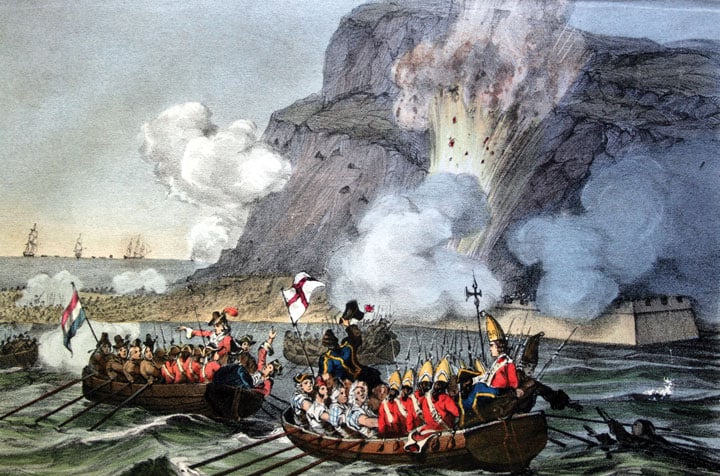
After replenishing their water supply at Tetuan on the Barbary Coast, Rooke’s fleet of 63 ships crossed the strait toward their new target on 30 July. Aboard his flagship, HMS Royal Katherine, the English admiral arrived off the Bay of Gibraltar the following day. Admiral George Byng, commanding a squadron of 22 ships of the line, was sent ahead, positioning himself with his cannons well within range of the town and its defenses. A British vessel, carrying a party of marines under Captain Edward Whitaker, closed in on the Old Mole to capture a French privateer, accomplishing the task without any casualties. Meanwhile, Field Marshal Prince George landed on the isthmus to the north of the settlement with 1,800 men. After repelling a cavalry charge, the beachhead was successfully secured by the Allied forces, effectively cutting Gibraltar off from the mainland.
The Anglo-Dutch commanders then summoned the governor, Don Diego de Salinas, to surrender. He promptly refused, reaffirming his allegiance to King Philip V. However, Salinas must have known he stood no chance and prepared to die for his king and country, alongside the few hundred defenders under his command.
One day later, Byng’s ships mercilessly opened fire on the town. Another beachhead was established at the New Mole after its battery was silenced, though the explosion of a powder magazine caused several casualties among the landing party. Finally, in the south, a third Anglo-Dutch contingent disembarked at Europa Point.
After enduring a heavy battering of some 40,000 rounds of shot and shells, and upon receiving news of the various successful Anglo-Dutch landings, Salinas finally came to terms with the futility of further defense. On 4 August 1704, Gibraltar surrendered to Admiral Rooke. The governor and his soldiers were allowed to leave the “Rock” safely, along with its Spanish Catholic inhabitants, who fled out of fear of potential excesses by their Protestant opponents. Most of these Spaniards resettled further north, within sight of their old homes. The Frenchmen present at Gibraltar, however, were taken as prisoners of war. The Allies’ butcher’s bill was relatively light, with about 300 killed or wounded.
The capture of Gibraltar significantly enhanced the Allies’ strategic position in the Iberian Peninsula and the Mediterranean. Before long, the English began regarding Gibraltar as a personal gain and treated the “Rock” as such. Over time, Gibraltar would grow into a central possession of the British Empire, earning the moniker “Key to the Mediterranean.”
In Madrid, King Philip V was dismayed upon receiving news of the defeat, making it clear that the “Rock” had to be retaken at the earliest opportunity. The Comte de Toulouse, now commanding the combined Brest and Toulon fleets after successfully effecting their junction, set sail toward the strait to challenge Rooke’s newfound dominance off Gibraltar. The stage was set for the next major naval clash of the war…
Olivier Goossens
Sources:
· Blumberg, A., “Grabbing and Holding ‘the Rock’”, Naval History, Vol. 26, 2012.
· Doedens, A. & Mulder, L., Spaanse Successieoorlog, 1701-1714, 2021.
· Falkner, J., The War of the Spanish Succession: 1701-1714, 2015.
· Francis, D., The First Peninsular War, 1702-1713, 1975.
· Le Fevre & Harding, Precursors of Nelson: British Admirals of the Eighteenth Century, 2000.
· Rodger, N.A.M., The Command of the Ocean: 1649-1815, 2004.
· Stanhope, P., History of the War of the Succession in Spain, 1836.
· Trevelyan, G., England under Queen Anne: Blenheim, 1930.
· Wilson, B., Empire of the Deep, 2013.
 Heart of Oak
Leave a comment