

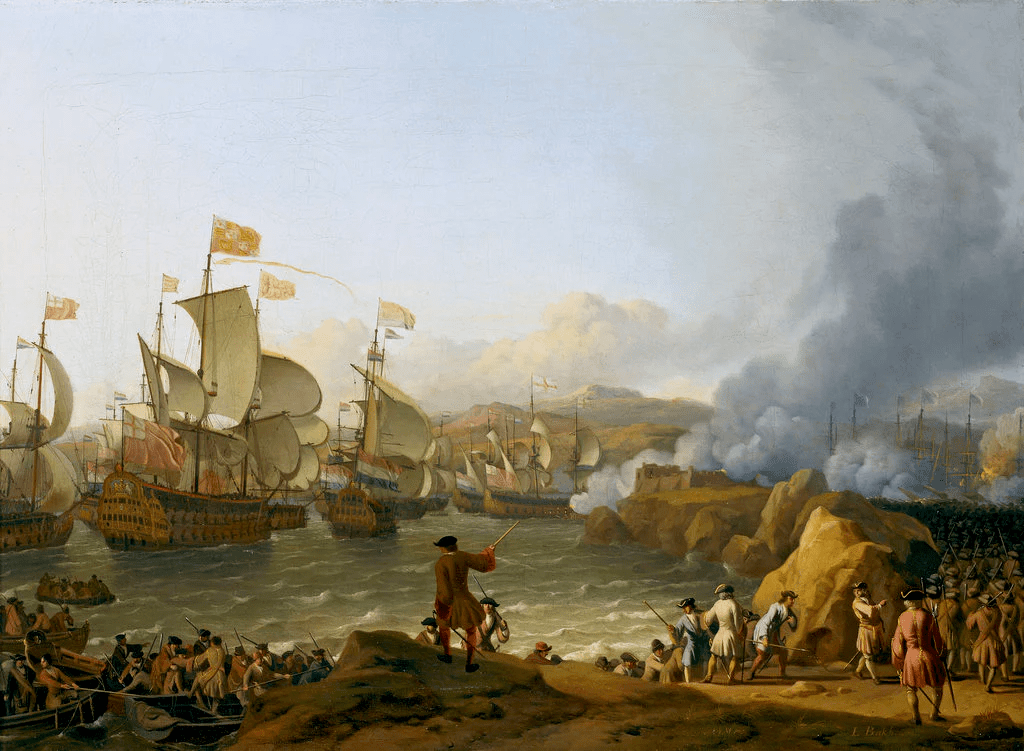
As Rooke’s vessels slipped past the Portuguese coastline in early October 1702, disappointment and low morale must have gripped the commanders and their men. The failed expedition to Cadiz, which lasted from August to September, had brought nothing but shame and squandered time. However, an opportunity for redemption arose when the English admiral caught wind of the arrival of the Spanish treasure fleet. The Spanish galleons, laden with silver, were escorted by a formidable force of 18 French and Spanish ships of the line, commanded by the Marquis de Châteaurenault. Spurred on by his eager Dutch colleague, Philips van Almonde, Rooke ordered his Anglo-Dutch force to intercept the enemy. At last, England had a chance to open its account of naval victories during the War of the Spanish Succession with a resounding triumph. This is the story of the Battle of Vigo Bay.
The three Spanish galleons and 13 trading vessels, commanded by Manuel de Velasco, had departed Veracruz, New Spain, on 11 June 1702. Their safe arrival in Europe became the responsibility of the Marquis de Châteaurenault and his 15 ships of the line, further supported by a small Spanish squadron of three ships of the line. The French assumption of escort duties for the Spanish American trade aligned perfectly with Louis XIV’s ambition to dominate commerce with New Spain. The Sun King leveraged his political influence over Spain, pressuring the Madrid government into signing trade agreements that favored France. One notable example was the Asiento de Negros — the monopoly on supplying slaves to Spanish colonies — which was handed over to France.
The arrival of these French warships in the Caribbean must have been met with suspicion by the Spanish crews, who deeply resented France’s interference in their trade. Previous illicit dealings with English and Dutch merchants, though forbidden, had been highly profitable for New Spain. Now, France had arrived in force in the West Indies, installing its own officials to administer the Spanish colonies as if they were French, all while closely monitoring illegal commercial activities. Furthermore, the French exploited their right to escort American trade, diverting Spanish ships into French ports rather than Spanish ones.
Châteaurenault was, however, forced to alter his course toward a Spanish port. Upon arriving in the Azores, he learned of the war that had broken out with England. This raised the likelihood of encountering an English squadron off Ushant, making Brest and the entire French west coast unsafe. The captains of the Spanish ships, meanwhile, were eager to propose an alternative: the fleet should seek refuge in the ria of Vigo, Galicia, nestled in the northwestern corner of the Iberian Peninsula. This small, narrow, and well-defended inlet would offer protection against both English naval forces and the autumnal gales that plagued the Atlantic at that time of year. Safeguarding the Silver Fleet was paramount, as it was rumored to be the wealthiest fleet ever to sail from the Americas. Beyond silver, the holds of the merchant ships and galleons brimmed with amethysts, emeralds, pearls, mahogany, redwood, cotton, tobacco, balsam, and more. Châteaurenault was relieved to reach Vigo safely by October. However, the Spaniards’ efforts to unload the precious cargo were frustratingly slow, hampered by the usual administrative inefficiencies that plagued Spain at the time.
Meanwhile, just as Admiral Rooke was about to sail into the Bay of Biscay, he was intercepted on 17 October by Captain Thomas Hardy of HMS Pembroke, who brought news of the Franco-Spanish fleet in Vigo Bay. Hardy had stayed behind in Lagos, Portugal, to gather supplies. There, his chaplain, a Jersey man named Beauvoir, learned of the Treasure Fleet’s presence from a boastful French consul who couldn’t keep his mouth shut. Encouraged by Admiral van Almonde, Rooke pressed on toward Vigo Bay with determination, noting in his diary:
“Under consideration of the intelligence brought to Captain Hardy of the Pembroke … It is resolved that we make best our way to the port of Vigo, and insult them immediately with our whole line, if not by such detachments as shall render the attempt most effectual.”
On 21 October, Rooke arrived off the city of Vigo. The enemy lay anchored in the lagoon-shaped harbor of Redondela, beyond the Rande Strait at the outermost end of the ria, set in a beautiful natural landscape dominated by the Galician heights. Rooke’s fleet was separated from its adversary by a boom, guarded by Fort Rande to the south and a strong battery of around 15 to 16 cannons to the north, bringing the total number of guns defending the Rande Strait to about 30. The local defenses were further bolstered by a significant number of levies, recruited by the local governor, the Prince of Barbançon.
A council of war was convened aboard HMS Royal Sovereign to determine the course of action. It was agreed that the English and Dutch ships would focus on destroying the boom and Franco-Spanish fleet, while Allied troops would be landed to neutralize the shore defenses.
On the morning of 23 October, Vice Admiral Thomas Hopsonn aboard HMS Torbay initiated the operation, heading toward the Rande Strait to breach the boom. The English Vice Admiral simply crashed his ship into the boom, successfully clearing the way for the rest of the fleet. In Hopsonn’s wake followed more warships, commanded by Dutch Admiral Philips van der Goes. Rooke, meanwhile, remained in his cabin during the action due to a flare-up of his gout. Meanwhile, Châteaurenault had prepared a formidable welcoming committee for the Allies, with two of his most powerful ships of the line positioned at either end of the boom, and five more battleships stationed in the middle, raking the Anglo-Dutch vessels as they approached.
Meanwhile, 4,000 Allied soldiers were disembarked at Teis. Half of them attacked Castro Castle to the south, while the Duke of Ormonde led the rest against Fort Rande. Ormonde’s ground attack was spearheaded by Lord Shannon’s grenadiers. The Allied ground troops made significant progress, silencing the seaward battery in time to allow the warships to concentrate on the boom and Châteaurenault. The last remnants of the Franco-Spanish defense, holed up in the tower of the fortress, were eventually subdued by Lord Shannon’s grenadiers. Meanwhile, the 90-gun HMS Association targeted the northern battery, and, here too, the enemy cannons soon fell silent.
Thus, the Anglo-Dutch vanguard successfully cleared the path for Admiral Rooke’s remaining warships, which began pouring into the inlet incessantly. With no option of escape, Châteaurenault ordered all his ships to be scuttled. The Allied ground troops and sailors worked around the clock to secure as many prizes as possible. By the end of the day, the entire Franco-Spanish fleet had either been destroyed or captured.
The loss of 15 ships of the line severely limited French naval capabilities for the rest of the war. Although the Sun King’s fleet remained formidable, it was now clearly outnumbered. The financial gain from the triumph, however, was not as significant as the Allies had hoped, as much of the silver aboard the Spanish vessels had already been unloaded before the encounter. Nevertheless, the Battle of Vigo Bay was an important symbolic victory, boosting morale and compensating for the earlier failure to capture Cádiz. Rooke’s actions also had significant strategic consequences, encouraging Portuguese King Pedro II to switch sides and join the Grand Alliance, thereby granting English and Dutch warships access to Portuguese harbors. Lisbon would become a crucial base for further naval operations against Spanish-American trade and bring the Allies closer to achieving their aim of carrying the war into the Mediterranean.
Olivier Goossens
Sources:
- Falkner, J., The War of the Spanish Succession: 1701-1714, 2015.
- Kamen, H., “The Destruction of the Spanish Silver Fleet at Vigo in 1702”, Historical Research, Vol. 39, 1966, pp. 165-173.
- Le Fevre & Harding, Precursors of Nelson: British Admirals of the Eighteenth Century, 2000.
- Nolan, C., Wars of the Age of Louis XIV, 1650-1715: An Encyclopedia of Global Warfare, 2008.
- Parry, J.H., Trade & Dominion: The European Oversea Empires in the Eighteenth Century, 1971.
- Rodger, N.A.M., The Command of the Ocean: 1649-1815, 2004.
- Smythe, C., “Battle of Vigo Bay: The Silver Fleet of 1702”, Sea Classics, Vol. 50, 2017, pp. 60-66.
- Symcox, G., War, Diplomacy, and Imperialism: 1618–1763, 1973.
- Trevelyan, G., England under Queen Anne: Blenheim, 1930.
- Wolf, J., The Emergence of the Great Powers: 1685–1715, 1951.
 Heart of Oak
Leave a comment