

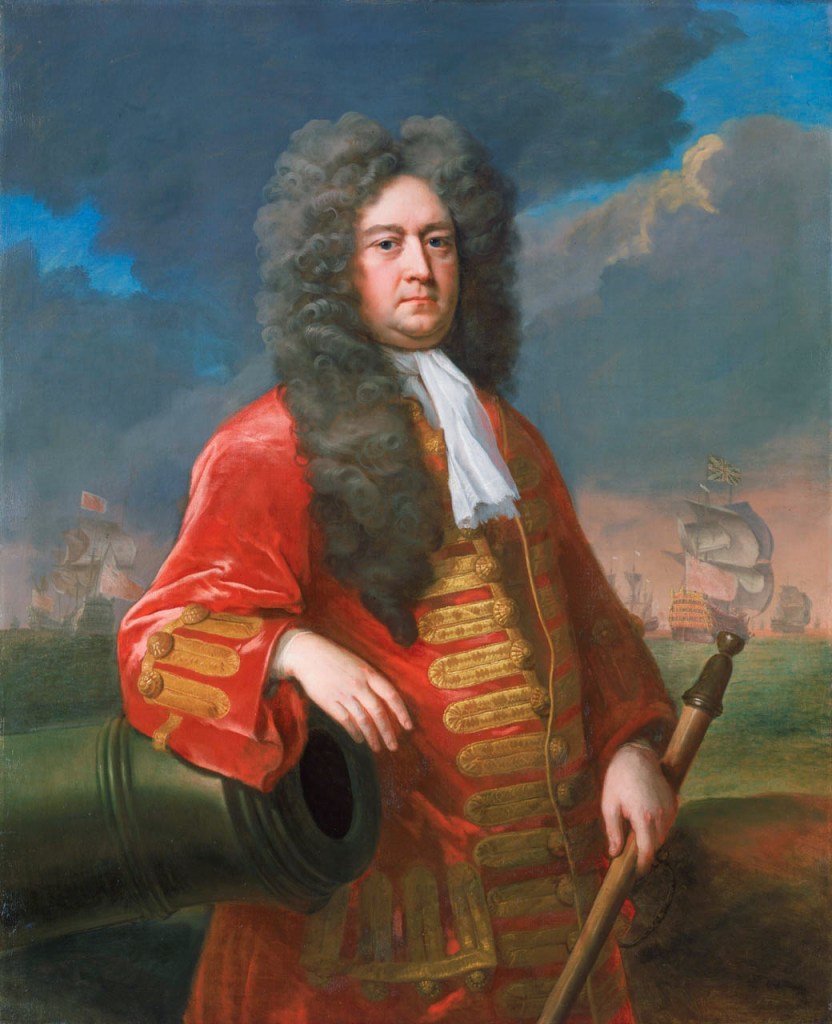
Born in St. Lawrence, Canterbury, Kent, in 1650, George was the second son of Colonel Sir William Rooke and Jane Rooke. He entered the Royal Navy as a volunteer in 1672 and quickly witnessed firsthand the chaos and bloodshed of the massive battles of the Anglo-Dutch Wars. His social background secured him a swift promotion to lieutenant aboard HMS London, the flagship of Sir Edward Spragge during the Battle of Solebay (1672). He later served under the future King James II aboard HMS Royal Prince. As the conflict progressed, he received his first command in November 1673 as captain of the sixth-rate HMS Holmes, primarily escorting convoys in this role. Commands of larger vessels followed in due course.
Although a conservative Tory at heart, George did not let his political views hinder his career. When his former superior, King James II, was ousted during the Glorious Revolution (1688–1689), he adapted to the changing tides and supported the revolutionary movement. He served under the Earl of Torrington during the Battle of Bantry Bay, when the French attempted to supply King James II’s forces in Ireland. He was afterwards dispatched with a small squadron to relieve Londonderry from the Jacobites.
During the Nine Years’ War, closely tied to the Glorious Revolution, George earned his next major promotion to Rear-Admiral of the Red in May 1690, raising his flag aboard the 90-gun HMS Duchess. He once again served under the Earl of Torrington during the controversial Battle of Beachy Head (1690) and later testified in defense of his commander when Torrington was court-martialed for his cautious approach.
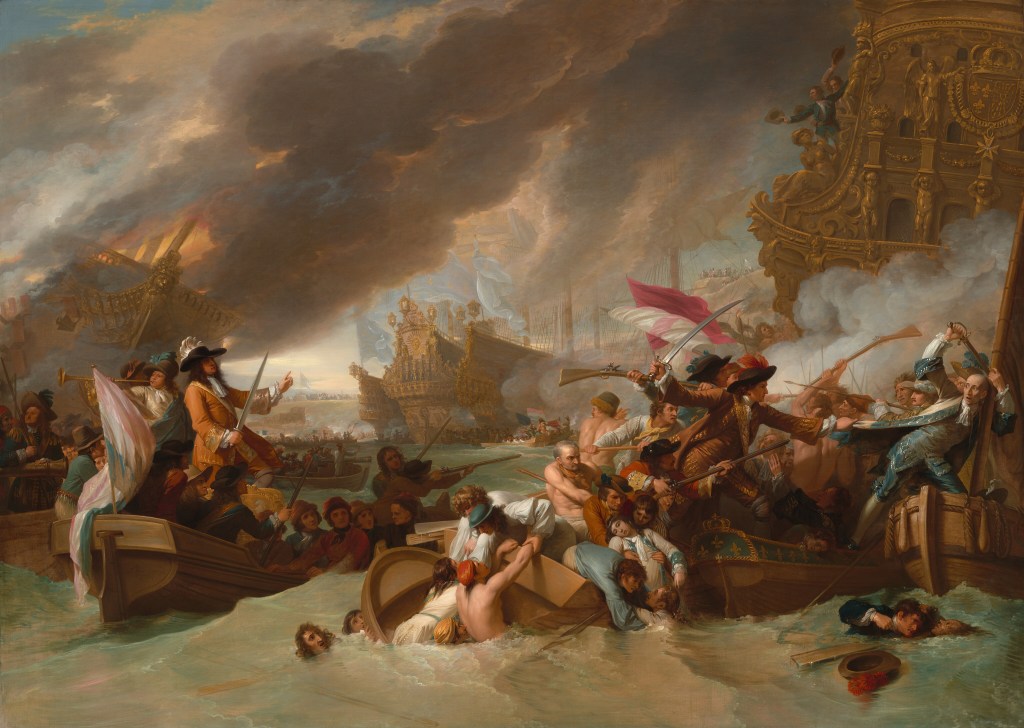
Rooke’s first moment of glory came during the Battles of Barfleur and La Hogue (May–June 1692). At the Battle of Barfleur, his squadron initially drifted helplessly to leeward of the enemy until a shift in the wind allowed him to fully engage the French, his actions contributing greatly to the Anglo-Dutch fleet’s success that day. When the French sought refuge in the Bay of La Hogue, it was Rooke who led the smaller warships in a daring assault, resulting in the annihilation of the French fleet. The British public, smitten by Rooke’s heroism, welcomed the Kentish admiral home as a national hero. Even King William III honored him, sharing a meal with Rooke before knighting him.
Rooke didn’t have long to relish his triumph, as a devastating defeat befell his squadron a year later near Lagos, Portugal. At the time, Rooke was escorting a massive convoy of approximately 400 merchant ships from Smyrna in the Ottoman Empire when he was caught completely by surprise by the superior force of French Admiral de Tourville — the English had not expected French operations in that region. Rooke’s warships were scattered, and around 100 merchant ships were captured as prizes. However, he faced no reproach; both the Admiralty and the public held his superiors responsible for failing to locate the enemy in advance. Rooke’s honor remained intact, allowing him to continue his naval career.
Shortly thereafter, Rooke’s career skyrocketed. He became a member of the Board of Admiralty in 1695, was promoted to commander-in-chief of the Mediterranean Fleet, and later assumed command of the Channel Fleet. However, another setback marred his record during his time leading the Channel Fleet. He failed to prevent the junction of the Toulon and Brest fleets, a misstep that drew considerable criticism.
When peace was finally concluded with France in 1697, Rooke found time to pursue politics, aligning himself with the Tories. He was elected Member of Parliament for Portsmouth in the autumn of 1698 while also securing a promotion on the Board of Admiralty. However, his peacetime political career was cut short when he hoisted his flag aboard the second-rate HMS Shrewsbury, ordered to assist the Swedes against the Danes during the opening stages of the Great Northern War.
When war with Spain and France broke out in 1701, Rooke was entrusted with the command of the squadron escorting the Duke of Ormonde’s force to Cádiz. However, he was at a very low point in his life, having recently received the news of his wife’s passing while also suffering severely from gout. The siege of the Spanish port achieved little, but on his return to England, Rooke intercepted the Spanish Treasure Fleet, which was escorted by numerous French warships off the Ría de Vigo in Galicia, Spain. What followed was arguably Rooke’s finest moment and perhaps the most spectacular naval victory of the war. All 15 French ships of the line and three Spanish galleons were either burned or captured.
Rooke was later involved in other significant naval engagements during the War of the Spanish Succession. He played an important role in the capture of Gibraltar in August 1704 and shortly thereafter clashed with the French off Málaga. His gout eventually took its toll, and Rooke requested to be discharged from service in 1705. He passed away at his home, Lawrence House, in Canterbury on 24 January 1709. Rooke was married three times and was survived by one son, George, from his marriage to his second wife, Mary, the daughter of Colonel Francis Luttrell of Dunster Castle.
His legacy lived on as an admiral who helped shape Britain’s future as a superpower, playing a crucial role in securing Gibraltar. In recognition of his significance in the history of Gibraltar, Peter Caruana, Chief Minister of Gibraltar, unveiled a statue in his honor in November 2004 during the festivities celebrating 300 years of British rule over the exclave.
Olivier Goossens
 Heart of Oak
Leave a comment