

By the time the War of the Spanish Succession broke out, Spain was but a shadow of its former self. Administrative inefficiency, military exhaustion, a lack of industrial productivity, and an overreliance on imports from the colonies had turned the Iberian superpower into a strong contender with the Ottoman Empire for the title of “The Sick Man of Europe.” Nevertheless, Spain still proved to be a potent ally, with massive manpower and extensive territorial influence.
One way to win the war was to knock Spain out of the contest, leaving France isolated and surrounded. One strategy for doing so was to cut the Iberian Peninsula off from its precious American trade and silver. With the loss of Portugal as an ally, the Anglo-Dutch naval forces lacked a suitable port in the region from which they could disrupt Spanish colonial commerce. A plan was therefore agreed upon to seize the Spanish harbor of Cádiz, a major gateway for trade with the Americas. The Grand Alliance could concurrently launch an offensive against Madrid from this quarter in order to place Archduke Charles on the throne.
Another advantage of capturing this Spanish port was that it could provide the English and Dutch with a base of operations for a future naval offensive in the Mediterranean. Initiating naval operations in the Mediterranean was considered of the utmost importance by the Grand Alliance, as they believed that the mere presence of a powerful Anglo-Dutch naval squadron could significantly enhance their prospects of victory in this theater of war. They were convinced, in fact, that Philip V’s rule in northern Spain was not widely accepted, and that the loyalty of the people of Naples to the new Bourbon king was also shaky. The arrival of English and Dutch warships off the Mediterranean coasts could therefore drive the people of these Spanish dependencies into the arms of the Allied forces. Furthermore, the Grand Alliance hoped that this show of military power might encourage Italian princes, such as the Duke of Savoy, to change sides.
A massive Anglo-Dutch naval task force was assembled, led by Sir George Rooke, a seasoned commander who had seen action in numerous important naval engagements during the late 17th century. The fleet consisted of around 30 English warships and 20 Dutch ones, escorting approximately 110 transports carrying 14,000 men under the command of the Duke of Ormonde. Of these, 10,000 were English, including 2,400 marines, while the remaining 4,000 were Dutch soldiers. The expeditionary force set sail in late July to capture “La Tacita de Plata” (The Little Silver Cup), as Cádiz is sometimes called.
From the outset, however, Rooke was pessimistic about his chances of success. His superiors had not accounted for the French fleet at Brest, which loomed ominously behind him. Without first dealing with this threat, the success of the expedition hung by a thread. The warships of the French Atlantic Fleet could easily disrupt communications and isolate the Allied troops in Spain. Additionally, Rooke’s supplies were running low and were clearly insufficient for a prolonged campaign in the Iberian Peninsula. On a more personal level, he had just hit rock bottom, having recently lost his wife and suffering severely from gout.
Rooke’s fleet arrived off the Portuguese coast by 20 August, where they were joined by Prince George of Hesse-Darmstadt, who represented Emperor Leopold I. He informed Rooke and Ormonde that Cádiz was poorly defended—a claim quickly contradicted by local fishermen, who reported the presence of a strong garrison of Spanish regulars.
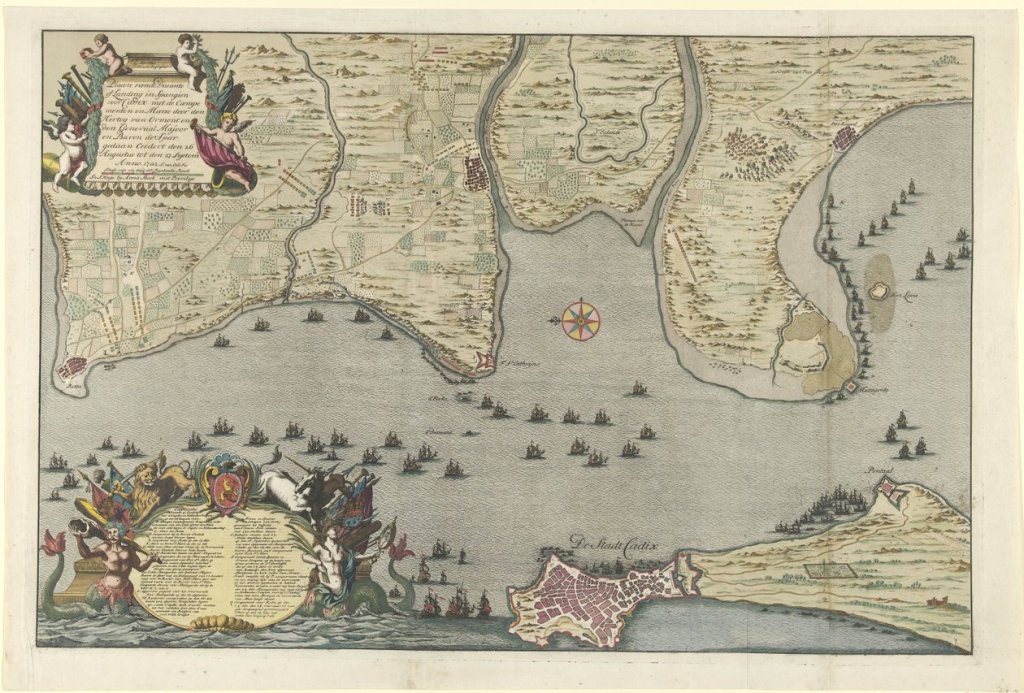
The fleet arrived off Cádiz on 23 August, and the commanders engaged in intense debates over their next course of action. After three days, they finally agreed that a direct assault on Cádiz was either too dangerous or would undermine the credibility of the Allied cause. It was therefore decided to land the troops somewhere between the Bay of Bulls and Fort Saint Catherine, north of Cádiz. Ormonde’s men were then to capture the towns of Rota and Port Saint Mary.
Meanwhile, the Marquis of Villadarias assumed command of the local defense. The garrison consisted of a mere 300 poorly equipped men. The undaunted Spanish commander, however, began rallying all able-bodied men to his cause. By the end of the mobilization, he had raised thousands of militiamen and commanded approximately five to six hundred cavalrymen. Furthermore, he blocked the entrance to Cádiz by sinking two hulks at the harbor’s mouth and erecting a strong boom.
On 26 August, Ormonde’s troops disembarked from the warships onto their landing craft to secure a beachhead. The landing did not go without difficulty, as some 25 landing craft sank, resulting in the loss of 20 men. The Anglo-Dutch force encountered stiff resistance on the beaches, coming under fire from a four-gun battery. Upon setting foot on Spanish soil, the Allied soldiers were immediately met with a fierce Spanish cavalry charge, leading to intense fighting. The Spanish were eventually repulsed, and the beachhead was secured.
The Allied forces then captured the town of Rota, which they found nearly deserted. They established their headquarters there and disembarked their supplies and horses. Meanwhile, Prince George began distributing pamphlets among the remaining locals, urging them to pledge loyalty to the House of Habsburg. However, this effort did not go as smoothly as he had hoped, as the threat of execution for treason still loomed large in the minds of the Spaniards.
After securing Rota, the next target was Port Saint Mary. To take the town, Ormonde’s forces first had to subdue Fort Saint Catherine. After overcoming this obstacle, the English and Dutch troops settled in the town—a decision the officers would soon regret. There, they discovered numerous unguarded warehouses filled with wine and brandy. Much to Prince George’s disgust, the soldiers indulged in excessive drinking, which quickly spiraled into widespread looting. Not only were private homes ransacked, but even churches and convents fell victim to the chaos. Though initially uninvolved, the navy soon joined in the debauchery.
This single act of misconduct shattered all Allied ambitions in the region. The local population, appalled by the soldiers’ behavior, lost any sympathy they might have had for the cause of Archduke Charles.
After the debacle in Port Saint Mary, the momentum of the Allied forces was completely broken. To make matters worse, tensions between the army and navy escalated when Admiral Rooke refused to further employ his crews for what he called “slavish labor” ashore. Due to disease and a shortage of men, the English admiral had been forced to commit his seamen to work on the army’s infrastructure and defenses, a situation he now resented.
Adding to the uncertainty, the fleet’s position posed a significant risk, as the ships were anchored off a perilous lee shore—meaning that heavy weather could easily drive Rooke’s vessels aground.
Hoping to turn the tide, the Allies made one final attempt, setting their sights on Fort Matagorda, a strategically important position overlooking the harbor of Cádiz. A force of 2,200 men began constructing a causeway toward the fort and setting up a battery to bombard the Spanish defenders. However, this maneuver brought Ormonde’s soldiers dangerously close to the French and Spanish warships anchored behind the boom. Before long, Spanish galleys stationed outside the harbor joined their allies in bombarding the Allied troops. Caught in a deadly crossfire, the attack on Fort Matagorda was abandoned.
Meanwhile, Villadarias repeatedly attacked small parties of English and Dutch soldiers. He even reconquered the town of Rota. The situation became completely untenable, and after one month, the Allied commanders agreed to abandon the expedition. The evacuation was completed by 30 September. Once again, Cádiz had become the site of a humiliating English defeat.
Prince George and the Duke of Ormonde wanted to try their luck again with an amphibious operation on the Iberian Peninsula, but Admiral Rooke, wary of the approaching Atlantic autumn gales, ordered the fleet to sail back to England. Fate had decreed, however, that the Anglo-Dutch task force would not return home empty-handed. As Rooke’s sails slowly swept past the shores of Portugal, a grand victory—one the English and Dutch desperately needed—lay ahead.
Olivier Goossens
Sources:
-N.A.M. Rodger, The Command of the Ocean: 1649-1815, 2004.
-J.H. Parry, Trade & Dominion: The European Oversea Empires in the Eighteenth Century, 1971.
– P. Stanhope, History of the War of the Succession in Spain, 1836.
-D. Francis, The First Peninsular War, 1702-1713, 1975.
-G. Trevelyan, England under Queen Anne: Blenheim, 1930.
 Heart of Oak
Leave a comment