

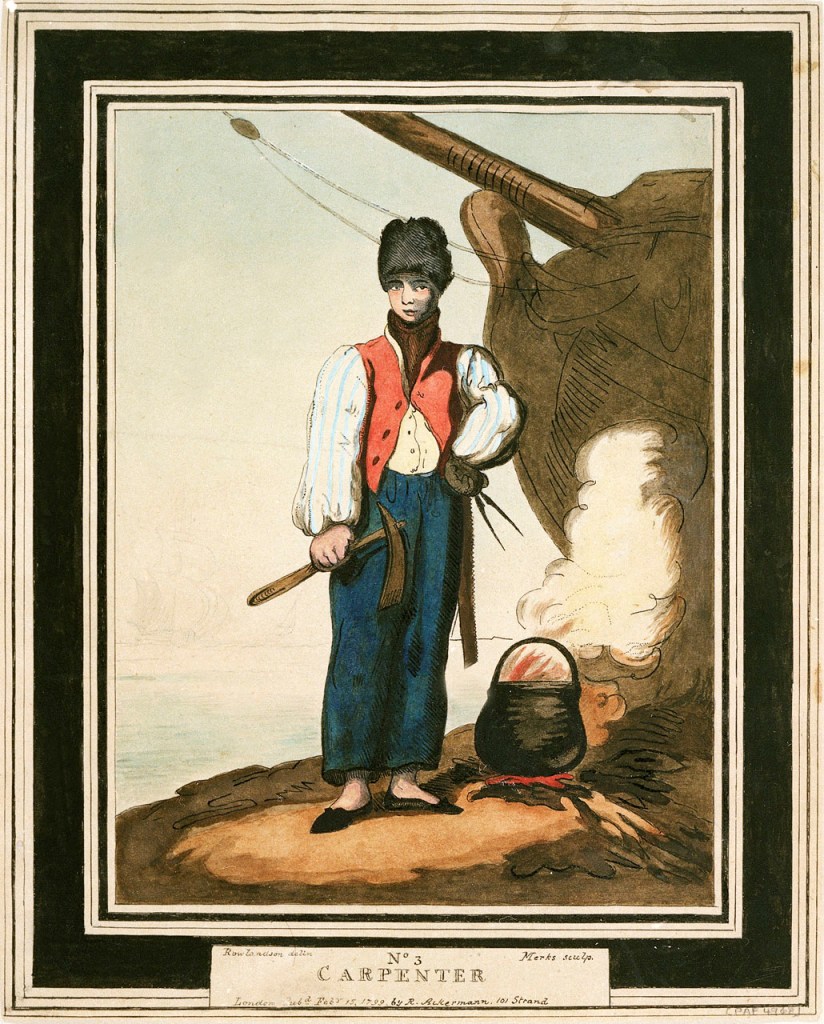
The ships of the line were true technological marvels of their time. These wooden leviathans, which roamed the seas in protection of the British Empire and trade, were exceedingly complex. Many things could go wrong—not only in battle but also during storms. To keep the vessel shipshape and Bristol fashion, a special officer was appointed by warrant: the carpenter. His job was of the utmost importance, as clearly reflected by the high standards imposed on those eligible for the position. His title, “the wooden artist,” sometimes bestowed upon him, demonstrates the reverence the ship’s crew had for him. He was not a mere handyman; he was an artist. This is the story of the carpenter.
No one could aspire to become a carpenter unless he had first served as an apprentice to a shipwright ashore and then worked as a shipwright or carpenter himself before entering or being impressed into the navy. Many British carpenters had a background in one of the navy’s royal dockyards or had served as carpenters’ mates aboard merchantmen. The service was only interested in those who knew the ins and outs of a sailing vessel. In most cases, the apprenticeship of a future navy carpenter lasted seven years, followed by another seven years working as a carpenter or shipwright.
Upon entering the navy, the “wooden artist” could not instantly become the carpenter of the vessel, as he first had to serve as a carpenter’s mate. On larger warships, there were two assistants to the carpenter. These assistants were given the privilege of slinging their hammocks in favorable places on the lower gun deck, and their pay was about two and a half guineas a month.
The navy was crystal clear in its regulations: “No person shall be appointed carpenter of one of His Majesty’s ships, unless he shall have served an apprenticeship to a shipwright and has been six calendar months a carpenter’s mate of one or more of His Majesty’s ships and shall produce certificates of his good conduct.”
After serving six or more months as a carpenter’s mate, the aspiring carpenter first had to pass an examination at Shipwrights’ Hall before a quorum of master shipwrights. In short, unlike higher-ranking officers, the carpenter earned his appointment through merit and personal ability.
These high standards are more than understandable, as the survival of a vessel often depended on them. The carpenter had a whole array of responsibilities entrusted to him. Before settling in aboard a warship, he was expected to thoroughly inspect all the timbers of the vessel, looking for damage, structural weaknesses, and rotting wood.
When the ship had endured a spell of bad weather, he was expected to go aloft in the masts to check the rigging. In other cases, he would stroll through the decks for routine inspections. Before nightfall, he had to inspect his stores and confirm to the first lieutenant that everything was present to take care of the ship in case of battle. He also had to ensure the rigging was in perfect condition.
When the ship had endured a spell of bad weather, he was expected to go aloft in the masts to check the rigging. In other cases, he would stroll through the decks for routine inspections. Before nightfall, he had to inspect his stores and confirm to the first lieutenant that everything was present to take care of the ship in case of battle. He also had to report on the condition of the rigging every night.
Additionally, the carpenter had to check if the decks were waterproof. A top-down leaking vessel could quickly become hellish for the sailors and hazardous to the ship’s seakeeping capabilities. This was an enormous job, and he was assisted in this by a caulker, an officer directly subordinated to the carpenter.
Another duty was keeping the pumps in working order. This was essential, as during a battle, leaks frequently erupted from enemy fire. The water that came into the ship obviously had to be pumped out as soon as possible. In between battles, he was to sound the water level of the ship’s well on a daily basis, making sure it never exceeded 15 inches. He had to pump it overboard regularly to prevent the water from becoming putrid, which was hazardous to the crew’s health. This was far from an amiable job, as the foul stench of the putrid water in the bilges became legendary.
When the ship was being refitted in dock or careened, he had to ensure the hull was properly supported with timber shores. When new masts were fitted, it was the carpenter’s responsibility to check if each mast was properly stepped and wedged at all deck levels.
During battle, the carpenter and his crew were present on the lower decks with wads of oakum, nails, sheet lead, and wooden bungs. They remained vigilant for any battle damage below the waterline, springing into action as soon as a hole in the hull appeared.
To perform these tasks, the carpenter had a storeroom at his disposal, near the boatswain’s storeroom on the fore platform of the orlop deck. Here, nails, bolts, copper and lead sheathing, paint, glass, glue, tar, and pitch were kept. He also had all sorts of tools necessary for repairs and maintenance. Additionally, a vast amount of timber was stored, sometimes pre-cut for the immediate replacement of specific yards and topmasts.
He worked in a special workshop on the second or upper gun deck, which was well lit by the gun ports. When the weather was foul, he could continue working below in the fore cockpit. It was in the fore cockpit that the carpenter was quartered, if not in some lodge in the steerage. For assistance, he had a boy in waiting, whom he sometimes shared with the boatswain.
The carpenter’s pay was around £5 16s. a month aboard a first-rate ship of the line, which was £1 more than his fellow warrant officers: the boatswain, gunner, and purser. This resulted in an annual compensation of £69 18s. 0d. for his services. His wages, however, gradually decreased according to the size of the ship he worked on. Aboard fourth, fifth, and sixth raters, he effectively received the same pay as the other warrant officers.
In short, the carpenter was a highly revered officer aboard a wooden warship in Nelson’s time, valued for his personal abilities. His high reputation is reflected in the selectiveness with which the Admiralty filled this position. Only those who thoroughly knew the intricacies of a fighting sailing ship were eligible. This was certainly warranted, given his vital role in keeping the vessel afloat.
Olivier Goossens
 Heart of Oak
Leave a comment