

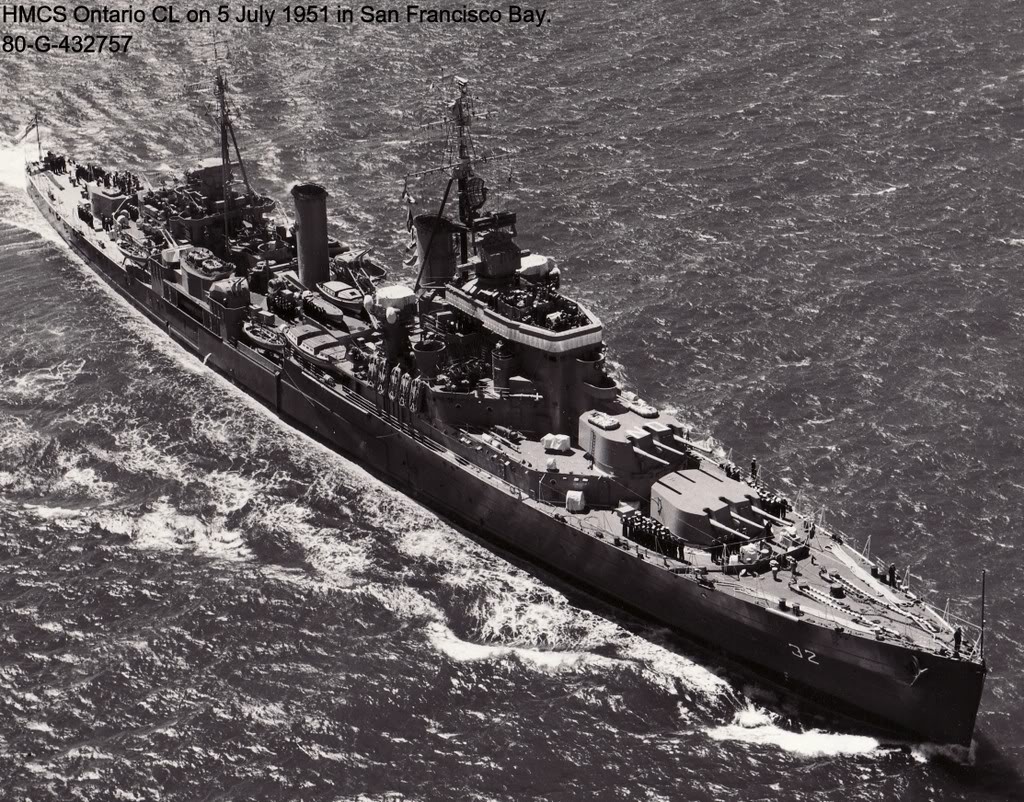
HMCS Ontario was a Minotaur-class light cruiser launched in 1943 by Harland & Wolff in Belfast. She was commissioned into the Royal Canadian Navy on 25 May 1945 as HMCS Ontario. Completed too late to participate in World War II, she nonetheless served Canada with distinction until 1958, demonstrating Canada’s commitment to the newly established world order.
Soon after completion, Ontario was deployed to the Far East, joining the 4th Cruiser Squadron. She then continued her eastward voyage toward her new homeport, Esquimalt, for an early refit in November 1945.
In October 1948, she sailed to Hawaii alongside the destroyers Cayuga, Athabaskan, Crescent and the frigate Antigonish, as part of the largest Canadian naval deployment since the war. The mission clearly demonstrated Canada’s commitment to maintaining a strong presence in the Indo-Pacific region.
A few months later, another significant Canadian naval exercise took place. In January 1949, Ontario participated in the training cruise of CTF 215, which included the aircraft carrier Magnificent, the destroyers Haida, Athabaskan, and the frigate Antigonish. This exercise, conducted in the Caribbean Sea, involved cooperation with both Britain and Canada’s growing ally, the United States.
In February 1951, the light cruiser trained with Australian naval units, once again demonstrating Canada’s commitment to Indo-Pacific security in cooperation with other major nations in the region.
Later, HMCS Ontario played a role in strengthening ties with the British monarchy when she transported Princess Elizabeth and Prince Philip from Sydney, Nova Scotia, through the Cabot Strait to Newfoundland during the Royal Visit. This would not be the last time the future queen saw the cruiser, as Ontario later represented Canada at the Coronation Review at Spithead on 15 June 1953.
It was not long before Ontario returned to familiar waters, reinforcing diplomatic relations with Australia and New Zealand during a visit in April 1954. She again trained off the coasts of these Commonwealth partners in early 1955.
After spending much of her career strengthening Canada’s ties with the United States and the Commonwealth Realms in the Indo-Pacific, she was deployed to Europe for four months, showcasing Canada’s commitment to the newly established NATO (1949) and supporting European allies facing the growing threat of Soviet Russia.
Additionally, Canada deployed its light cruiser to Latin America twice—once in 1952 and again in 1956—further extending its diplomatic and naval reach.
After 13 years with the Canadian Navy, HMCS Ontario was sold for scrap to Mitsui & Co. of Japan, along with the Fiji-class light cruiser HMCS Quebec. The era of large cruisers in the Royal Canadian Navy had come to an end. Though Ontario never fired her guns in combat, she remains noteworthy as an important diplomatic tool for Canada, helping to reaffirm old alliances with the Commonwealth Realms and strengthen new ones with NATO.
Olivier Goossens
 Heart of Oak
Leave a comment