

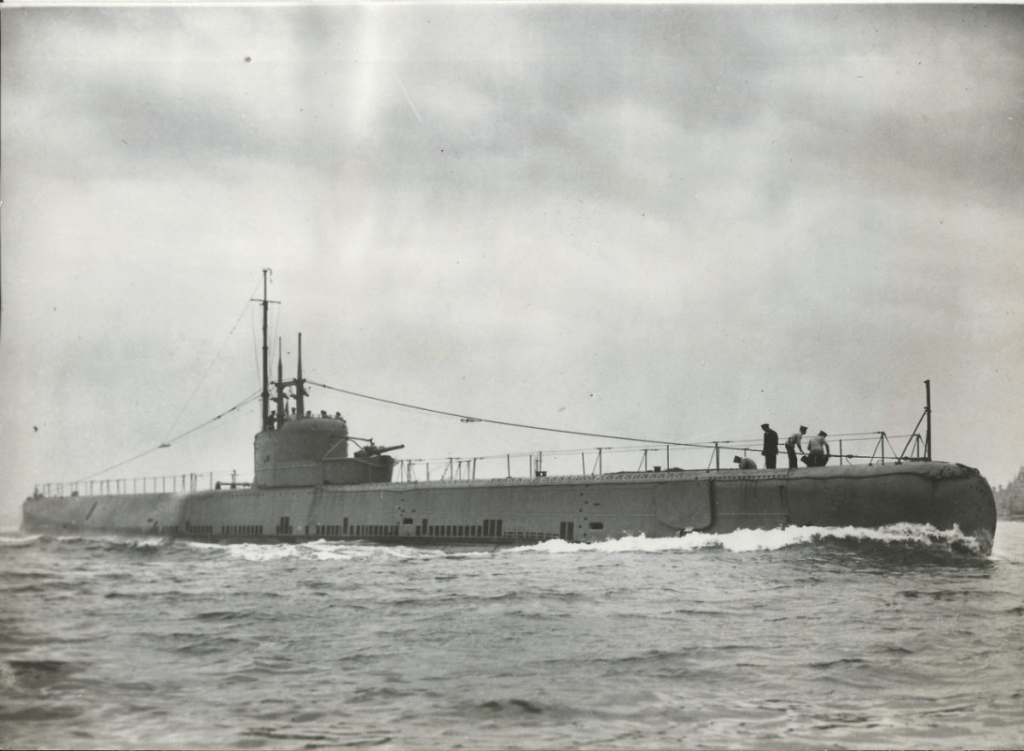
HMS Rorqual was a Grampus-class submarine that primarily served in the Mediterranean during the Second World War. Like her five sister ships, she was specialized in minelaying. However, the Grampus-class submarines also played a crucial role in supplying the besieged island of Malta. Tragically, only one of them, HMS Rorqual, survived the war. She is considered the most successful minelaying submarine of the conflict, having singlehandedly sunk 57,704 GRT of enemy shipping—35,951 of which were destroyed by her mines.
The Grampus-class had a submerged displacement of approximately 2,150 tons and, with a length of 89 meters, was quite large for its time. She was equipped with 50 standard Mk XVI mines housed in a superstructure casing external to the pressure hull, following the successful use of this configuration in the experimental HMS M3. Earlier minelaying submarines from the First World War carried their mines within the pressure hull. Unlike M3, the Grampus-class used a chain-and-rack system rather than the earlier inefficient jigger-type mine-launching equipment. The large mine capacity of the Grampus-class required the removal of the stern torpedo tubes, though HMS Rorqual retained six forward-facing 21-inch torpedo tubes.
When mines capable of being launched from 21-inch torpedo tubes were developed, dedicated minelaying vessels became redundant. However, the Royal Navy continued to use them as minelayers while also repurposing some as supply ships, utilizing their large mine decks to transport various goods.
To prevent oil leaks that could reveal the submarine’s position during depth charge attacks, fuel was carried in internal tanks. This also increased the main ballast water, which in turn improved stability and buoyancy. Additionally, balloon tanks were fitted in the forward superstructure to counterbalance the weight of the mines carried aft.
The vessel was powered by two Admiralty-designed, vertical four-stroke, blast-injection six-cylinder diesel engines, producing 3,300 bhp and allowing a surface speed of 16 knots. While submerged, her electric motors generated 1,630 bhp, enabling a speed of 8.9 knots. Her submerged endurance was 66 miles at 4 knots, powered by 336 battery cells.
HMS Rorqual was launched in 1936 at Vickers Armstrong, Barrow, and commissioned in 1937. When war broke out, she began laying minefields in the Mediterranean from 1940 onward. Many Italian warships and merchant vessels fell victim to Rorqual’s mines, including five torpedo boats. A significant kill was the Italian submarine Pier Capponi, which she sank on 31 March 1941. She also occasionally engaged entire convoys, such as in August 1940, though the attack failed, as she was heavily counterattacked by the Italian escort torpedo boat Generale Achille Papa.
A particularly fierce engagement took place in January 1941, when Rorqual attacked a floating battery and the tug Ursus. Because the battery was mounted on a lighter, Rorqual’s torpedoes proved ineffective. As a result, the Grampus-class submarine was forced to surface and engage the enemy with her 4-inch deck gun. Her crew managed to score hits on both the battery and Ursus, but the tug returned heavy fire, forcing Rorqual to shift focus. The British submarine’s gunners found their mark repeatedly, forcing Ursus’s crew to abandon ship.
However, the floating battery remained operational. Rorqual attempted to sink it with a torpedo, but a gyro failure caused the torpedo to veer off course. The submarine was forced to dive quickly to avoid being struck by her own weapon. She ultimately disengaged, and the floating battery was later towed to Dubrovnik.
In addition to her distinguished service as a minelayer and attack submarine, HMS Rorqual was also used, like her sister ships, as a supply vessel. In July 1941, her mine deck was loaded at Alexandria with stores for Malta. In total, she conducted five supply runs from Alexandria and Beirut throughout 1941 and 1942. Her cargo primarily consisted of aviation spirit (avgas) for the Hurricane fighters defending the besieged island. In October 1943, she delivered an entire battery of 40 mm Bofors guns and a jeep for towing to the beleaguered British forces on the island of Leros.
After years of service in the Mediterranean, Rorqual was eventually transferred to another theater of war. In 1945, she was attached to the British Pacific Fleet, where she laid minefields and attacked Japanese vessels with her deck gun. Following her brief deployment in the Far East, she returned home.
HMS Rorqual was the only Grampus-class submarine to survive the war. However, her service was short-lived after the conflict, and she was scrapped in March 1946.
Olivier Goossens
 Heart of Oak
Leave a comment