

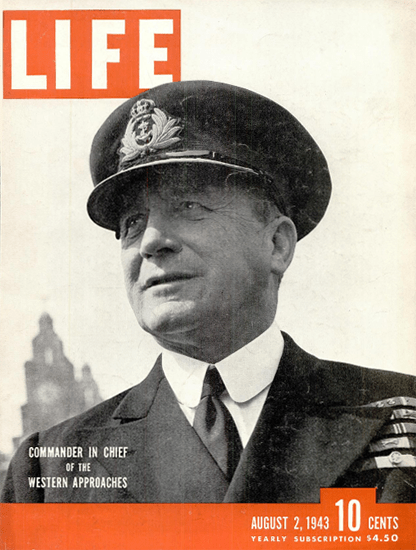
This man was as crucial to the Allied victory as Field Marshal Montgomery. Between 1942 and 1945, he developed aggressive tactics to combat Germany’s U-boat menace. A modest yet confident man, he always maintained a professional distance from his employees. Nevertheless, all who worked for him came to respect and trust his decisions. This is the life of Max Horton.
Born in 1883 in Rhosneigr, Anglesey, he was the second of four sons of a stockbroker and a Jewish mother. His family encountered financial troubles early in his life. With their remaining money, his parents bought a hotel in Rhosneigr, North Wales. It was there that the young Max developed a love for the sea. His biographer, Rear Admiral W.S. Chalmers, claims that he was already an adept sailor as a boy.
Horton joined the Royal Navy in 1898, training aboard HMS Britannia to become an officer. He earned a reputation for gallantry in December 1911 during the rescue of SS Delhi, a steamship that ran aground off Cape Spartel. His bravery earned him the Board of Trade Medal for Saving Life at Sea, the predecessor of today’s Sea Gallantry Medal.
When war broke out in 1914, Max Horton was a Lieutenant-Commander in the Submarine Service, commanding HMS E9. He quickly proved his worth as a combat leader in September 1914, sinking the light cruiser SMS Hela six miles southwest of Heligoland. After a tense pursuit by German forces, E9 safely returned to Harwich.
Another victory followed just three weeks later, on 6 October, when the daring submariner ventured to the mouth of the River Ems. There, he spotted the enemy destroyer S116. One of the two torpedoes he fired struck its target, breaking the torpedo boat in two.
Promoted to Commander in December 1914, Horton joined the Baltic submarine flotilla, where he sank several German merchant ships and damaged the armored cruiser SMS Prinz Adalbert.
These early actions earned Horton the Distinguished Service Order (DSO). In 1917, a bar was added to his DSO for his long and tireless patrols, with another bar awarded three years later.
During his time as a submarine commander, he initiated a tradition that would endure in the Submarine Service—hoisting the Jolly Roger after every successful patrol.
Horton’s days as an active submariner ended during the interwar period when he captained several major surface vessels, including HMS Resolution. He attained the rank of rear admiral in 1932, taking command of the 2nd Battle Squadron and later the 1st Cruiser Squadron. Just before the outbreak of World War II, he oversaw the Reserve Fleet.
When war with Germany erupted again, Horton briefly commanded the Northern Patrol, tasked with organizing the distant blockade of Germany. Shortly thereafter, he was appointed Rear Admiral Submarines, becoming the flag officer in charge of the submarine fleet. With his extensive experience in the Silent Service during the First World War, he proved to be the perfect fit for the role.
During the invasion of Norway, Horton skillfully positioned his units, leading to significant successes: British submarines destroyed 21 enemy transports and supply ships, sank two German cruisers, and damaged the battleship Gneisenau.
Horton declined an offer to command the Home Fleet, preferring to continue leading the British submarines. He championed technological advancements, overseeing the development of midget submarines and human torpedoes.
However, his most significant contribution to the war effort came in November 1942, when he was appointed Commander-in-Chief of Western Approaches Command. At the time, Britain faced a dire situation due to Germany’s devastating unrestricted submarine warfare. On average, four merchant ships were being sunk every day, and at one point, it was estimated that Britain would run out of food within three weeks.
Horton decided to shift the focus of operations from protecting convoys to actively hunting U-boats. He organized a system of support groups—squadrons of warships with greater freedom to pursue and destroy German submarines. Another crucial development in combating the threat was the deployment of improved long-range aircraft. Additionally, the number and quality of escort ships increased significantly.
However, this was a risky decision, as merchant ships were sometimes left to defend themselves. Indeed, Allied convoy losses initially rose. Horton, however, understood that the problem could never be solved if the Admiralty focused only on treating the symptoms rather than addressing the root cause.
Over time, U-boat losses became so severe that the German high command decided to withdraw from the North Atlantic. Horton’s aggressive tactics effectively kept Britain in the war. Naval historian Charles McCain also emphasized Horton’s meticulous attention to detail as a key factor in overcoming the U-boat threat.
The immense responsibility of the job took its toll, and by the end of the war, Horton was completely exhausted. He died in 1951, unable to fulfill his dream of retiring in the south of France.
Olivier Goossens
 Heart of Oak
Leave a comment