

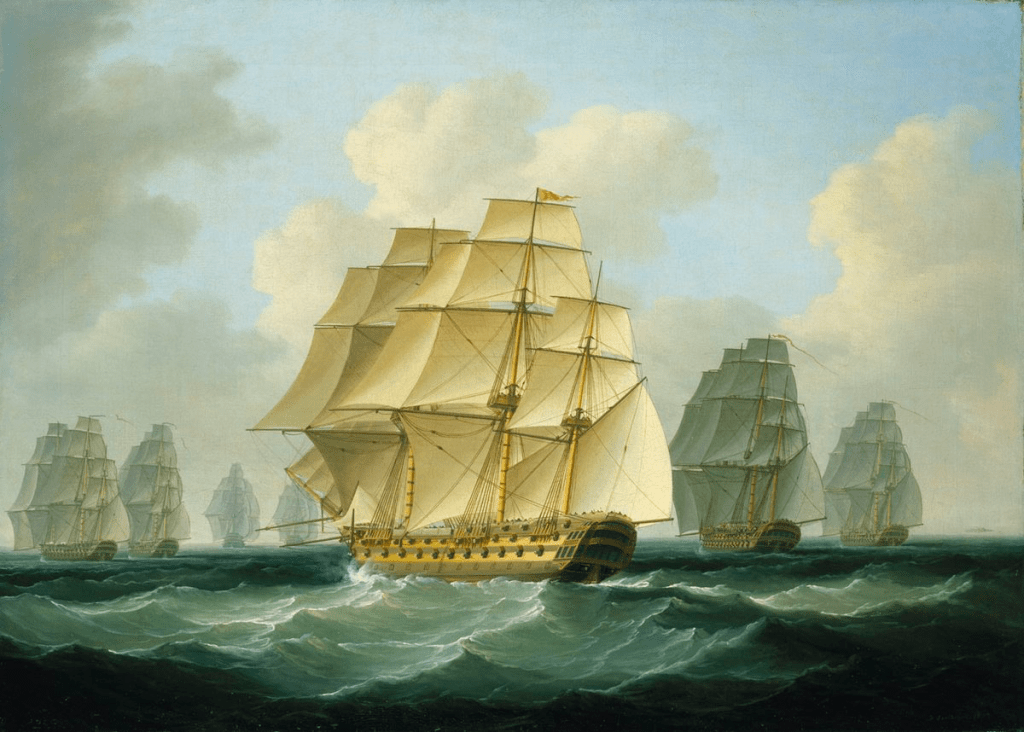
The Battle of Cape Ortegal, the final action of the Trafalgar campaign, took place on November 4, 1805. A Royal Navy squadron led by Captain Sir Richard Strachan defeated a remnant of the fleet that had been overcome at Trafalgar just weeks before.
Rear-Admiral Pierre Dumanoir le Pelley commanded the escaped French squadron, which had suffered minimal damage at Trafalgar. Initially headed for the Mediterranean, Dumanoir changed course upon learning that Rear-Admiral Thomas Louis’s force was patrolling the straits, and aimed instead for French Atlantic ports.
On his way north, Dumanoir’s squadron encountered the British frigate HMS Phoenix, under the command of Captain Thomas Baker, who feigned a retreat but was actually leading Dumanoir toward Captain Strachan’s sizable squadron.
Strachan’s ships, despite being scattered, immediately gave chase. The exchange of fire began at 5:45 AM between the frigate HMS Santa Margarita and the 74-gun Scipion. The British frigates continued to slow Dumanoir until Strachan’s ships of the line eventually caught up. Realizing that a general engagement was inevitable, the French admiral formed his line and engaged the Royal Navy ships.
Dumanoir ordered his line to tack in succession so that the leading ship, the Duguay-Trouin, could come to the aid of his centre, a manoeuvre that was executed after some delay. The French admiral then realized the British had formed a strong double line with the frigates on one side and the ships of the line on the other, firing upon the foe without respite. After passing Dumanoir’s fleet on an opposite tack, the British then successfully tacked to keep their ships engaged with the battered French, having added the latecomer HMS Namur (74) to their line.
By late afternoon, each of Dumanoir’s four ships had surrendered. They were taken to Britain, where they were commissioned into the Royal Navy. Strachan and his men were richly rewarded, their triumph seen as the closing act of Trafalgar. With this victory, only five ships from Villeneuve’s fleet at Trafalgar remained, bottled up in Cadiz. The former Duguay-Trouin from Dumanoir’s fleet would go on to serve Britain for another 144 years as HMS Implacable.
Though acquitted in later French courts, Dumanoir faced harsh criticism for his failures at Trafalgar and Cape Ortegal. Strachan, on the other hand, was celebrated, promoted, and honored, his victory remembered as a crowning achievement in the Trafalgar campaign.
Olivier Goossens
 Heart of Oak
Leave a comment