

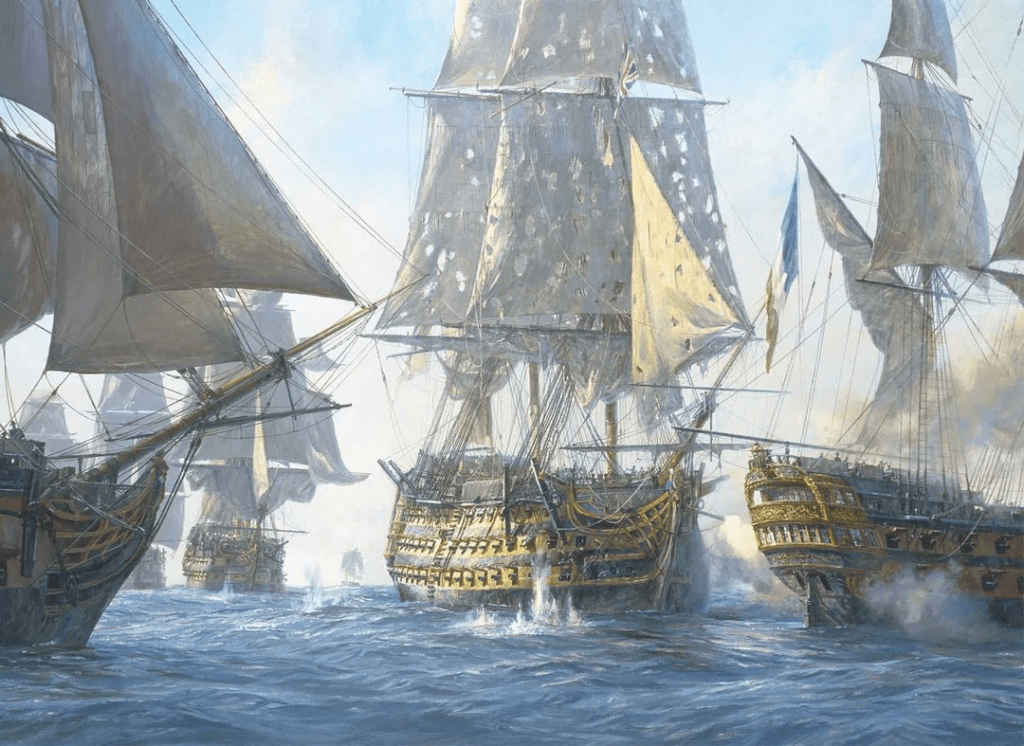
Nelson first raised his flag on the Victory in May 1803, preparing to hunt down the French forces. After discovering the French had left Brest, he transferred his flag to the faster frigate HMS Amphion in order to reach the Mediterranean as soon as possible. The Victory later rejoined Nelson off Toulon and the admiral hoisted his flag again in the legendary first-rate ship of the line.
HMS Victory pursued the combined Franco-Spanish fleet across the Mediterranean and Atlantic after their escape from Toulon. Upon reaching the West Indies, Nelson discovered that Villeneuve had returned to Europe. Nelson met up with Collingwood, who was blockading Cádiz. Villeneuve had already slipped into the harbour on 28 August. A tense wait began as the British fleet anticipated Villeneuve’s next move.
On 21 October 1805, Villeneuve sailed out the harbour with his 33 ships of the line and the two fleets met off Cape Trafalgar. The Victory led the Weather Column, sailing straight into the enemy line, while his second-in-command, Cuthbert Collingwood, led the Lee Column. The tactic was designed to break the Franco-Spanish line, divide it into smaller sections, and deal with them separately.
Victory struck hard, firing devastating broadsides into the stern of Villeneuve’s flagship Bucentaure. With cannonballs and grapeshot, HMS Victory disabled many of Bucentaure’s guns, decimated her crew and crippled the ship in minutes. The Victory, however, then came under heavy fire of the 74-gun Redoutable and the 130-gun Santísima Trinidad.
At 1:15 PM, tragedy struck: Nelson was fatally wounded by a French sniper while on the Victory’s deck, exclaiming shortly after to captain Hardy:
“Hardy, I do believe they have done it at last …. my backbone is shot through.”
He was taken down to the cockpit. He died around 4:30 PM, with the chaplain Alexander Scott recording his last words as:
“God and my country.”
Despite her heroics, HMS Victory suffered heavy damage, losing 57 men and seeing 102 wounded. Such a bloodbath was to be seen on Victory’s quarterdeck that Redoutable attempted to board her, but they were thwarted by the arrival of Eliab Harvey in the 98-gun HMS Temeraire.
After Trafalgar, HMS Victory brought Nelson’s body back to England for his funeral in a cask of brandy mixed with camphor and myrrh. King George III, on receiving the news, is alleged to have said, in tears:
“We have lost more than we have gained.”
Nevertheless, the victory secured undisputed British naval dominance for the entire 19th century.
Olivier Goossens
 Heart of Oak
Leave a comment