

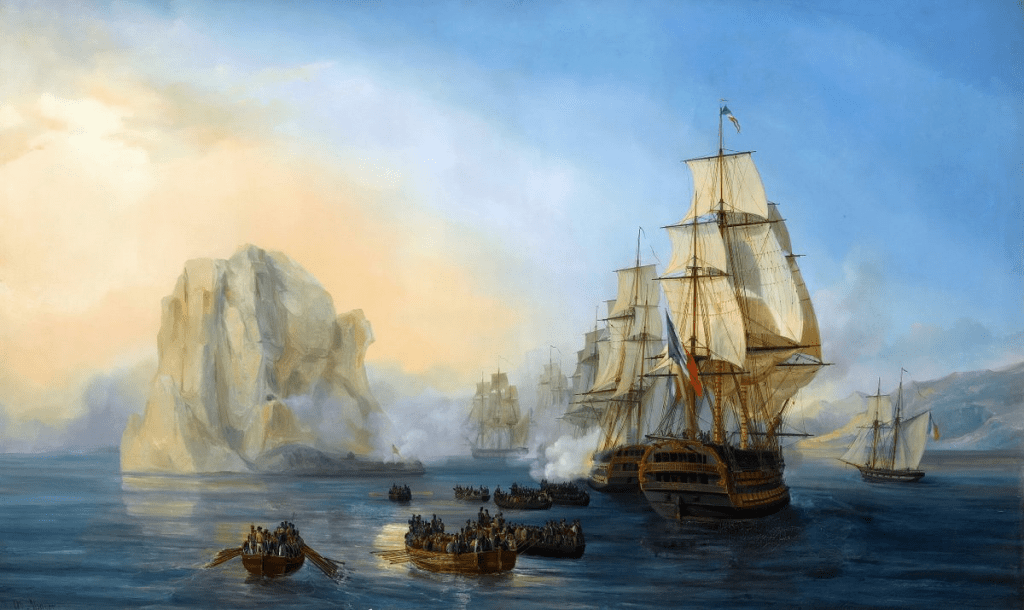
HM Sloop-of-War Diamond Rock was a thorn in Napoleon’s side, effectively placing the lucrative French-held Martinique under blockade for 18 months with minimal resources. However, Diamond Rock was no ordinary warship…
In 1804, with Britain at war with France, most of the Royal Navy was blockading French ports to protect against Napoleon’s invasion plans. In the Caribbean, Commodore Sir Samuel Hood led a small British force tasked with defending British interests in the region.
To maximize his limited resources, Hood occupied Diamond Rock, a small uninhabited island near Martinique. This rugged 200m high rock, while barren and populated only by seabirds and snakes, held a valuable strategic position along French shipping routes. It was situated along the southern approach to Fort-de-France, the capital of Martinique—one of France’s most valuable islands in the West Indies.
Lieutenant James Wilkes Maurice, the Centaur’s first lieutenant, led the British landing party. They discovered caves suitable for supplies and quarters, built rope ladders, and expanded caves to create essential spaces like a galley, forge, water cistern, and hammocks.
Thanks to German painter John Eckstein, we have sketches of this Herculean task of turning this rock into a livable fortress. The crew from the Centaur spent entire days hauling 24-pounder and long 18-pounder guns up the cliffs to establish various batteries, including one named “Hood’s Battery,” to defend against any French approach.
On March 1, 1804, Diamond Rock officially became HMS Diamond Rock, a sloop-of-war under Maurice’s command. A six-gun support sloop, HMS Fort Diamond, was also stationed there to inspect passing ships. From the summit, British forces could spot enemy vessels up to 40 miles away, maintaining watch for approaching French forces. HMS Diamond Rock was highly effective, maintaining a constant blockade of Fort-de-France with a garrison of only around 100 men.
Life on HMS Diamond Rock was isolated yet efficient and enjoyable according to our sources. Crews intercepted ships, drilled regularly, and even played cricket in the caves. Local canoes traded fresh fish, breaking the monotony of salted provisions. The island was treated like a ship, with watches and ship bells.
The island’s British presence, just off Martinique where Napoleon’s wife Empress Josephine was born, provoked Napoleon’s fury. He viewed it as a “symbol of British insolence.” When the French-Spanish fleet under Villeneuve reached Martinique in May 1805, he was ordered to take the Rock.
HMS Diamond Rock’s water supply was critical; a crack in their main tank after an earth tremor forced severe rationing just as Villeneuve’s fleet launched an attack. Despite sinking two French longboats, the British were overwhelmed. After three days, exhausted, dehydrated, and low on ammo, Maurice surrendered.
After the intense defense, Maurice was court-martialed but honorably acquitted for his bravery. HMS Diamond Rock’s fall echoed in the Napoleonic Wars, and many of the involved French ships would soon face Nelson at Trafalgar. Maurice went on to become a rear admiral.
Olivier Goossens
 Heart of Oak
Leave a comment