

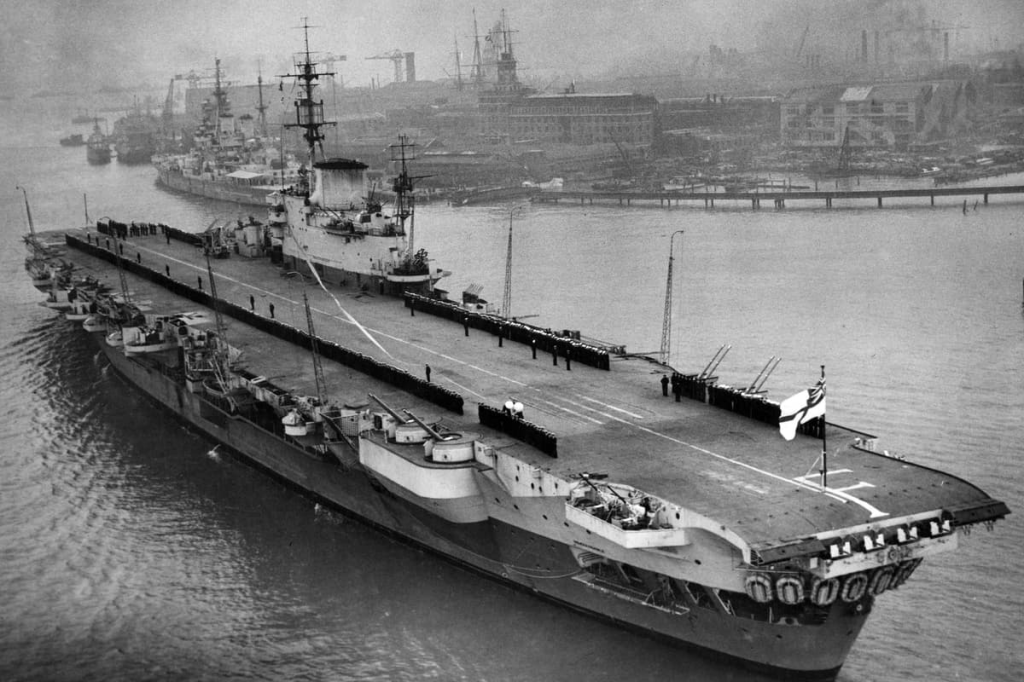
HMS Indefatigable was one of the Royal Navy’s two Implacable-class aircraft carriers, ordered by the Chamberlain government as a response to Germany and Italy’s rearmament. Her design was basically an improved version of the Illustrious-class.
With four Parsons geared steam turbines, each driving one shaft, using steam supplied by eight Admiralty 3-drum boilers, the 32,110 long tons ship could reach a maximum speed of 32.5 knots! Approximately 2,300 officers and ratings served aboard her.
She had one hydraulic aircraft catapult on the forward part of her armored deck and the carrier could operate around 48 aircraft (with the use of a permanent deck park the Implacable-class could accommodate up to 81 aircraft!). For her defense, the Indefatigable was fitted with 16 QF 4.5-inch guns, 5 octuple mounts of QF 2-pounder AA guns and 55 Oerlikon 20 mm guns, of which some were replaced by 40 mm Bofors AA guns in the Pacific Theatre for improved efficiency against kamikaze attacks.
Her radar system consisted of the Type 277 surface-search/height-finding radar on top of the bridge and a Type 293 target indicator radar on the foremast, while Type 282 and Type 285 gunnery radars were mounted on the fire-control directors.
She was built at the John Brown & Co. shipyard in Clydebank and launched on December 8, 1942, entering service in December 1943. She was initially deployed with the Home Fleet, operating Fairey Fireflies and Barracudas early in her career.
She had her first mission on 1 July 1944, escorting the RMS Queen Elizabeth carrying US troops. Shortly after, the carrier’s first combat mission aimed at attacking the German battleship Tirpitz in Norway. Smoke screens hindered visibility, preventing her aircraft from landing hits on the target.
In August 1944, the Indefatigable and escort carriers took down 6 Messerschmitt Bf 110s and a minesweeper in Norway. She was then assigned to the British Pacific Fleet, becoming the flagship of the 1st Aircraft Carrier Squadron with Rear-Admiral Sir Philip Vian hoisting his flag aboard her. In January her squadrons attacked Japanese oil refineries at Sumatra before moving further East.
The carrier played a major role in the BPF’s support for the Okinawa invasion in March 1945. On April 1, the Indefatigable became the first British carrier to be hit by a kamikaze attack. Miraculously, damage was minimal, and flight ops resumed in 30 minutes. This episode demonstrated the wisdom of the Admiralty’s decision to prioritize armor over aircraft-carrying capacity, unlike the U.S. Navy. Royal Navy aircraft could be redeployed much faster than those of the U.S. Navy after sustaining damage, helping to offset Britain’s smaller fleet size.

In August 1945, the Indefatigable led airstrikes near Japan’s coast, hitting warships, merchantmen, and key targets in Honshu & Hokkaido. On August 15, her last air combat saw her downing a dozen Japanese planes, just as the ceasefire came into effect. WWII came to an end.
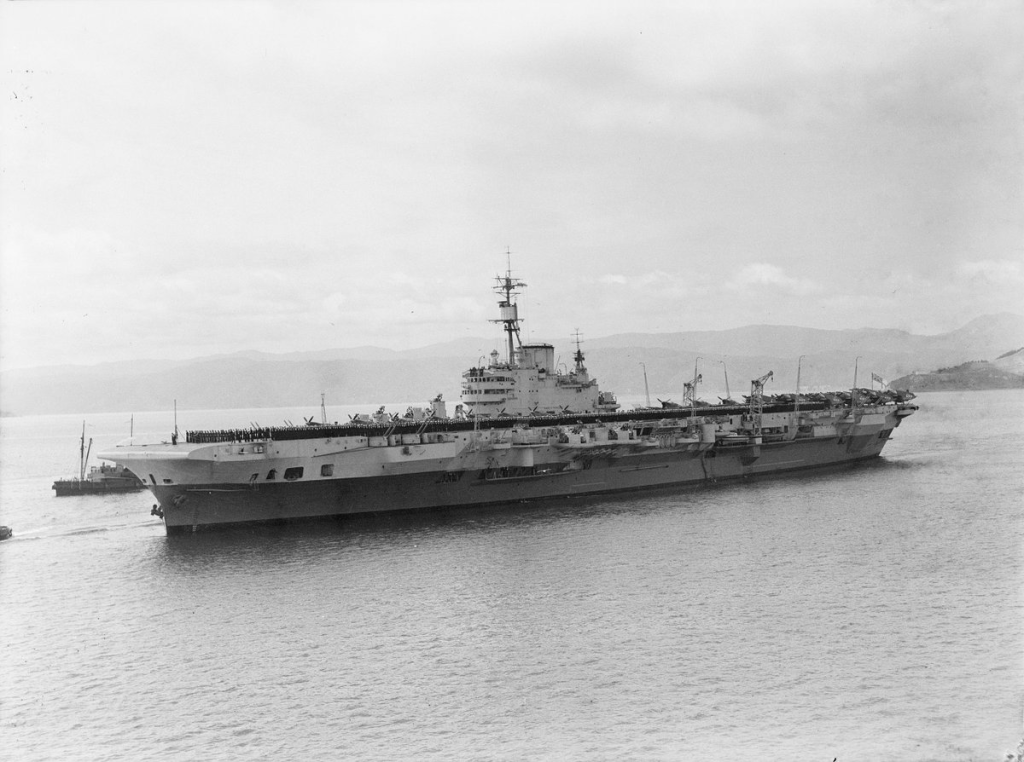
Post-war, the carrier served as a troop transport and training ship until her decommissioning in 1956. This iconic vessel supported historic missions across the Atlantic, Indian Ocean, and Pacific, embodying British resilience at sea.
Olivier Goossens
 Heart of Oak
Leave a comment