

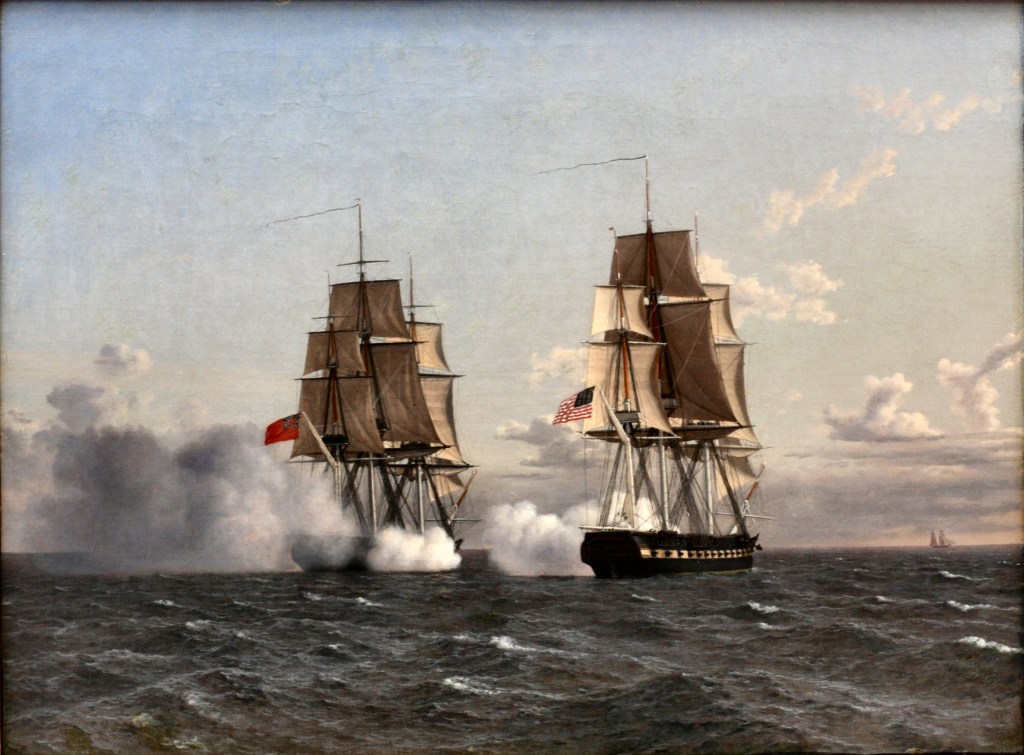
Britain relentlessly enforced its self-proclaimed right to search all neutral shipping for contraband bound for Napoleon’s empire, as established in the Orders in Council. The young United States, whose merchant fleet was the second largest in the world, suffered particularly under these measures. The situation bore a striking resemblance to colonial times, as the Orders in Council also required all American shipping bound for Europe to pass through British ports and pay duties. Furthermore, the impressment of American merchants into the Royal Navy further exacerbated Anglo-American tensions.
Britain, however, went to great lengths to placate America, as its export trade with the Thirteen Colonies was highly lucrative. Furthermore, the Royal Navy, fully occupied with combating the French Empire, was understandably reluctant to open another front. The Orders in Council were even revoked by the British government in 1812, but this proved too little, too late. As British ships continued to press American seamen into Royal Navy service, and following the infamous collision between USS President and the sloop Little Belt, the United States declared war on Britain in June 1812.
On paper, winning the war seemed an easy task for the Royal Navy, but the West Indies fleet was poorly manned and had grown sluggish in gunnery after years of peace in the region. Admiral Warren, tasked with combating the United States, had 11 ships of the line, 34 frigates, and 40 sloops of war at his disposal.
The Americans, led by Commodore Rodgers, on the other hand, had only 10 frigates and 8 sloops. Some of their frigates, however, were sturdily built and heavily armed for their class. Furthermore, their crews were well trained in operating as a raiding force, intent on disrupting British trade in the region.
The British initially lacked the means to execute their signature move: a close blockade of American ports, an effective strategy for crippling the American economy. Furthermore, the prevailing winds off the American East Coast frequently drove blockading squadrons away from the shore. The lack of a nearby operating base also posed a serious challenge to disrupting American trade. However, there were some advantages for Britain as well. In 1810, they had captured the last French-held island in the West Indies, meaning the United States could not rely on French naval support as it had in the past.
The war began disastrously for Britain, as the Royal Navy suffered several defeats in the opening year of the conflict. USS Constitution (44) made quite a name for herself during this period. After escaping a squadron of four ships, she encountered HMS Guerriere (38) on August 19. The British frigate had an inferior broadside of 570 lb compared to Constitution’s 736 lb. The Guerriere was dismasted by the accurate fire of the American warship, which then closed in, with sharpshooters firing from above. The duel lasted two hours before Guerriere finally surrendered. However, she was so badly damaged that she had to be burned at sea. Ironically, about 200 British deserters were serving aboard the American frigate at the time.
In October, USS United States (44), commanded by Stephen Decatur, encountered HMS Macedonian (38), commanded by John Surman Carden, in the middle of the Atlantic. Despite her inferior firepower, HMS Macedonian gave chase to the American ship. During a running fight, the British frigate gradually lost more and more of her rigging. With her opponent turned into a wreck, United States positioned herself across the stern of Macedonian, raking her into submission. The British prize was pressed into U.S. service as USS Macedonian, which served until 1828.
A third victory was added to the U.S. Navy’s spectacular record in 1812 on December 29, when HMS Java (38) and USS Constitution (44) crossed paths off Brazil. Both ships maneuvered intensely around each other to gain the advantageous position for raking fire. The American gunners once again proved highly efficient in bringing down the rigging of their opponent. The unwieldy Java was forced to haul down her colors. However, Constitution’s broadsides were too fierce to secure a prize, as Java was reduced to a dismasted hulk not worth taking. The British frigate was left in flames and exploded on January 1, 1813.
These setbacks alarmed the British public at home, with Canning stating in the House of Commons: ‘The sacred spell of the invincibility of the British Navy has been broken by these unfortunate victories.’ Consequently, Warren’s squadron was bolstered to a total of 20 ships of the line, a reinforcement made possible by Napoleon’s defeats in Europe. In response to the powerful American frigates, British dockyards constructed two new ships in record time: HMS Newcastle and HMS Leander, each carrying 58 guns on two gun decks and built from pine due to a shortage of seasoned oak.
With this increase in warships, Admiral Warren could effectively blockade the southern states. However, the northern states, with their numerous privateers, still posed a significant threat to British commerce in North America. Estimates suggest that around 1,300 merchantmen were captured by approximately 600 privateers during that time.
Fortunately, the Royal Navy had an experienced naval commander in the vicinity: Captain Philip Broke of HMS Shannon, a 38-gun frigate that actually carried 52 carriage guns at the time. He would ultimately deliver a much-needed victory to Britain, boosting morale. On June 1, 1813, off Boston, Broke invited the captain of USS Chesapeake to duel in a gentlemanly manner characteristic of the period: ‘As the Chesapeake appears ready for sea, I request that you do me the favor of meeting the Shannon with her, ship to ship, to try the fortune of our respective flags.’ Lawrence never received the letter but engaged the British nonetheless. An intense duel with little maneuvering ensued, during which the efficiency of the excellently trained British gun crews brought down the rigging of the American frigate in ten minutes. Captain Lawrence himself was mortally wounded, famously exclaiming before his death: ‘Don’t give up the ship!’ After a British boarding party overwhelmed the Americans, the battered crew surrendered. The duel was as intense as it was brief, with about 226 men dead or wounded in roughly a quarter of an hour. USS Chesapeake was taken to Nova Scotia and commissioned as a Royal Navy frigate, while the American prisoners of war were detained in local camps.
The Royal Navy further improved the British position on the oceans with another naval triumph off Valparaíso, Chile. Here, on March 28, 1814, HMS Phoebe (36), commanded by Captain James Hillyar, and the sloop HMS Cherub (18) bested and captured the American frigate USS Essex (36), commanded by Captain David Porter, along with USS Essex Junior (20).
Meanwhile, in and around the Great Lakes, the U.S. and Royal Navy also confronted each other. Despite initial setbacks, including the loss of Fort Detroit in August 1812, the Americans bounced back. Lieutenant Jesse Duncan Elliott led a daring raid with his soldiers and sailors, capturing two British vessels at Fort Erie. He burned one to prevent its recapture and further use by the Royal Navy, while the other vessel joined the small local U.S. Navy fleet, which also consisted of two schooners and one sloop but gradually increased in numbers.
The significant clash on the Great Lakes came in September 1813, when Master Commandant Oliver Hazard Perry defeated six British warships under Captain Robert Heriot Barclay on Lake Erie with his nine ships. The capture of the entire British squadron tipped the balance of the war entirely in favor of the U.S. Detroit was consequently abandoned by the British, ending their campaign along the border between Canada and the U.S.
However, by 1814, the entire coastline of the U.S. was firmly blockaded, severely damaging American commerce, with exports dropping from £45 million to £7 million. When the uncle of the famed Thomas Cochrane, the aggressive Sir Alexander Cochrane, succeeded Warren as commander-in-chief of the Royal Navy forces, the British doubled their efforts to bring the U.S. to its knees.
After the Peninsular War was won and Napoleon’s brother Joseph was ousted from Spain, troops became available to be committed to the war across the pond. The force, led by Major-General Robert Ross, landed near Washington, D.C., and after defeating the Americans at the Battle of Bladensburg on August 24, 1814, entered the capital of the U.S. Washington, D.C., was burned to the ground, with multiple important buildings going up in flames, including the White House. Fortunately for the Americans, the British advance slowed, and their attacks on New Orleans and Baltimore were repelled.
The U.S., devastated by the blockade, and Britain, exhausted after more than two decades of continuous war on multiple fronts, finally signed a peace treaty in Ghent, Belgium, in December 1814, which was ratified in February 1815. Neither side achieved significant gains, as the status quo ante bellum was restored. The British were pleased for commerce in the Atlantic and the West Indies to safely resume, while the Americans welcomed the cessation of hostilities in Europe that ended the British blockade. American exports could be resumed without further harassment from the Royal Navy and without the dreaded impressment of its merchants. Furthermore, the British Navy had once again demonstrated the efficacy of a blockade as a wartime strategy, while the young U.S. Navy gained respect on the international stage due to the excellent performances of its well-built frigates.
Olivier Goossens
 Heart of Oak
Leave a comment