

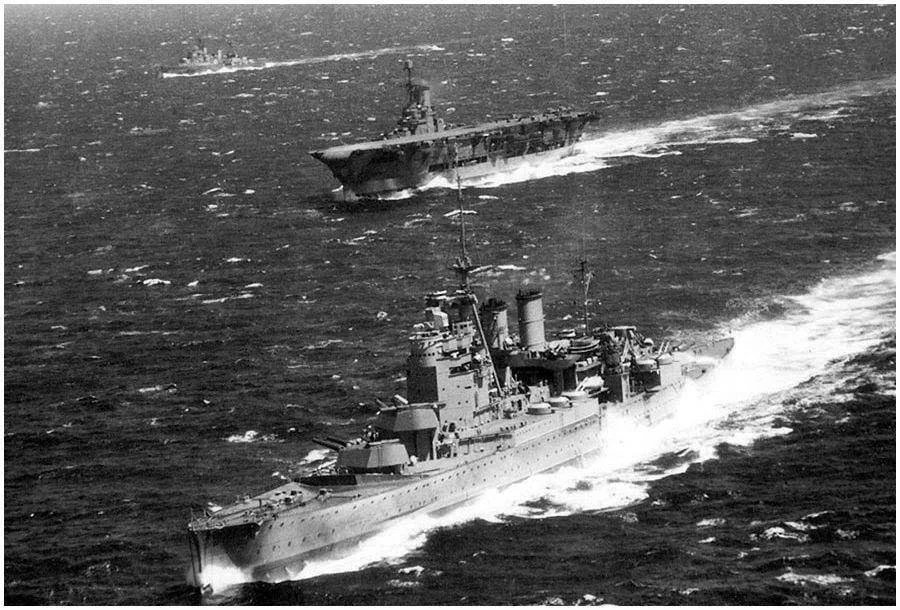
After the French surrendered on 22 June 1940, a significant power vacuum emerged in the Mediterranean. The British had lost their principal ally in the region and now faced Axis threats alone. This created a precarious situation, as the Mediterranean was a vital trade route connecting Britain to the Far East. To safeguard commerce flowing between Suez and Gibraltar, a special naval force was established. This is the story of Force H.
Force H had a precursor at the outbreak of the war. Initially, it was one of several squadrons formed together with the French to protect the Atlantic from German commerce raiders. This original Force H was stationed at the Cape of Good Hope and comprised the heavy cruisers HMS Shropshire and HMS Sussex. However, following the sinking of the Graf Spee and the return of other German commerce raiders to port by the end of 1939, the threat had subsided, leading to Force H’s disbandment.
After the French surrender, Force H was reestablished to counter the Italians and Germans in the Mediterranean. The group was somewhat of an anomaly within the chain of command, as naval squadrons typically reported to the First Sea Lord through a flag officer. However, Force H’s commander reported directly to the First Sea Lord—Admiral of the Fleet Sir Dudley Pound at the time. This underscores the squadron’s special importance and its ability to execute the Admiralty’s directives more swiftly.
When Force H reemerged as an active combat group on 27 June, Vice Admiral James Somerville was appointed to lead the new formation. A seasoned officer, Somerville had served during World War I at Gallipoli. He and Force H operated from Gibraltar.
Force H’s first mission was of utmost importance: neutralizing the powerful French fleet at Mers-el-Kébir, Algeria. Despite earlier assurances from the French, the British feared that the Vichy regime might hand over its warships to the Germans, which would shift the balance of power in the Mediterranean in favor of Hitler and Mussolini. In fact, after Britain, the French possessed the largest fleet of capital ships in Europe. Churchill ordered Force H to demand the surrender of the French warships at the Algerian harbor—and, if they refused, to sink them.
After Force H arrived off the Algerian harbor on 3 July, an envoy was sent to present terms of surrender. However, the French rejected the offer, leaving Force H with no choice but to open fire on their former ally. During the bombardment, 1,297 French tragically perished. Nevertheless, Force H had successfully eliminated the threat of a junction between the French and Axis naval forces. Meanwhile, back home, most Britons applauded the Prime Minister for taking decisive action, while President Roosevelt viewed it as a powerful demonstration of Britain’s determination to continue the fight.
Force H then assumed a more conventional role, escorting convoys through the Western Mediterranean to Malta. Initially, these duties encountered little resistance. However, in 1941, the Luftwaffe arrived in full force with the deployment of X. Fliegerkorps to Sicily. Relentless air raids soon became a routine challenge for the sailors of Force H. The situation worsened further in 1942, as the Regia Aeronautica and Regia Marina began operating more effectively against the Royal Navy.
Force H’s moment of glory occurred outside its usual area of operations. In May 1941, the Bismarck broke out into the Atlantic alongside the heavy cruiser Prinz Eugen, infamously sinking the mighty Hood along the way. The Admiralty made it a top priority to eliminate this threat. Among the many vessels deployed to hunt down the Bismarck were ships from Force H, which at the time comprised the battlecruiser HMS Renown, the light cruiser HMS Sheffield, and the aircraft carrier HMS Ark Royal.
After disappearing from British radar, the Bismarck reemerged, heading for Brest to repair an oil leak caused by shells fired from HMS Prince of Wales during the Battle of the Denmark Strait. If the Royal Navy wanted to catch the German battleship, she needed to be slowed down. This placed immense pressure on the pilots of the Fleet Air Arm to further cripple the German leviathan. However, the crews of the Fairey Swordfish performed their duty with distinction. On 26 May, Lt. Cdr. Jock Moffat successfully launched a torpedo which struck the steering gear of the adversary. The battleship was later spotted aimlessly circling. The efforts of Force H enabled the Royal Navy to close in on the German vessel and sink her on 27 May.
The fall of 1941 proved disastrous for the navy. The Barham was sunk by a German U-boat, the two remaining battleships of the Mediterranean Fleet were disabled at Alexandria, HMS Illustrious was out of action, and Force H’s pride, HMS Ark Royal, was sunk by U-81. As if this weren’t enough, the Germans and Italians intensified their efforts to bring Malta to its knees, launching a total of 282 air raids in April 1942 alone. Malta was on the brink of starvation, were it not for the heroic efforts of Force H and other ships. The most intensive episode for Force H during the Malta convoys was Operation Pedestal in August 1942, when, among others, its aircraft carrier HMS Eagle was torpedoed by U-73. However, the large number of supplies that made it to Malta effectively broke the siege.
Meanwhile, Admiral James Somerville left his command of Force H to address British naval affairs in Asia, facing the seemingly unstoppable Japanese onslaught. Vice-Admiral Edward N. Syfret was appointed to replace Somerville as the head of Force H.
The combat group faced an uncertain future for a time, being practically nonexistent in May 1942 after having been stripped of its units to reinforce Allied efforts against the Vichy regime in Madagascar. However, with the arrival of the Americans in the Mediterranean turning the tide, Force H suddenly became relevant again. The squadron was tasked with supporting crucial landings in North Africa during Operation Torch in November 1942, assisting the British First Army in Morocco and Algeria.
By the time the Axis forces were surrounded in Tunisia, an intensive interdiction campaign had been launched, denying the Germans and Italians any supplies. Force H played a key role in the success of this operation. The naval combat group then supported the Allied fight against the enemy in Sicily and mainland Italy. The pressure on Germany’s ally became too great, and Italy surrendered on 3 September 1943. As the Italian and German naval threats in this theater of war diminished, the need for Force H lessened. Its units were gradually transferred to the Home and Eastern Fleets, and the force was finally disbanded in October 1943.
Olivier Goossens
 Heart of Oak
Leave a comment