

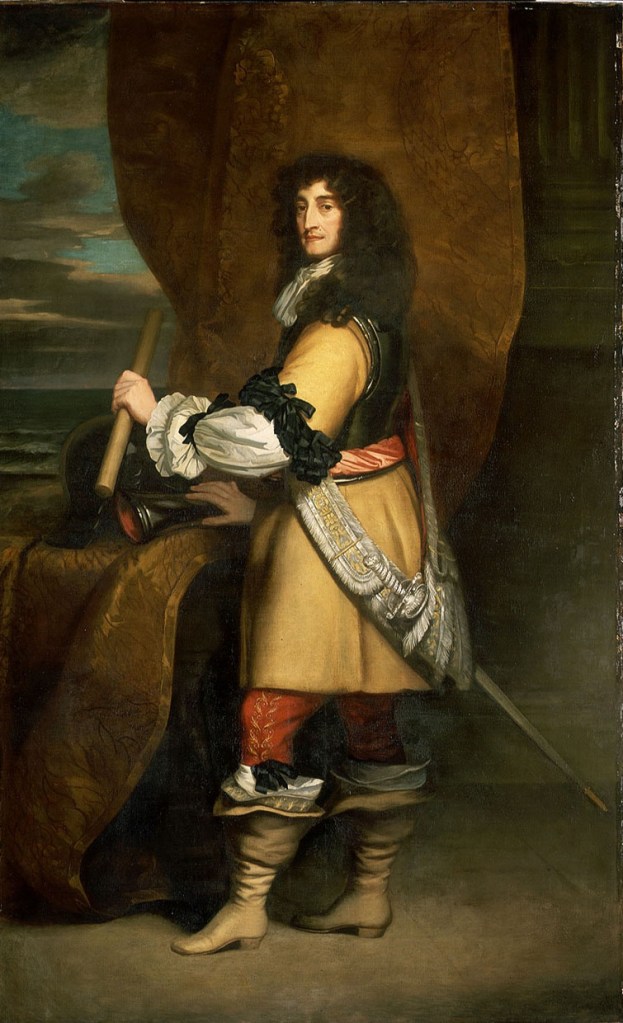
Prince Rupert (1619–1682), the German nephew of King Charles I, was a highly successful commander who fought for the Royalists during the English Civil War (1642–1651). An energetic and inventive leader, he secured many victories on the field of battle through his tactical abilities and bold use of cavalry. However, after the king’s defeat, Parliament sent him into exile in 1646. Rupert’s fight against England’s anti-Royalist forces did not end there. He took command of the remnants of the Royalist Navy at Helvoetsluis, Holland, and launched a campaign to disrupt the Commonwealth’s interests by any means possible. In response, the Republicans dispatched their most talented commander, Robert Blake, to eliminate this threat. The ensuing chase became a high-stakes game of cat and mouse, leading the two rivals from the stormy waters of Ireland to the sunlit Mediterranean.
With remarkable determination, Prince Rupert sold the guns of an old ship and pawned his mother’s jewels to outfit a squadron for sea. Setting sail in January 1649, he traveled to Ireland and established himself in Kinsale. At the time, Cromwell’s hold on Ireland was weak, allowing Rupert to harass English shipping in the Western Approaches with impunity. Many Royalist privateers were already active in the region, and upon the arrival of the charismatic Prince Rupert, they rallied to his cause, redoubling their efforts against Cromwell.
The government in London could no longer tolerate the Royalist presence off Ireland and ordered a large squadron, under the able Robert Blake and Richard Deane, to blockade Prince Rupert at Kinsale. Their mission was to keep the Royalists trapped in the harbor while the Republican army crossed the Irish Sea to seize the enemy naval bases. Sensing the grave danger he faced, Rupert seized the first opportunity to escape and take the fight elsewhere. That opportunity came in October when a gale forced the State’s fleet off station.
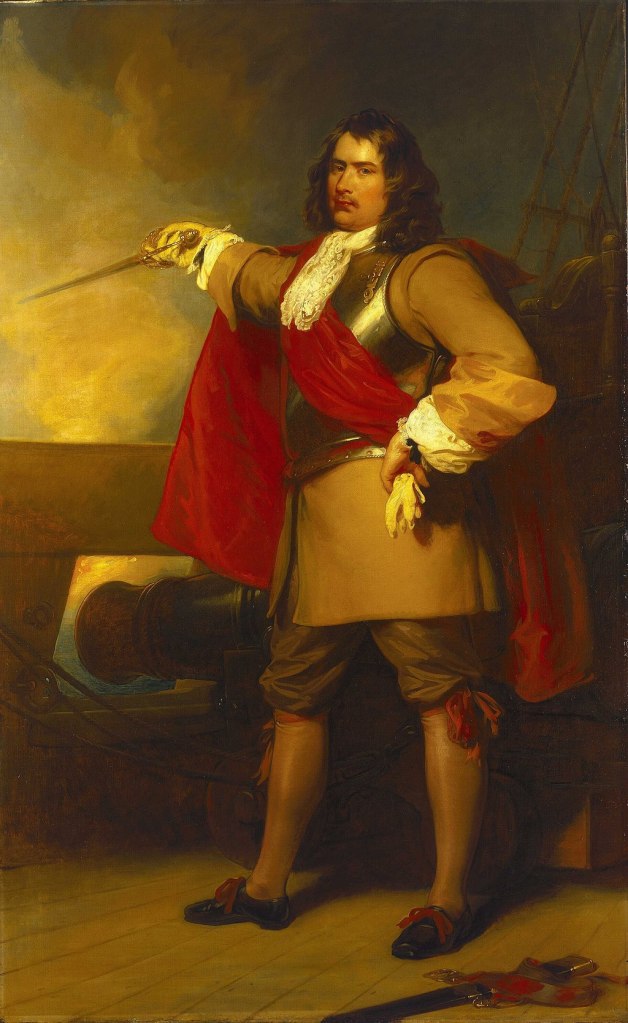
The staunch Royalists then sought refuge with the neutral King John IV of Portugal, a friend of the late English king and consequently well disposed toward Rupert’s cause. Rupert anchored his squadron of seven ships in Lisbon, remaining a serious threat to the Commonwealth’s maritime interests. His fleet in fact included three powerful warships: the Constant Reformation (52 guns), the Convertine (46 guns), and the Swallow (40 guns).
Much to the surprise of both Rupert and King John IV, Admiral Blake appeared off the Portuguese capital in March 1650 and relentlessly blockaded the city, waiting for the Royalists to emerge. Tensions between Portugal and the new government in London escalated, but John IV remained loyal to his old alliance with the Stuarts, forbidding Blake from attacking Rupert in the harbor. However, aware of the difficult position he had placed his Portuguese ally in, Rupert repeatedly attempted to slip past Blake—without success. After several months of stalemate, Rupert finally seized his chance to escape in October when Blake was forced to refit in Cádiz.
Prince Rupert’s men-of-war cruised past the Pillars of Hercules into the Mediterranean, but Blake, relentless as ever, soon followed in his wake, determined to capture the renegade prince. Blake finally got his opportunity to engage the Royalists off Cartagena in early November, capturing most of the squadron. However, Rupert and his brother, aboard HMS Constant Reformation and Swallow, managed to escape to Toulon.
Blake was then recalled to England and relieved in the Mediterranean by Captain William Penn. His efforts to bring Rupert’s squadron to its knees deserve recognition—he proved to be a formidable asset to the Republic, demonstrating the new government’s power and determination to crush its enemies, even if it meant pursuing them to distant lands.
In May 1651, Prince Rupert weighed anchor and set sail for the West Indies with his two remaining ships. However, disaster struck when his flagship, Constant Reformation, was wrecked near Terceira Island in the Azores on 30 September. Upon arriving in the Caribbean in May 1652, he found that not a single island was willing to harbor the Royalists. Later that year, he suffered another devastating loss when his brother perished in a hurricane.
With his forces depleted, Rupert made his way back to Europe. In March 1653, Swallow docked in the Loire, and Rupert left the vessel, never to set foot aboard her again. Thus ended his eventful four-year campaign at sea, culminating in a disastrous final year. It would be a long time before Rupert returned to the seas.
Meanwhile, under Robert Blake’s leadership, the Commonwealth’s navy continued to rise in prominence. Some even claim that during Cromwell’s regime, the foundations of British naval supremacy were laid—a dominance that would last well into the 20th century.
Olivier Goossens
 Heart of Oak
Leave a comment