

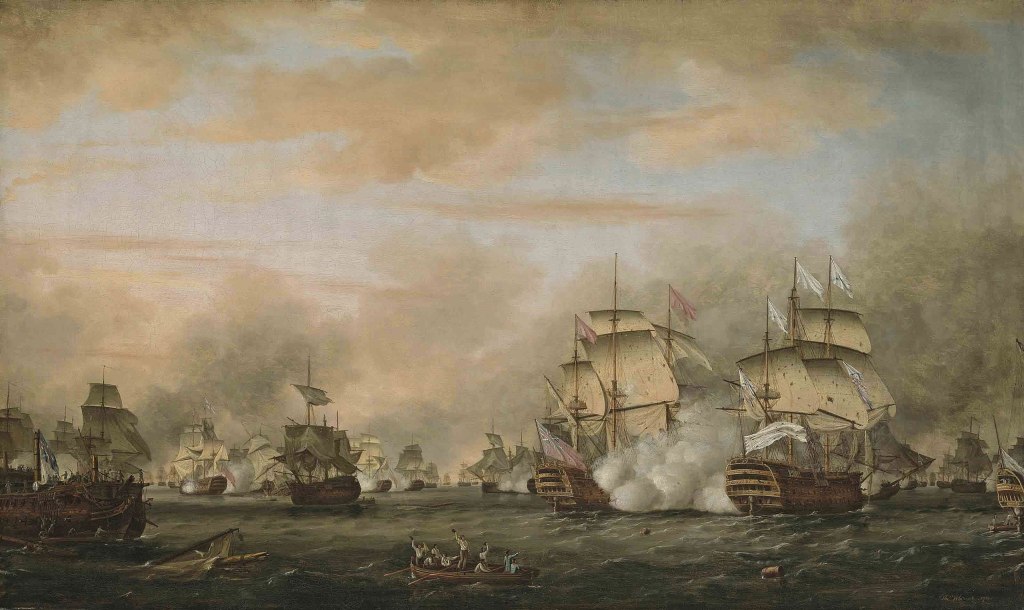
Between April 9 and 12, 1782, over the course of four days, the Royal Navy achieved its greatest victory against the French during the American War of Independence, when Admiral Sir George Rodney defeated over 30 French ships of the line under Comte de Grasse. He successfully thwarted the planned invasion of Jamaica and restored British naval dominance in the West Indies. The French momentum was broken, and the British could now open peace negotiations from a position of power. This final engagement of the American Revolution is also considered by some to be the first instance of the use of the battle tactic of ‘breaking the line.’
After the Siege of Yorktown in 1781, the independence of the United States was secured. Nevertheless, the British and French continued fighting each other for dominance in the West Indies. Both parties sought to secure as many of the rich plantation islands as possible before peace was concluded.
The French planned to take Jamaica in cooperation with the Spanish fleet from Cuba. Jamaica was the most valuable British possession in the West Indies. At that time, Jamaica even yielded more profit than all 13 rebellious American colonies combined. This was due to the presence of numerous, highly lucrative sugar plantations on the island. Sugar was worth five times more than tobacco. In short, the seizure of Jamaica would deal a massive blow to the British economy.
An enemy convoy, carrying 9,000 soldiers, had managed to slip past Hood and Rodney and arrived at Fort Royal, Martinique. Comte de Grasse was anchored there with an escort force of around 36 ships of the line. Another 12 Spanish battleships were to meet up with the French before invading Jamaica. With such a powerful army, guided by a mighty armada, disaster loomed over the British in the Caribbean.
When England got wind of the planned Franco-Spanish expedition, the government, petrified at the prospect of losing Jamaica, immediately sent the experienced Sir George Rodney to defend the island. He arrived at St. Lucia in March 1782 with 17 ships of the line. Rodney joined forces with the squadron of Sir Samuel Hood, bringing the British total to 33 ships of the line.
On April 7, 1782, Comte de Grasse weighed anchor and sailed west. As soon as Rodney heard of the French departure, he immediately set out in pursuit with his ships of the line. Fortunately, the Admiralty had by then sheathed most of the Royal Navy’s battleships with copper, which protected the vessels’ hulls against marine growth. This significantly enhanced their speed, allowing Rodney to quickly catch up with Comte de Grasse.
On April 8, 1782, at 4:00 pm, HMS Barfleur, the flagship of Sir Samuel Hood and spearheading the British line, reported seeing several sails on the horizon. It soon became clear that Comte de Grasse’s fleet was near at hand. The next day, surprised by the British speed, Comte de Grasse ordered the convoy to head for Guadeloupe while his ships covered the retreat. Meanwhile, Hood in his HMS Barfleur and eight other vessels had become separated from the main fleet due to the initial winds only filling the vanguard’s sails. A brief encounter followed, in which Captain William Bayne of HMS Alfred was killed. De Grasse broke off the engagement when he saw the rest of the British column closing in.
After the first engagement, de Grasse moved to the Saintes Islands to the north, while Rodney ordered Rear Admiral Francis Samuel Drake’s squadron (a descendant of the famous Sir Francis Drake) to take up position as the vanguard, and Hood’s ships slipped back to the rear for repairs.
On the night of April 11, the French third-rater Zélé and de Grasse’s flagship, Ville de Paris (104), collided. Rodney seized this opportunity to lure the rest of the French fleet into battle, sending in four ships to attack the straggling French flagship and the Zélé. The ruse worked, and de Grasse formed a line to ward off the British attack. Rodney countered this French movement by recalling his pursuing vessels and forming a line of his own. The stage was now set for one of the biggest naval encounters of the 18th century, with almost 70 ships of the line involved.
On April 12, the French and British lines were nearing each other on opposite tacks, with the French sailing southward while Rodney’s battleships were heading north. Once the opposing ships started passing each other, the sounds of broadsides could be heard from all sides. After a while, de Grasse realized that if his ships continued their current course, they would end up under the lee of the island of Dominica, which was to the southeast of his fleet. Being under the lee of Dominica meant that this landmass would block the easterly wind, which came from the other side of the island. De Grasse was consequently in danger of becoming immobile. He ordered his ships several times to wear to the north, but his captains ignored the signal time and again, fearing the maneuver would expose their bows to the British.
Then the wind changed from east to southeast. The French had to turn starboard to fill their sails. Gaps opened up in the French column, which the British soon took advantage of. Rodney’s ships of the line began breaking through the French line, positioning themselves to leeward of the enemy. De Grasse’s fleet was now sliced into three smaller sections, each being bombarded from both sides by the Royal Navy. According to some historians, this masterstroke was the first occasion on which the tactic of ‘breaking the line’ was used, although this remains disputed. In any case, ‘breaking the line’ would go on to become a signature move of the Royal Navy during the later stages of the Age of Sail, a tactic that would later be perfected by Admiral Nelson.
British gunnery was particularly deadly that day. Rodney’s captain of the fleet, Captain Sir Charles Douglas, was a gunnery expert who made significant innovations to the Royal Navy’s gun decks. He removed unnecessary, obstructive support structures aboard HMS Duke (90), Formidable (90), and Arrogant (74), and added a ringbolt between each gunport. This modification allowed the guns of these ships to move more freely horizontally, increasing their arc to 90°, whereas previously, they were largely stationary in that direction. As a result, the gun crews of the Duke, Formidable, and Arrogant could select their targets with greater flexibility, enabling a single ship to engage multiple enemies simultaneously. Consequently, during the Battle of the Saintes, the guns of these ships consistently found their marks, while the French cannons remained dependent on their ship’s heading to aim effectively. As historian Ben Wilson remarks, it was no coincidence that these modified vessels of Rodney’s fleet were sent into the thick of the fighting, significantly changing the outcome of the battle in Britain’s favor.
After the British broke through, Rodney ordered his ships to chase the enemy, who were now fleeing with the wind to the northwest. Four enemy vessels were captured in the process, including the ship that transported the siege train for the attack on Jamaica. By evening, Hood’s squadron had caught up with de Grasse’s flagship, the Ville de Paris (104), which had been abandoned by the rest of his fleet. He now became the target of nine ships of the line. De Grasse, defiantly, remained on the quarterdeck throughout the onslaught but eventually surrendered. His bravery did not go unnoticed, as he was cheered by the crowds in London upon arrival as a prisoner of war.
After the capture of the French flagship, Rodney, weary from several days of maneuvering and fighting, broke off the chase, much to Hood’s anger, as he desired more. Several days later, Rodney permitted Hood to continue his pursuit of the remaining vessels of the French fleet, and his second-in-command returned triumphantly with two captured ships of the line, a frigate, and a sloop.
With the French invasion of Jamaica averted and British supremacy in the West Indies restored, the victory was hailed by several leading figures as the greatest of the century. However, Sir Samuel Hood grew increasingly vocal about his disappointment with the battle’s outcome. He believed much more could have been achieved had his commander not called off the chase. He later claimed that if he had been in command at the Battle of the Saintes, “I may, without imputation of much vanity, say the flag of England should now have graced the stems of twenty sail of the enemy’s line.”
Hood’s role in the battle and the West Indies Fleet became widely recognized and celebrated. It was he who oversaw the fleet in the Caribbean in the months leading up to the battle, and he who received the sword of de Grasse aboard HMS Barfleur. Consequently, many ambitious young men vied for a position on Hood’s staff. The young Horatio Nelson later boasted of his special relationship with him, and King George III even appointed his son, Prince William, as a midshipman under Hood’s command.
Although Rodney was still honored with a peerage, growing voices began to question his judgment during those fateful days.
Be that as it may, the Battle of the Saintes helped bring the American War of Independence to a conclusion more favorable to Britain than expected, given the setbacks in the rebellious colonies. The independence of the United States was later recognized in the Treaty of Paris of 1783, but thanks to the battle, Britain maintained its dominance in the wealthy West Indies.
Olivier Goossens
 Heart of Oak
Leave a comment