

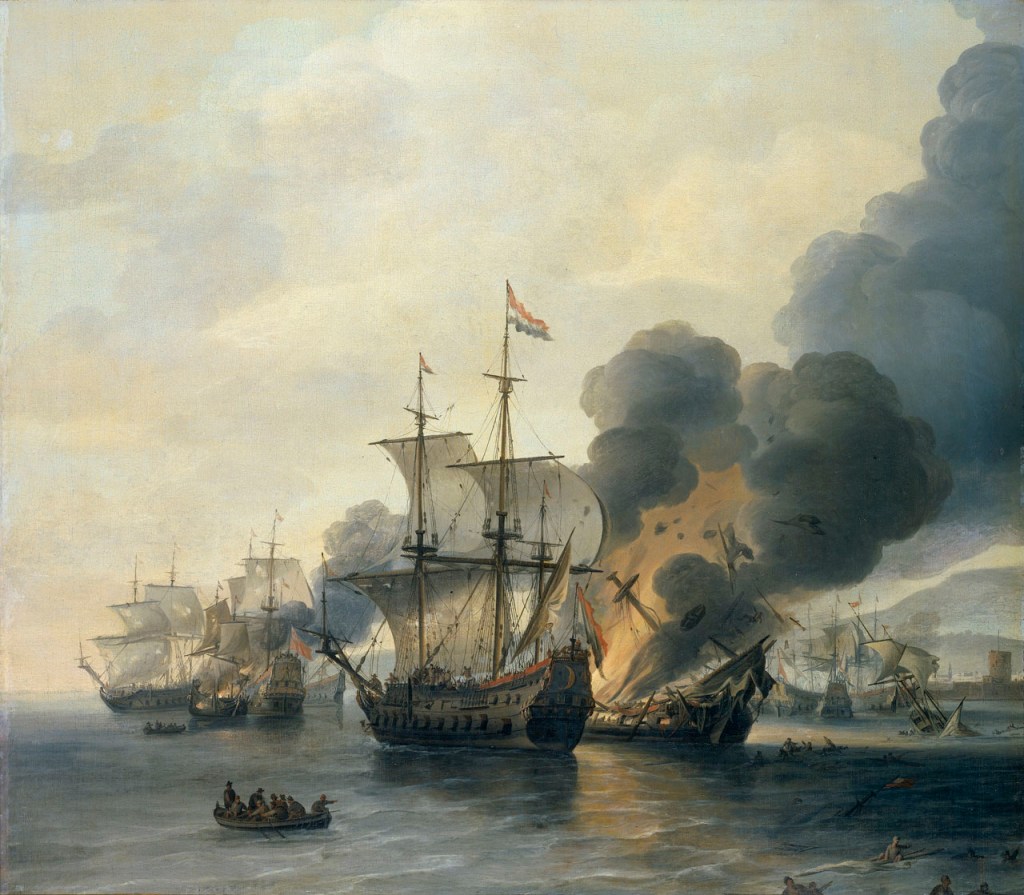
When thinking of the Anglo-Dutch Wars of the 17th century, with their numerous massive battles in the Channel, it is quite surprising to learn that these two mercantile powers also clashed in the Mediterranean. Today, I wish to briefly explore one important battle that took place in this unexpected theater of war during the First Anglo-Dutch War (1652–1654): the Battle of Leghorn in 1653, a clash that ended English ambitions in the Mediterranean for the remainder of the conflict.
An English squadron had been operating in these waters since the outset of the First Anglo-Dutch War (1652–1654) between the two nations. The English had remained there ever since their conflict with the Barbary Corsairs, the scourge of the Christian world in the Mediterranean. London had decided to prolong the presence of its local naval squadron to further safeguard lucrative trade with the Levant. The English force consisted of about 20 warships under the commands of Commodore Henry Appleton and Commodore Richard Badiley, which were split into two smaller sections.
Meanwhile, the Dutch Republic also maintained a local force in the Mediterranean to protect its commercial interests there. The flotilla was initially led by Joris van Cats until the States General decided to transfer command to the more capable Jan van Galen after the outbreak of war with England. Van Galen was a seasoned commander who had proven his worth against the Spanish and had most recently fought the Barbary Pirates. He received his orders on July 13, instructing him to keep the English bottled up in the Mediterranean. A notable figure who sailed with the Dutch commodore was Cornelis Tromp, the son of Admiral Maarten Tromp, a man who would go on to carve out a distinguished career of his own.
During the opening months of the conflict, Appleton’s force of six ships became trapped in ‘Leghorn,’ the traditional English name for the northwestern Italian port city of Livorno. They had been unwelcome guests ever since Appleton offended the local ruler, Grand Duke Ferdinando II de’ Medici of Tuscany, by capturing a French merchant vessel just outside the harbor in November 1651.
Meanwhile, Badiley’s small force of four warships was confronted by a superior Dutch fleet off Elba on August 3. The English commander lost one ship before retreating into the island’s main harbor, Porto Longone. The Dutch then focused all their efforts on maintaining the blockade of Appleton at Leghorn, allowing Badiley to sail into the open sea.
The two English captains knew that their only chance of survival lay in uniting their forces. Furthermore, the hostile Grand Duke of Tuscany, Ferdinando II de’ Medici, was pressuring the English to leave the Italian harbor, as he wished to avoid involvement in the conflict. A plan was agreed upon: Badiley would engage the Dutch, giving Appleton ample space and time to sail out of Leghorn and join forces with him. The English might even overwhelm the Dutch by attacking from two sides. March 4 was to be their D-Day.
The operation started off poorly. The commander of the force at Leghorn mistimed his departure and left the harbor too early. He was soon overtaken by the Dutch fleet of 16 ships, while Badiley was still too far away to make a difference. The Dutch relentlessly battered Appleton’s squadron. HMS Bonaventure (44 guns) exploded after a broadside from the enemy flagship, Vereenigde Provincien, ignited the ship’s magazine. HMS Samson (40 guns) also sank after colliding with a Dutch fireship. The flagship, HMS Leopard (48 guns), was captured along with HMS Peregrine and Levant Merchant. Only HMS Mary managed to escape thanks to her superior speed, eventually reaching Badiley. The English fled, acknowledging their defeat.
On the Dutch side, however, Commodore Van Galen was struck in his right lower leg during the engagement. He had his leg amputated but resumed command of the fleet shortly afterward. However, he succumbed to his wound nine days later due to blood poisoning. Van Galen was honored in his home country as a national hero. The total number of Dutch casualties is unknown but was likely relatively light, as their entire squadron of 16 warships remained intact. Badiley, heavily outnumbered, decided to abandon the Mediterranean with his remaining vessels. No English force returned to this theater of war until after the conflict had ended.
Olivier Goossens
 Heart of Oak
Leave a comment