

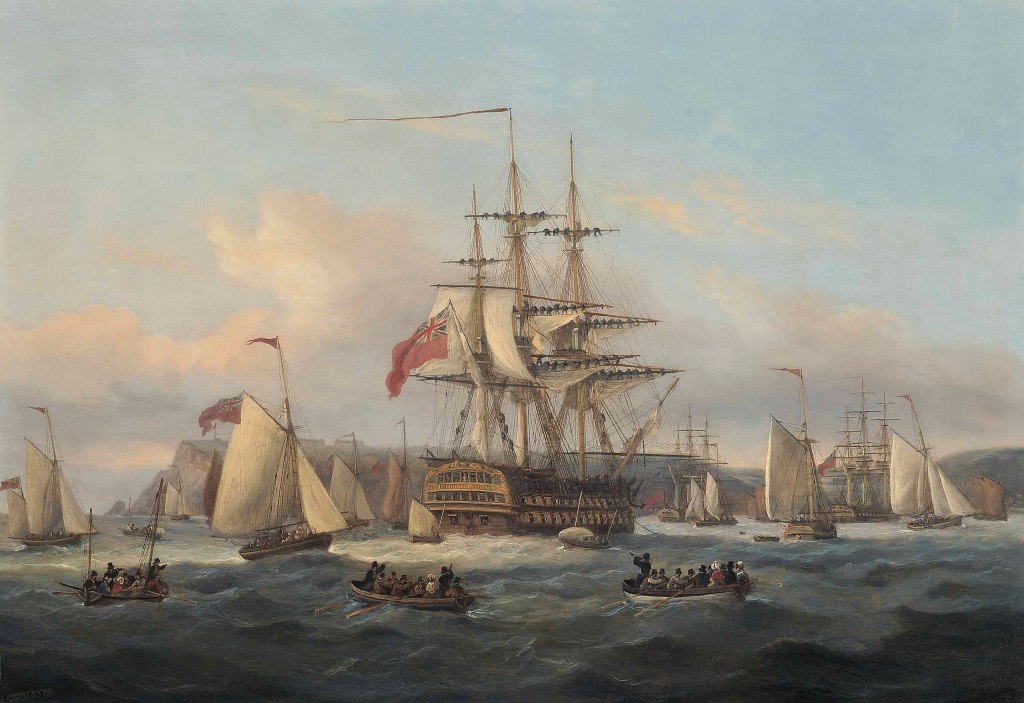
HMS Bellerophon was a third-rate ship of the line of 74 guns that saw extensive service during Britain’s wars against France between 1793 and 1815. She was involved in three major naval engagements, including Nelson’s victories at the Nile and Trafalgar. Thus, the “Billy Ruffian,” as she was commonly called by her crew, was closely intertwined with Lord Nelson’s success and, consequently, Britain’s fate to become the most powerful naval power in history.
HMS Bellerophon was one of the ten Arrogant-class third raters ordered by the Royal Navy. Their design was based on that of the famed Bellona-class of Sir Thomas Slade, the famed shipwright whose 74-gun vessels revolutionized the navy and formed the backbone of British naval power right up until the advent of the age of steam. In any case, the Bellerophon was ordered to be built by Edward Greaves and Company of Frindsbury in Kent, a company normally specializing in constructing merchant ships. This Arrogant-class “battleship” was launched in October 1786. She boasted a typical third rater armament: twenty-eight 32-pounder guns on her lower gundeck, twenty-eight 18-pounder guns on the upper gundeck, fourteen 9-pounder guns on the quarterdeck, and four 9-pounder guns on the forecastle.
The naming of the ship as “Bellerophon” was supposedly a decision made by then First Lord of the Admiralty, John Montagu, who showed a marked interest in classical history, always having John Lemprière’s Classical Dictionary on his desk. Bellerophon was a Greek mythological hero who famously tamed and rode the winged horse Pegasus. Her name, however, proved to be quite challenging to pronounce for many. Therefore, she colloquially came to be known as the “Billy Ruffian,” a quite humorous but half-hearted attempt to utter the Greek original word.
Bellerophon’s completion awaited half a year after her launching, having been put into dry dock in March 1787 for her to receive a usual copper sheathing treatment. With peace between the French and Spanish royal houses and Britain, there was no urgent need to press new ships into service, and she was laid up in Chatham in the coming months. However, the Nootka Sound crisis in 1790 presented Britain with the prospect of renewed conflict with Spain, and many vessels, such as the Bellerophon, were commissioned. Her first commander, Sir Thomas Pasley, was hauled aboard her on 19 July, and the able Captain began to prepare the ship for war. The tensions with Spain soon abated, however, and the vessel was paid off in September 1791 at Chatham.
As France deposed its king and sent its armies rampaging through the Low Countries, war with Britain’s traditional enemy became a reality again. The Royal Navy bolstered its numbers once more to counter the threat across the Channel, and Bellerophon joined the ranks of the British fleet again. A familiar face clambered aboard to assume command of her: Thomas Pasley. Pasley joined the Channel Fleet under the command of the seasoned Lord Howe. Tiresome, long months of blockading Brest appeared to be Bellerophon’s fate until she suffered extensive damage after a collision with HMS Majestic.
After repairs at Plymouth, Pasley’s vessel was again with the Channel Fleet, this time out at large patrolling the Western Approaches. She made quite a name for herself, proving to be among the fastest ships of Howe’s fleet. The admiral subsequently made the “Billy Ruffian” the flagship of a flying squadron, promoting Pasley to Commodore and Rear-Admiral shortly thereafter. Consequently, Bellerophon received William Johnstone Hope as her new captain, while Pasley continued flying his broad pennant aboard her.
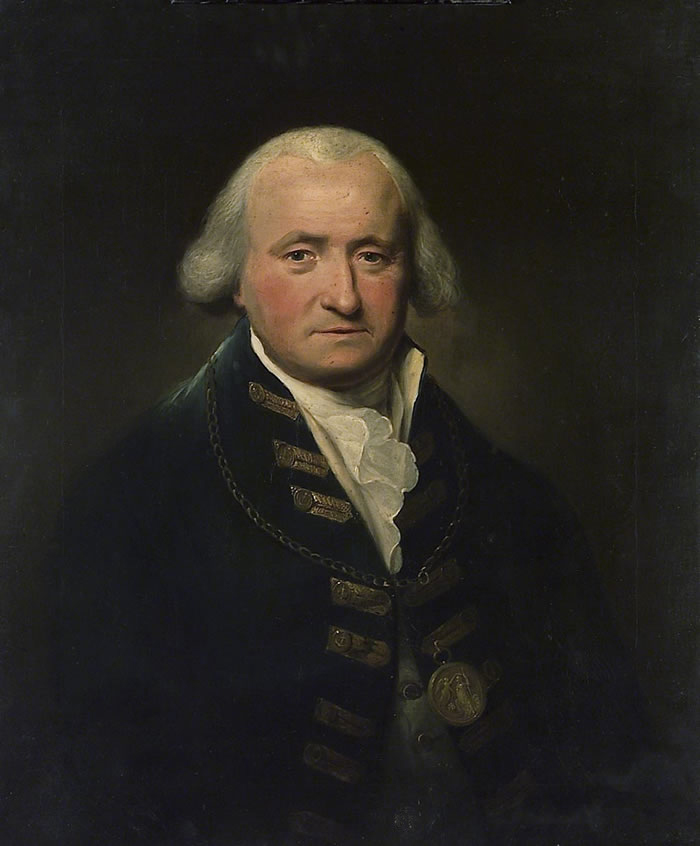
When Howe received intelligence of an approaching grain fleet under Admiral Pierre Jean Van Stabel from the West Indies, he split his force into two sections. He himself, with the bulk of his fleet, was to track and engage the Brest fleet, which was bound to escort Van Stabel, while Rear-Admiral George Montagu was to apprehend the ships carrying the precious grain to France. Rear-Admiral Pasley and Captain Johnstone Hope remained with Lord Howe.
Meanwhile, the commander of the Brest fleet, Villaret de Joyeuse, had managed to slip past Howe’s ships to rendezvous with Van Stabel. Howe, after realizing the enemy’s escape, set in for the pursuit. Some 400 miles west of Ushant, the two fleets met in what was to become the first and largest naval battle of the Revolutionary Wars.
Pasley’s faster flying squadron consisted of the Bellerophon, Russell, Thunderer, and Marlborough, as well as the frigate HMS Phaeton. They were scouting ahead of Howe’s main force, and the Phaeton discerned strange sails on the horizon at 6 a.m. on 28 May. Pasley hurried to the southeast to investigate and confirmed by noon that this was Villaret de Joyeuse’s battle fleet. The Royal Navy’s 25 ships of the line prepared themselves to engage the enemy’s 26 men-of-war.
Howe had ordered his ships to chase down the enemy. By the evening, Pasley’s ships, forming the vanguard, caught up with the French rearmost vessels. The Bellerophon was the first British vessel to open fire when the French 110-gun Révolutionnaire fell out of line to block Pasley’s relentless advance. The 110-gun leviathan and the “Billy Ruffian” closed in on each other and exchanged broadsides. The outgunned Royal Navy third rater suffered significant damage, particularly to her main topmast. Pasley and Captain Johnstone Hope had to wait some time until reinforcements arrived. They, in fact, had gone ahead of the rest of the squadron in their determination to give battle to the enemy. The Bellerophon had demonstrated her superior speed once more. The evening mêlée ended undecided. Howe ordered his ships to disengage, form a line ahead, and wait until morning.
The next day, 29 May, action resumed with greater intensity. The British managed to isolate several units of Villaret de Joyeuse’s rear, but the French vanguard came to their rescue, denying Howe a clear victory that day. The Bellerophon followed the wake of the fleet’s flagship, 100-gun HMS Queen Charlotte, and endured several enemy broadsides once again. The “Billy Ruffian,” however, remained very much in the fight. The next two days, bad weather prevented the Royal Navy from taking any further action. But all of that was to change on the 1st of June.
On the 1st of June, all hell broke loose. Howe’s line had the weather gauge, thus gaining the initiative. He bore down on the enemy with the intent of cutting through their line. The admiral wanted each of his ships to engage their opposite number to leeward after breaking through, thus cutting off the French from their escape route. That day, the Bellerophon was the rearmost British vessel. As His Majesty’s Ships neared the French in line abreast, they received a heavy battering. For the Bellerophon, tragedy was to come at an early hour. As she made her way to the French, an 18-pounder cannonball whistled past the ship’s masts, hitting the rear-admiral’s leg as he stood tall on the quarterdeck. The admiral fell to the deck. As Pasley witnessed the horror in his men’s faces, he exhorted them with the words: “Thank you, but never mind my leg: take care of my flag.”
Captain Hope kept the “Billy Ruffian” in the engagement as the admiral was rushed to the cockpit to have his struck leg amputated. The ship dueled with the 74-gun Éole and became even more severely damaged, as all of the ship’s topmasts were blown away and the mainsail was in tatters. Captain Hope signaled to the frigate Latona to tow her clear of the action. Despite the heavy damage, the butcher’s bill aboard Bellerophon was relatively light: four killed and around thirty wounded.
One chapter ended in the ship’s history, as she arrived at Portsmouth for extensive repairs and her admiral was taken ashore. Pasley did not return to service and bade farewell to the ship that defined the closing stages of his long and illustrious career. The rear-admiral’s action at the Glorious First of June secured his reputation as a daring commander and earned him a baronetcy at the age of 60. The Bellerophon returned to the sea with a set of new faces on the quarterdeck, as James Cranstoun succeeded Hope as captain of the “Billy Ruffian.” Many more glorious moments were to come for the ship.
Olivier Goossens
 Heart of Oak
Leave a comment