

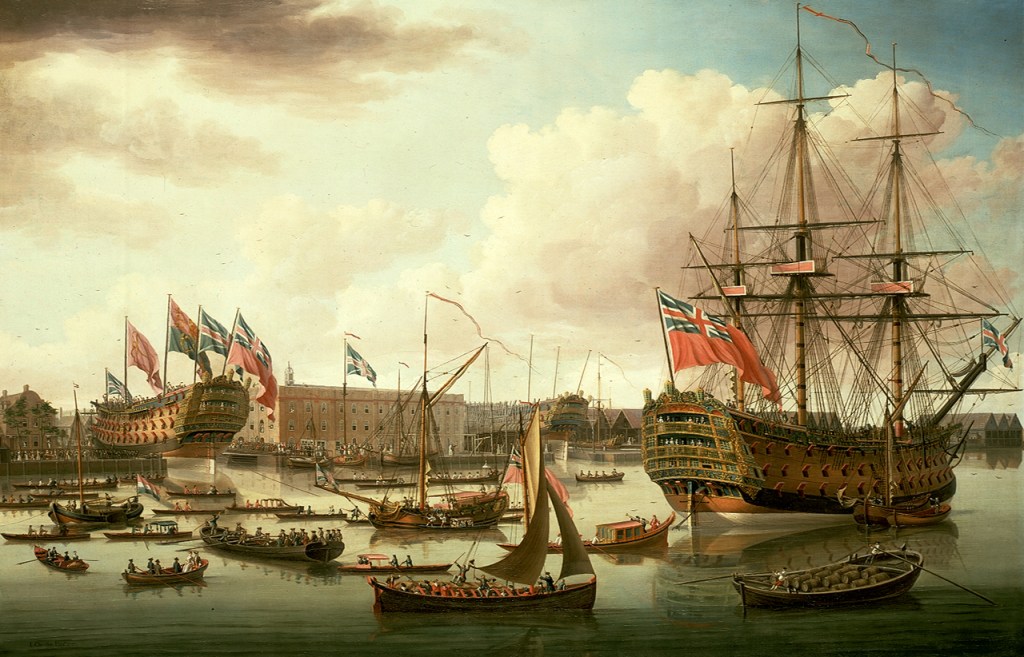
In this exquisite painting, we witness the birth of a new vessel for His Majesty’s Royal Navy at Deptford Dockyard. The piece was created by the painter John Cleveley the Elder, whose meticulous attention to detail reflects his deep familiarity with the subject. Cleveley was not only an accomplished artist but also a shipwright at Deptford Royal Dockyard, where he worked for many years. He must have felt a deep sense of pride in being privileged to work at one of the most significant sites in British naval history. Deptford, often referred to as the “Cradle of the Navy” or simply the “King’s Yard,” occupies a special place in the story of Britain’s maritime legacy.
Deptford Royal Dockyard, situated on the banks of the Thames near London, was founded by King Henry VIII in 1513. This initiative was part of a broader Tudor program to transform the English fleet into a formidable fighting force capable of competing with its rivals. Henry VIII also established three other dockyards: Woolwich, Portsmouth, and Erith. However, Erith was soon abandoned due to persistent flooding problems, while Woolwich, Portsmouth, and Deptford remained critical to the Royal Navy for centuries.
Although English warships had been sporadically built at Deptford on previous occasions, the site now became a nearly permanent operating wharf and naval base under government control. But why was this site chosen?
Deptford was located some distance upstream on the Thames, which meant it took considerable time to move ships into open waters. However, Henry’s decision to establish a shipyard here made sense given the historical context. At the time, England did not dominate the seas as it would in later centuries. Consequently, it was considered prudent to station English warships farther up the Thames for added protection against enemy raids. The ships would be safeguarded by various shore batteries, a precaution that proved wise.
The threat of such raids was vividly demonstrated about 150 years later, in 1667, when Dutch Admiral Michiel de Ruyter raided the anchorage off Chatham Dockyard on the River Medway. This event underscored the legitimacy of Henry’s concerns and the strategic value of positioning warships where they were less vulnerable to enemy attacks.
Over time, England gradually came to possess one of the most powerful navies in Europe, if not the world. As a result, Deptford became less useful as a naval base. The ships of the Royal Navy emerged as the island’s first line of defense, famously referred to as Britain’s “Wooden Wall.” Raids into England’s rivers were increasingly regarded as unlikely events, as the navy was considered capable of intercepting any serious enemy force before it could approach the homeland’s shores.
The warships no longer needed additional support from the mainland, as they were deemed self-sufficient in defending against threats. Consequently, it was no longer necessary to station them so far inland on England’s rivers. In fact, this was now seen as a disadvantage, as it delayed the ships’ ability to intercept adversaries in the open sea.
Moreover, Deptford, located on the Thames near London, faced practical limitations. Although the Thames is a relatively large river, the area around Deptford lacked the space needed to accommodate a significant naval fighting force. The river there was simply too narrow.
For these reasons, other locations such as Portsmouth, Plymouth, and Chatham became preferred operating bases for the Royal Navy. These sites offered greater proximity to the North Sea and the Atlantic, making them strategically superior for naval operations.
Deptford, however, never ceased to be a major shipyard for the navy. In fact, it was perhaps the most important shipyard during the 16th century, the Tudor Era. Many vessels were launched here, and it became a symbolic site for the navy. Significant events took place here, such as Queen Elizabeth I knighting Francis Drake aboard the Golden Hinde, following his circumnavigation of the globe.
During the 17th century, Deptford retained its role as an important naval shipyard, with London continuing to expand the shipbuilding facilities there. The dockyard managed to survive the many domestic political upheavals of the century, including the Civil War, the Commonwealth regime, the Restoration, and the Glorious Revolution.
During the 18th century, the ships of the Royal Navy grew ever larger, and the Thames River at Deptford proved too shallow for launching the massive men-o’-war. Consequently, the largest ships, such as the first and second-raters, were built at the larger and deeper shipyard in Woolwich. However, smaller-rated vessels continued to be constructed at Deptford.
Additionally, due to its proximity to the Navy Board offices in London, Deptford became the preferred site for the construction of experimental vessels. For instance, the first 74-gun third-rates, designed by the prolific Thomas Slade, were laid down here in the 1750s. These innovative ships became the backbone of the navy throughout the remainder of the 18th century and into the early 19th century.
Furthermore, in the 1760s and 1770s, trials were conducted at Deptford to test the sheathing of hulls with copper, a development that would significantly enhance the performance and durability of naval vessels. To support the construction of these ships, the dockyard had several building slips at its disposal.
Another major activity at the yard was the repair of ships. Before hulls were sheathed with copper in the late 18th century, the wooden bodies of warships below the waterline needed to be cleaned every four months. To access this part of the ship, the vessel had to be placed in a drydock. Deptford had three drydocks: one single and one double.
Deptford’s proximity to the markets of London, where many of the navy’s supplies were purchased, made it an ideal operating area for the Victualling Board. Several warehouses were constructed next to the shipyard to store these supplies. Deptford primarily provided goods to the warships stationed at the Nore, but it also supplied certain commodities to other naval bases as needed.
After the Napoleonic Wars, a sharp decline in shipbuilding, combined with the continued increase in the size of the navy’s ships, led to Deptford’s decline in the 19th century. The shipyard was officially closed in 1869. However, the Victualling Board continued to operate at the site well into the 1960s.
Today, almost nothing remains of the once-great shipyard. An archaeological survey conducted between 2010 and 2012 uncovered some traces of its past. The site of the former dockyard is now being redeveloped into a residential, commercial, and entertainment area.
Olivier Goossens
 Heart of Oak
Leave a comment