

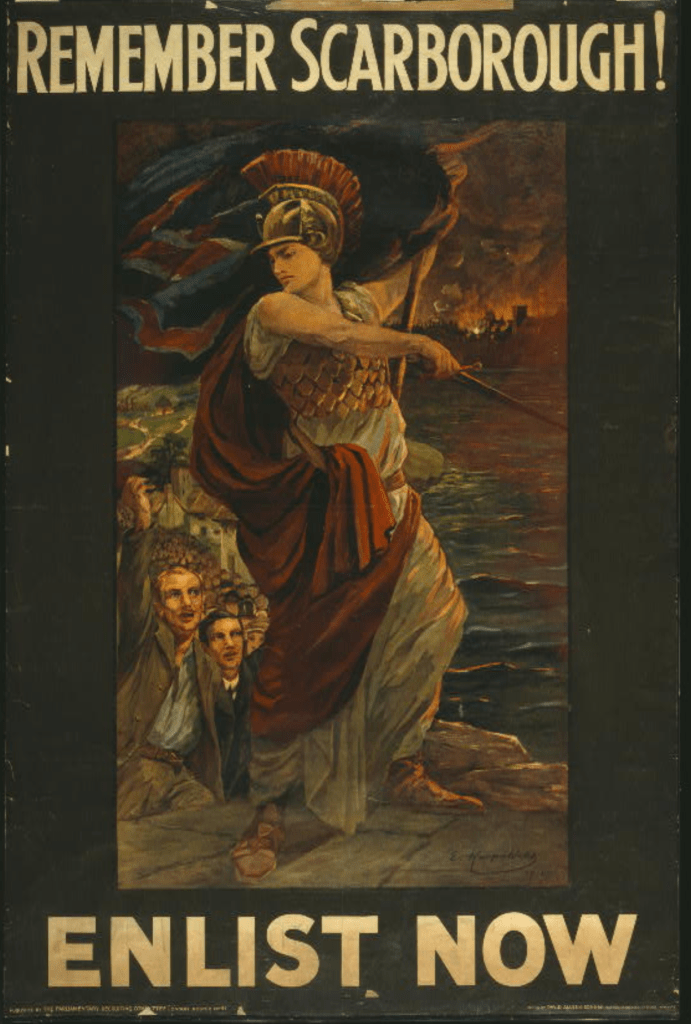
Just a few days before Christmas in 1914, the German Navy launched a daring nighttime raid on several English coastal towns. The attack sparked controversy due to the Royal Navy’s failure to prevent it. However, the British government later turned public outrage to its advantage. The German “barbaric” attacks on Scarborough, Hartlepool, and Whitby became a rallying cry, urging young men to enlist in the army. The propaganda posters created in response to this incident remain some of the most iconic examples of British wartime messaging during the First World War.
When war broke out, Germany acknowledged that its navy was no match for the Royal Navy, despite substantial investments during the pre-war naval arms race. Consequently, a more cautious strategy was adopted. The German High Seas Fleet (Hochseeflotte) aimed to gradually weaken its opponent by luring out and destroying segments of the Royal Navy piece by piece before engaging in full-scale confrontation.
German battlecruisers played a crucial role in this strategy, leveraging their superior speed to evade British reinforcements swiftly. To provoke the Royal Navy, the Germans launched attacks on British harbors, deliberately targeting civilians. This tactic pressured the Royal Navy into hastily deploying squadrons to protect British subjects.
The first of these raids was the attack on Great Yarmouth on November 3, 1914. Although the Germans caused little damage, it demonstrated their determination to carry out bombardments all the way up to the British shore. Unfortunately, the Admiralty did not learn any lessons from the incident.
Another raid was planned for December 1914. The 1st Scouting Group, consisting of battlecruisers, a light cruiser, and an armored cruiser under the command of Franz von Hipper, was tasked with bombarding British coastal towns. Meanwhile, a larger German fleet, led by Admiral Friedrich von Ingenohl, waited near Dogger Bank. Von Hipper’s objective was to lure nearby British naval forces into an engagement with von Ingenohl’s fleet or direct them into a minefield.
In the early morning of December 15, von Hipper’s squadron departed from the River Jade and split into two groups. The battlecruisers Seydlitz and Moltke, along with the armored cruiser Blücher, set course for Hartlepool, while the battlecruisers Derfflinger and Von der Tann, accompanied by the light cruiser Kolberg, targeted Scarborough.
In Scarborough, several notable buildings, including Scarborough Castle and the Grand Hotel, were hit during the attack. As the bombardment unfolded, the town’s inhabitants fled toward the railway station, seeking safety until the enemy guns fell silent around 9:30 a.m. The squadron then moved on to Whitby, where shells struck several buildings, including the historic Whitby Abbey.
Meanwhile, Hartlepool was alerted to the impending attack around 4:30 a.m. It was the only of the three targeted cities with coastal batteries and a local flotilla of three destroyers available for defense. Approximately four hours later, the High Seas Fleet arrived and opened fire. The bombardment killed 86 civilians and wounded hundreds more. The local squadron launched a counterattack but failed to make a significant impact. All three destroyers sustained damage and were forced to retreat.
Thanks to Room 40’s decryption of German wireless messages, the British were well aware that a German offensive operation was underway. Consequently, Beatty’s battlecruisers, along with the Grand Fleet’s 2nd Battle Squadron, were mobilized. This counterattacking force of 10 ships, assembled off Moray Firth under the command of George Warrender, was ready by 11:00 a.m. They then steamed toward Dogger Bank to cut off von Hipper’s 1st Scouting Group from its bases. Unbeknownst to them, they were heading straight toward the full might of the High Seas Fleet.
The very next morning, this force’s destroyers clashed with the vanguard of von Ingenohl’s fleet. However, von Ingenohl, fearing he was up against the full strength of the Grand Fleet, chose to retreat. Ironically, the Germans had succeeded in luring out a small portion of the British fleet but failed to capitalize on the opportunity due to their caution. This underscores how even the perception of a superior fleet, such as Britain’s, could exert a significant strategic impact.
Meanwhile, after von Ingenohl’s retreat, von Hipper’s forces were left to fend for themselves. Upon hearing about the coastal bombardment, Beatty’s battlecruisers raced toward the coast, hoping to intercept the retreating German cruisers. However, von Hipper managed to slip past the British forces, although contact was made between one of Beatty’s light cruisers and a German light cruiser.
The bombardments of Scarborough, Hartlepool, and Whitby resulted in the deaths of 137 civilians and caused significant damage to several buildings. The raids sparked public outcry, with widespread criticism of the Royal Navy for failing to intervene in time. Pressure on the Admiralty increased for a more aggressive approach. The attacks also highlighted the wisdom of Jackie Fisher’s policy of establishing coastal flotillas along the British coast. At the time, most ships from local squadrons had been absorbed into the Grand Fleet at Scapa Flow. When the Germans attacked Scarborough, Hartlepool, and Whitby, the local forces were too small to make any difference. Meanwhile, British authorities capitalized on public anger to boost recruitment efforts. Posters bearing the slogan “Remember Scarborough” quickly appeared on the streets of towns across Britain.
Olivier Goossens
 Heart of Oak
Leave a comment