

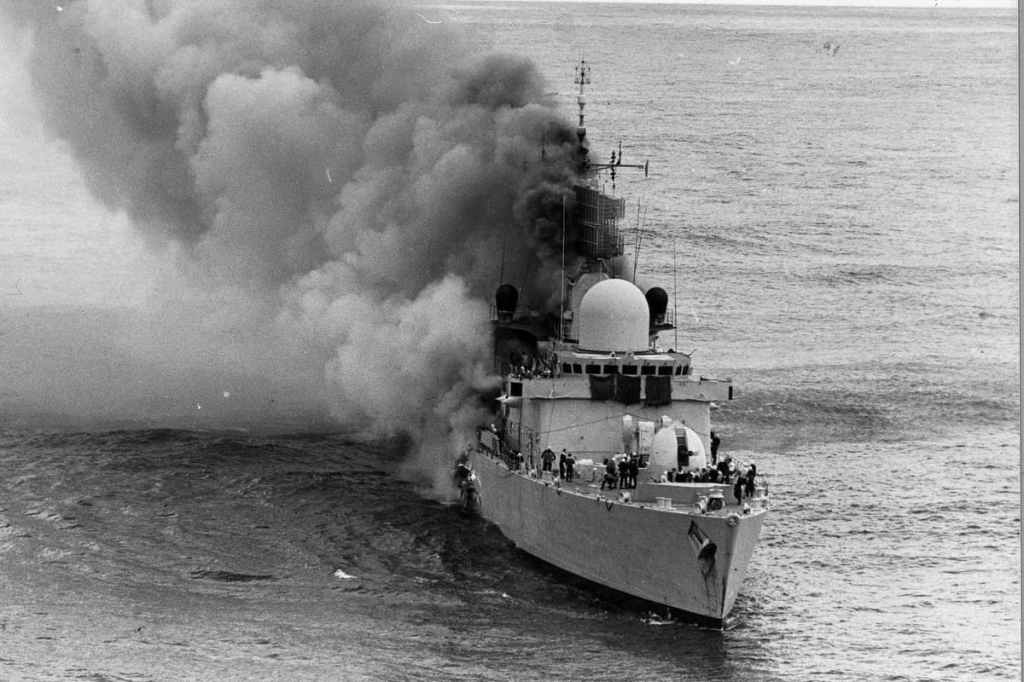
When Argentine dictator Leopoldo Galtieri ordered the invasion of the Falklands, he assumed the British would not retaliate. He was wrong. Prime Minister Margaret Thatcher, a woman of indomitable spirit, was resolute in her determination not to back down. A grand armada was assembled to reclaim the islands in the icy waters of the South Atlantic. Among the many vessels deployed to the war zone was HMS Sheffield, the lead ship of the Royal Navy’s newest class of destroyers.
Launched on 10 June 1971 by Her Majesty Queen Elizabeth II and commissioned on 16 February 1975, HMS Sheffield became the first of 14 Type 42 destroyers built for the Royal Navy. Easily recognizable by their forward Type 909 tracking radar antenna, housed within a radome above the bridge, the Type 42s — particularly the first batch — were, in my opinion, some of the best-looking destroyers of the late Cold War era.
The Type 909 radar was a crucial component of HMS Sheffield‘s equipment, as it assisted in guiding the new surface-to-air Sea Dart missiles, which entered service in 1973. Initially, HMS Bristol was designated as the primary testing platform for the Sea Dart system. However, serious fires and issues with her steam systems rendered her out of commission until the late 1970s. As a result, the responsibility for testing the new missile system fell to HMS Sheffield. During an early 1980s refit, several issues identified with the Type 909 radar were addressed. A significant gap in the ship’s capabilities, however, was the absence of an electronic countermeasures (ECM) jammer.
Following the Argentine invasion of the Falkland Islands on April 2, 1982, Sheffield was ordered to join the British task force. Supplies were loaded, loose items stowed, and markings were added to distinguish her from Argentine ships—a crucial step, as the Argentines also operated Type 42s. She reached Ascension Island on April 14.
On May 1, 1982, Sheffield began operations within the Total Exclusion Zone around the Falklands alongside other task force vessels. British naval protocol prioritized countermeasures against submarine and air threats. Sheffield and her sister ships were well equipped to counter the Argentine Air Force, provided their aircraft operated at high altitudes. However, the Type 42s were primarily designed to counter high-altitude Soviet bombers. When the Argentine jets later swooped just above the waves, launching their tricky Exocet missiles, Sheffield would pay dearly. In any case, Captain Salt then shifted his focus to countering the threat of Argentine Type 209 submarines, fearing retaliation after the sinking of the General Belgrano.
On May 4, 1982, an Argentine Neptune patrol aircraft detected HMS Sheffield. Two Super Étendard aircraft, armed with AM39 Exocet missiles, were scrambled from the Río Grande air base at 09:45, supported by a KC-130H Hercules tanker, which refueled the jets at 10:00. The Super Étendards were piloted by mission commander Capitán de Fragata (Lieutenant Commander) Augusto Bedacarratz and Teniente (Lieutenant) Armando Mayora, flying aircraft 3-A-202 and 3-A-203, respectively.
In the weeks leading up to the war, Argentine pilots extensively practiced attack scenarios against their own ships, including the two Type 42 destroyers, Hércules and Santísima Trinidad. These exercises provided the pilots with a thorough understanding of the ships’ radar systems and effective methods to evade detection.
Bedacarratz and Mayora were scouting the area where the Neptune patrol aircraft had detected the British ships. Shortly after 10:30, the Neptune updated the Étendards with the enemy positions, and the Argentine jets moved in for the attack. They approached at very low altitude, knowing the radar horizon of the Type 42s from their previous exercises. At 11:04, each pilot launched an Exocet missile from approximately 20 to 30 miles (32 to 48 km) away from their target.
At that moment, Sheffield was at second-degree readiness and positioned as one of four Type 42 destroyers cruising west of the main task force. Although intelligence had previously warned Sheffield about the potential threat posed by Exocet missiles, this threat had been dismissed as overrated. Two factors that worked to the enemy’s advantage were Sheffield‘s lack of effective radar jamming equipment and the presence of an Argentine Learjet 35 operating nearby as a decoy.
The radars of HMS Glasgow and HMS Invincible detected unidentified contacts, but patrolling Harrier jets found nothing. Consequently, the Anti-Air Warfare Coordinator (AAWC) declared the radar contacts false and kept the Air Warning at yellow, rather than elevating it to red.
Aboard Sheffield, it was only when lookouts spotted smoke from the approaching missile that the crew became aware they were under attack. The bridge officers neither summoned the captain nor sounded action stations. No evasive maneuvers were undertaken, and no attempts were made to ready the 4.5-inch gun, arm the Sea Dart missiles, or deploy chaff. The anti-air warfare officer, alerted by the principal warfare officer, reached the operations room mere moments before the first missile struck. It is clear that mistakes were made.
One missile missed Sheffield, while the other struck the ship on the starboard side, breaching the hull and disabling critical systems. The missile strike caused significant structural damage, crippling the ship’s electrical and firefighting systems. Attempts to control the fire using portable equipment proved ineffective, and confusion among the crew further hindered coordinated efforts.
After hours of unsuccessful firefighting, Captain Salt ordered the ship to be abandoned due to the risk of further explosions and air attacks. The crew evacuated to nearby ships, famously singing “Always Look on the Bright Side of Life” from the Monty Python movie “The Life of Brian” (1979), as they departed.
Over six days, the burnt-out hulk was inspected for salvageable equipment and towed by HMS Yarmouth. High seas caused flooding through the damaged hull, leading Sheffield to list and eventually sink on May 10, 1982, in the South Atlantic. The attack claimed the lives of 20 crew members, with 26 to 63 injured. Survivors were transported to Ascension Island. The wreck of HMS Sheffield remains a war grave and is protected under the Protection of Military Remains Act 1986.
The sinking of HMS Sheffield marked the first Royal Navy vessel lost in action since World War II. The Royal Navy would go on to lose another Type 42 destroyer during the conflict, as well as two frigates, the requisitioned merchant vessel SS Atlantic Conveyor, and RFA Sir Galahad. The Falklands War was a cold reminder of the lethality of guided missiles and demonstrated the flaws of the Type 42s which were addressed in later batches.
Olivier Goossens
 Heart of Oak
Leave a comment