

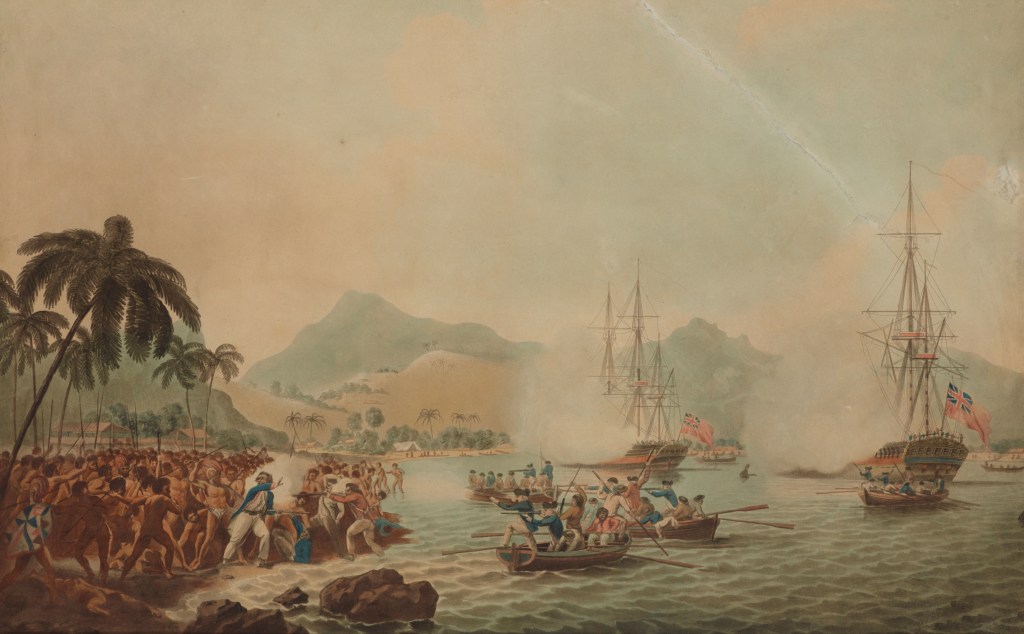
Death of Captain Cook by John Cleveley the Younger.
On January 18, 1778, the renowned Captain James Cook sighted Kauai and Niʻihau, becoming the first Europeans to behold the Hawaiian Islands. Cook was on his third and final journey, which involved exploring the North American and Alaskan coasts in search of the Northwest Passage, the theorized sea route between the Atlantic and Pacific Oceans through the Arctic. The British sought a faster route for their merchant vessels to reach the Far East, hoping to avoid the lengthy route around the Cape of Good Hope and the stormy waters off Cape Horn. Cook’s flotilla, consisting of two ships—the HMS Resolution and the Discovery—had departed Plymouth in July 1776. By the time they arrived at the Hawaiian Islands, Cook and his crew had already spent a year and a half at sea.
Cook was immediately greeted by locals who rowed out to meet him in their canoes, eager to trade. The captain soon realized that the people spoke Polynesian and were organized in a remarkably complex society. Despite an unfortunate incident that resulted in the death of one native, Cook and his men were warmly received. To his amazement, some local villagers began prostrating before him, an honor typically reserved for their own kings. However, Cook couldn’t stay long, as strong winds and rough waters forced his ships to leave their anchorage. Unable to find another safe harbor, he spent only three days ashore during his two-week stay in Hawaii.
Cook departed the islands again on February 2, 1779, and continued his exploration along the coasts of North America and Alaska, venturing as far north as the Bering Strait, where ice forced them to turn back south. The Resolution and Discovery were unable to locate the Northwest Passage, so Cook decided to spend the winter of 1778–79 in the Hawaiian Islands, allowing his men to rest and his ships to resupply.
The Resolution and Discovery arrived at the Hawaiian Islands on November 30, 1778. However, Cook refrained from landing his men until mid-January, initially preferring to stay at a safe distance and trade with the natives via their canoes. A storm at the end of December disrupted this cautious approach, as strong winds severely damaged the ships, forcing Cook to seek shelter in a harbor to repair his vessels.
On January 17, they anchored in Kealakekua Bay. As soon as the British set foot on land, they were once again greeted by masses of prostrating natives. Koa, a local priest-chieftain, performed an honorary ritual in which he draped Cook in red cloth and offered him a hog. It was then that Cook began to realize what was happening, as he noticed the locals calling him ‘Orono.’ He understood that the Hawaiians saw him as some sort of god.
The natives may have interpreted his second arrival as the prophesied coming of the god Lono, the Hawaiian deity of the year, celebrated during the Hawaiian New Year festival, Makahiki, which was occurring at that time. However, it remains debated whether the locals truly saw Cook as the incarnation of Lono. In any case, the natives continued to honor him for the remainder of January, and he was even visited by the Hawaiian king, Kalaniʻōpuʻu.
On February 4, 1779, Cook’s ships finally weighed anchor and left Kealakekua Bay, searching for another bay to settle. They were escorted by a fleet of canoes during this solemn occasion. However, the weather gods struck again, and a fierce gale tore the sails of the Adventure and broke the foremast of the Resolution. Cook was forced to return to the shelter of Kealakekua Bay once more.
This time, Cook and his men were met with a noticeably colder reception. A third arrival of Lono was not part of the prophecy, leading the Hawaiians to question the captain’s divine nature. Moreover, his return coincided with a less celebratory time—the season of Kūkaʻilimoku, the god of war, had begun. Although the king permitted Cook to repair his mast, tensions grew as several natives began stealing equipment from the British. Cook’s protests further displeased the locals, escalating the situation.
The growing hostility reached its climax on the night of February 13, when a group of angry Hawaiians stole one of Cook’s longboats, an essential craft for exploration. Dismayed and furious over the theft, Cook devised a bold plan to recover it: kidnapping Kalaniʻōpuʻu, the ruling chief of Hawaii, to arrange a swap.
Initially, all went well, and Kalaniʻōpuʻu agreed to Cook’s request to come aboard his ship. However, when Cook and his armed escort reached the beach, an angry mob prevented their sovereign from proceeding further and began threatening the British. Cook found himself in a dire situation, surrounded by thousands of enraged Hawaiians.
The captain abandoned his plan and ordered his men to leave the longboat and re-embark. The situation escalated as news simultaneously arrived of another chief being killed by British fire on the opposite side of the bay. Cook shot and killed one of his assailants but was quickly overwhelmed. A volley from his Marines failed to calm the chaos, and four of them were killed on the beach before they could reach the boats. Cook himself was stabbed from behind, then clubbed and hacked to death. The remaining members of the British landing party managed to reach the boats safely.
Command of the expedition now passed to Captain Charles Clerke of HMS Discovery. However, the ships remained in Kealakekua Bay to complete repairs. After a British watering party was attacked, the crew retaliated by setting fire to a village. Realizing that these continued reprisals would achieve nothing, Clerke negotiated a truce with the Hawaiians.
Clerke was permitted to complete repairs to the Resolution’s foremast and demanded the return of Cook’s body. Six days later, King Kalaniʻōpuʻu returned the captain’s bones, having performed the funerary rituals reserved for high-ranking individuals. To the shock of the British, these rituals included stripping the flesh from the bones. The natives handed over the larger bones, including the skull, hands, and feet, while the smaller remains had already been distributed among the populace as relics.
On February 21, Cook was given a Christian funeral with full naval honors. The very next day, Clerke weighed anchor and departed the tragic site. Clerke himself would later succumb to tuberculosis. The Resolution and Discovery arrived off Sheerness on October 4, 1780. Their return home was met with mixed emotions. While many rejoiced at the safe return of their loved ones, the nation mourned the loss of one of the greatest explorers it had ever produced.
Olivier Goossens
 Heart of Oak
Leave a comment