

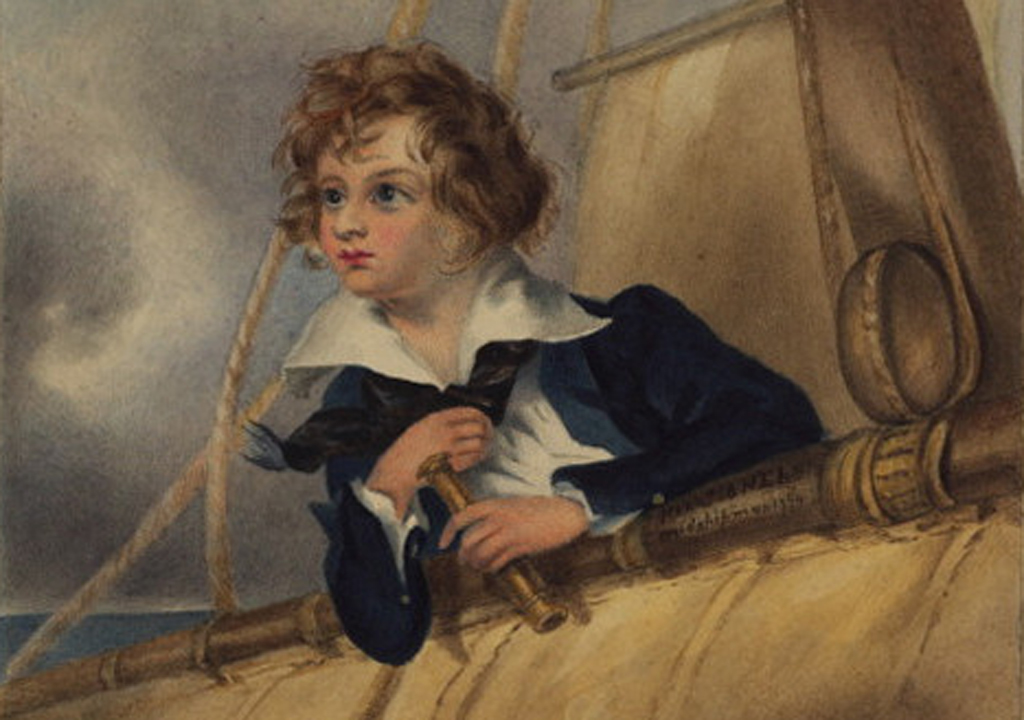
The career path for a young person aspiring to become an officer was relatively straightforward. With only a few exceptions, they typically joined a warship at a young age, ideally between 11 and 13. Joining at a later age was considered unfavorable. Seafaring was undeniably challenging, especially during the age of sail, and required considerable time to master. Consequently, these youngsters spent most of their teenage years aboard ship, learning the ropes. They were enlisted mostly as “captain’s servants.” The captain was allowed four servants per 100 men. On a first-rate battleship, this entitlement amounted to 24 men. However, no captain actually required that much assistance. Most of these youngsters were simply awaiting promotion to midshipman.
They were quartered in the gun room and placed under the supervision of the master gunner. This practice was abolished in 1794, after which aspiring midshipmen were enrolled as “Volunteers Class I” and received a pay of about six pounds per annum. To qualify as a midshipman, these young recruits initially needed to accrue three years of seafaring experience. However, some influential figures manipulated the system by officially enlisting their relatives in the “books” of a warship, even though these individuals remained ashore to pursue their education. As a result, they effectively entered the service as midshipmen without ever setting foot aboard a man-o’-war.
Before being eligible to sit for the lieutenant examination, which represented the next step in an officer’s career, one first had to serve as a midshipman for three years. If unsuccessful in these exams, individuals retained their midshipman status. Consequently, those who repeatedly failed the examination could remain midshipmen indefinitely. This situation led to a few unfortunate souls observing their peers ascend to the rank of lieutenant while they themselves remained midshipmen, as depicted by the character Mr. Hollom in the film Master and Commander.
Another notable case is that of Billy Culmer, dubbed “the oldest midshipman in the fleet,” who eventually attained the rank of lieutenant at the age of 57. Remarkably, he is said to have taken pride in this distinction. Otherwise, the typical age range for serving as a midshipman was between 15 and 22 years. Once again, nepotism and cronyism could accelerate this process. For example, Admiral Rodney had his son promoted to captain at the age of 15. This, however, proved to be an unhappy decision, as the son was later court-martialed for negligence.
Meanwhile, a man of great talent but humble origins, such as James Cook, was 40 years old when he was “made”—a popular expression signifying one’s commission as a lieutenant.
Aboard a first-rate ship-of-the-line, there were typically 24 midshipmen, while a 74-gun warship accommodated around 20 of these young men. Smaller vessels, such as frigates and sloops, typically had about 2 to 6 midshipmen aboard. Consequently, the ratio of midshipmen aboard a man-o’-war was similar to that of the previously mentioned “captain’s servants.”
Midshipmen were usually quartered on the orlop deck. On larger battleships, they had two berths for recreation, study, and dining. However, they did not sleep there; instead, they hung their hammocks in the cockpit at night and, like the rest of the crew, were expected to roll them up at daybreak. One can easily imagine the discomfort of being quartered here after a fierce naval encounter. The cockpit served as the location where the surgeon treated wounded sailors during battle, so the scent of blood and sweat must have lingered in the air.
The atmosphere in the midshipmen’s living quarters often exhibited a recognizable dynamic, given their youthful age. This environment frequently displayed more childish behavior, including pranks and, unfortunately, instances of bullying—particularly by older midshipmen toward newcomers.
Midshipmen were expected to cover the costs of their own books, navigational equipment, bedding, and uniforms. These expenses were significant and effectively limited access to this position to the middle and upper classes, who could afford such items. Sons of merchants or the working class rarely entered the navy with aspirations of becoming officers. Approximately 50% of midshipmen were relatives of professional men, such as priests, captains, or doctors. The other 50% came from the higher echelons of society, namely the landed gentry and aristocracy.
In some respects, the regime of the midshipmen was as stringent as that of an ordinary seaman. They received the same food rations, although some affluent individuals received financial assistance from their families to supplement their nourishment. Moreover, they could face equally severe punishments as able seamen, such as enduring the punishment known as “kissing the gunner’s daughter,” which involved being flogged while tied to the barrel of a gun. However, they were often spared the humiliation of public flogging.
Another common disciplinary measure was “mastheading,” wherein they were compelled to sit aloft in the rigging on the crosstrees for several hours, sometimes enduring stormy and bitterly cold weather. Once again, personal connections could easily influence a captain’s attitude toward a particular midshipman, making him more lenient toward the young man.
As an example, I wish to reference the masterpiece Master and Commander. In this film, we observe Captain Jack Aubrey providing special care to the young Mister Blakeney, assuming a fatherly role toward him, as the captain is very close to the young man’s parents.
What were the duties of a midshipman? Firstly, they were expected to actively assist in the watch system under the supervision of a lieutenant. The ship’s crew was divided into three watches, spread out across different parts of the ship. Midshipmen could also be called upon to take command of one of the ship’s boats or even to command a prize—a captured ship.
During naval engagements, they served as deputies to the lieutenants and as aides-de-camp to the captain. When not on duty, they were expected to study and train themselves in various skills. Typical training included practicing knots, casting lead, training with small arms, and manning the big guns. While at sea, midshipmen were required to keep detailed navigational logs, which they had to present to the captain.
Olivier Goossens
 Heart of Oak
Leave a comment