

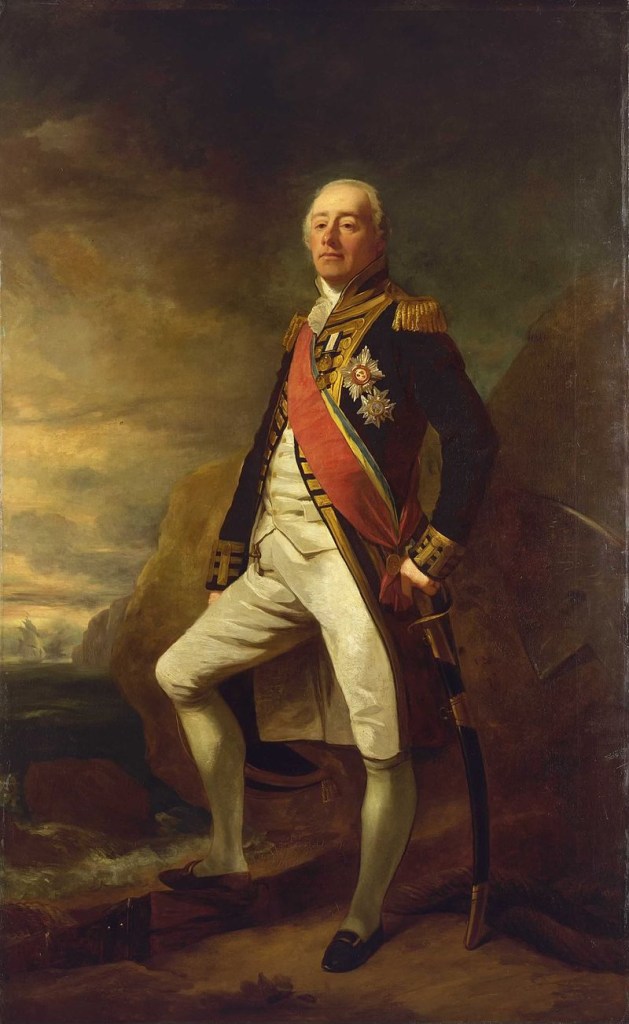
Admiral James Saumarez, 1st Baron de Saumarez, was a British naval officer whose career spanned the American Revolutionary War, Napoleonic Wars, and beyond. He is best known for his leadership during the Second Battle of Algeciras in 1801. He was second-in-command at the Nile in 1798.
Saumarez was born in Saint Peter Port, Guernsey, into a prominent naval family; his uncle was Captain Philip Saumarez. He joined the Royal Navy at the age of 13 in 1770. During the American War of Independence, he impressed his superiors with his quick thinking and bravery. Initially posted aboard Sir Peter Parker’s flagship, HMS Bristol, he distinguished himself under Parker’s command and served as acting lieutenant during the Battle of Sullivan’s Island on 28 June 1776. He fought with remarkable fervor and courage, although the operation ultimately failed to capture Charleston.
Promoted to lieutenant in 1778, Saumarez earned command of the galley Spitfire. After 47 engagements, he burned the vessel on 30 July 1778 to prevent capture by the French. He later served as third lieutenant aboard the legendary HMS Victory, under various commanders, eventually attaining the rank of 1st lieutenant under Sir Hyde Parker. Saumarez followed Parker aboard the 74-gun HMS Fortitude, where he participated in the Battle of Dogger Bank in 1781 and sustained a wound. After being promoted to commander, he sailed to the West Indies, arriving in time to witness the final stages of Admiral Hood’s victory off St. Kitts.
At the Battle of the Saintes (1782), Saumarez commanded HMS Russell of 74 guns, and took his ship out of line to help take the French flagship Ville de Paris. Admiral Rodney commended his initiative and skill, having said reportedly during the engagement:
“The Russell’s captain is a fine fellow, whoever he is.”
After years on half-pay, Saumarez was finally awarded command of a vessel again following the outbreak of war with France in 1793. With his frigate HMS Crescent, a 36-gun ship, he gained prominence in one of the first single-ship actions of the war. On 20 October 1793, he captured the French frigate Réunion, which was subsequently pressed into the Royal Navy. Saumarez and his crew achieved this remarkable victory with only one man wounded, an impressive accomplishment, while the French suffered 81 casualties. In recognition of this success, he was knighted by King George III.
In 1794, Saumarez commanded the Guernsey-based Channel Islands Squadron, consisting of three frigates, which included his beloved HMS Crescent. He successfully disrupted French plans to invade the Channel Islands with a force of 20,000 troops. Saumarez skillfully navigated his squadron through dangerous waters to the safety of the St. Peter Port anchorage, evading a superior French force. This strategic maneuver prevented the destruction of his squadron and effectively deterred the French from attempting to invade Guernsey and Jersey.
As captain of HMS Orion, Saumarez took part in Admiral Hood’s significant victory against the French off Lorient on 22 June 1795. He was then sent to Admiral Jervis’ fleet at Gibraltar as a reinforcement. As a member of Jervis’ squadron, Saumarez played a crucial role in the Battle of Cape St. Vincent in 1797. He forced the Salvador del Mundo to strike her colors and then attacked the formidable Santissima Trinidad (130 guns). Saumarez nearly succeeded in capturing this massive ship, but his efforts were ultimately thwarted by the arrival of Spanish reinforcements.
Saumarez continued serving with Jervis’s fleet and took part in the blockade of Cadiz from February 1797 to April 1798. In May 1798, the Orion joined Nelson’s squadron, which was deployed to the Mediterranean with the objective of locating and defeating the French fleet. Saumarez served as Nelson’s second-in-command during the Battle of the Nile, where he further demonstrated his prowess by securing the surrender of the Peuple Souverain and the 80-gun Franklin.
Saumarez then commanded HMS Caesar, an 80-gun ship, to monitor the French fleet off Brest during the winters of 1799 and 1800. In 1801, he was promoted to Rear-Admiral of the Blue, created a baronet, and commanded a squadron to observe the Spanish fleet at Cadiz. During the Algeciras campaign in July 1801, he displayed outstanding resilience by regrouping after an initial defeat and pursuing the enemy despite being outnumbered. In the Second Battle of Algeciras (12–13 July 1801) arguably his finest moment, his forces achieved significant success, resulting in the destruction of two Spanish ships and the capture of a French vessel. Saumarez was honored with the Order of the Bath and the Freedom of the City of London. In 1803, the UK Parliament granted him an annuity of £1,200 per year. During the Peace of Amiens (1802–03), Saumarez stayed in Guernsey with his family, and when war resumed, he once again took command of forces defending the Channel Islands. He was not present at the Battle of Trafalgar in 1805 and was promoted to Rear-Admiral of the White on 23 April 1804.
From 1808 to 1812, Saumarez commanded the Baltic fleet, ensuring British trade routes remained open and maintaining a blockade of French-controlled ports. His diplomatic skills earned him recognition, including the Swedish Order of the Sword, as he skillfully managed relations with the Swedish government and their shipping. Saumarez accurately predicted that the Swedes, compelled to declare war on Britain by Napoleon, would eventually resist the French.
Before his elevation to Admiral of the Red in 1830, Saumarez also held senior positions such as Commander-in-Chief at Plymouth between 1824 and 1827. In 1831, he was created Baron de Saumarez in recognition of his naval achievements. He died in Guernsey in 1836.
Saumarez’s legacy includes a statue at the National Maritime Museum and references in naval fiction, including C.S. Forester’s Hornblower series. His leadership is widely regarded as exemplary and Saumarez is seen as one of Britain’s most able commanders during the wars with France.
Olivier Goossens
 Heart of Oak
Leave a comment