

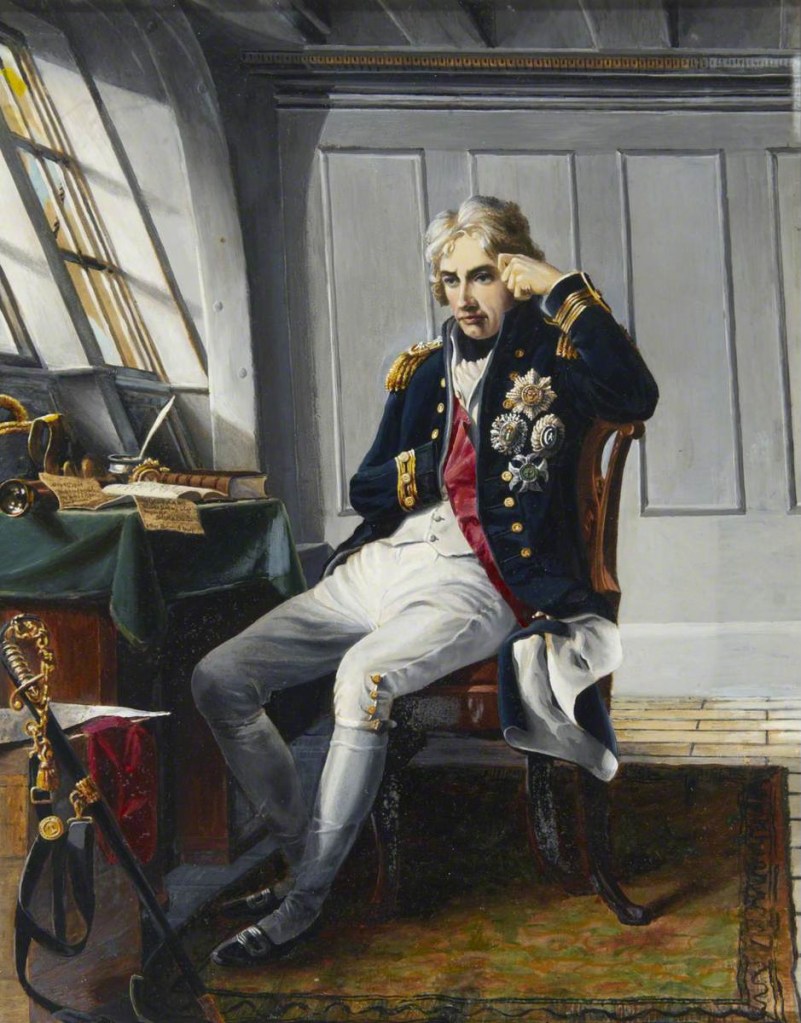
Who was Lord Horatio Nelson? What did he stand for? What did he believe in? Answering these questions in full would require lengthy biographies—and rightly so. One effective way to provide a legitimate short answer is to highlight a selection of quotes attributed to the man himself. So here they are …
- “You must consider every man your enemy who speaks ill of your king: and…you must hate a Frenchman as you hate the devil.” Robert Southey Life of Nelson (1813) ch. 3
Despite his infamous affair with Lady Hamilton, Lord Nelson was a devout Christian. He was also a proud Englishman who firmly believed in Britain’s rightful place as a global superpower. He saw it as every Briton’s duty to sacrifice their life for their country if necessary. Additionally, he upheld the traditional social order, with the king’s unalienable authority at its pinnacle.
2. “Before this time to-morrow I shall have gained a peerage, or Westminster Abbey.” before the battle of the Nile, 1 August 1798; Robert Southey Life of Nelson (1813) ch. 5
This illustrates Lord Nelson’s obsession with total victory: he would either crush his enemy or die trying. To further underscore this, consider his famous words during the Battle of St. Vincent (1797) as he gave the order to board the Spanish ship San Josef: “Victory or Westminster Abbey.”
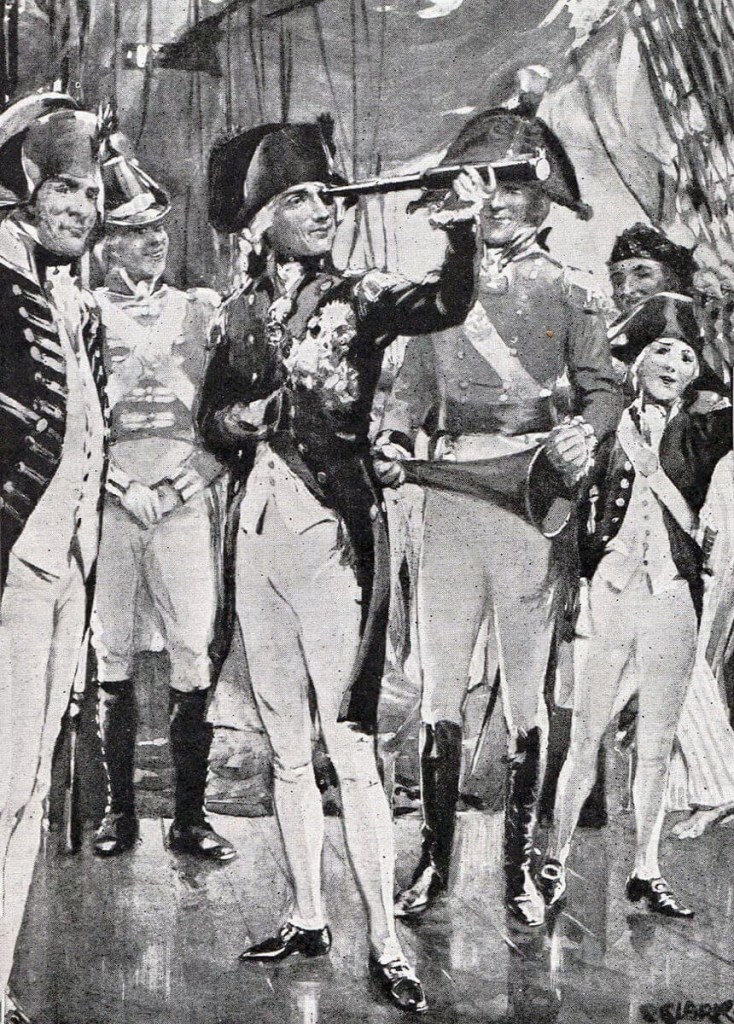
3. “I have only one eye,—I have a right to be blind sometimes…I really do not see the signal!” at the battle of Copenhagen, 1801; Robert Southey Life of Nelson (1813) ch. 7.
During this engagement, his superior, Admiral Hyde Parker, ordered him to disengage. However, in his indomitable spirit, Lord Nelson refused. Defiantly, he raised a telescope to his right eye—blinded in Corsica in 1794—and aimed it toward Parker’s signal, deliberately choosing not to see it… The expression “to turn a blind eye” is reportedly derived from this episode.
4. “In case signals cannot be seen, or perfectly understood, no captain can do very wrong if he places his ship alongside that of an enemy.” memorandum to commanders of ships before the battle of Trafalgar, 10 October 1805, in The Naval Chronicle vol. 14 (1805)
This quote underscores Nelson’s revolutionary approach to naval warfare and the foundation of his success. He encouraged his captains to take initiative during the heat of action. At the time, the Royal Navy was an institution deeply rooted in regulations and rigid tactics, leaving little room for individual action. Nelson demonstrated the effectiveness of his approach during the Battle of Cape St. Vincent in 1797, when he broke from the British line to support the outnumbered vanguard—without waiting for orders from Admiral Jervis. As often happens in battle, gun smoke seriously hampered signaling. Rather than wait for a signal he might never see, Nelson acted as he believed aligned with Jervis’s wishes. When Jervis’s flag captain commented on this insubordination, the admiral, a great admirer of Nelson’s boldness, replied, “It certainly was so, and if you ever commit such a breach of your orders, I will forgive you also.”
This entire approach was built on trust, respect, and camaraderie. Nelson sought to surround himself with officers who shared his mindset and could independently determine the best course of action during an engagement without waiting for the admiral’s orders. By freeing his officers from the need to constantly await instructions, they could act with greater speed and decisiveness. To cultivate this like-minded, victory-obsessed group of captains, Nelson frequently held private, amicable discussions with his subordinates, focusing primarily on tactics and strategy. These conversations ensured that they were aligned in their thinking and that Nelson could trust them to take the initiative in battle. He often asked for their opinions, making the captains feel heard and respected by their admiral.
This approach fostered deep mutual respect and loyalty, creating a group of captains who admired Nelson and were willing to risk their lives for him. Nelson affectionately referred to them as his “Band of Brothers.” Together, they achieved greatness. An example of this trust in action occurred during the Battle of the Nile (1798). Captain Foley, leading the British column, noticed a narrow navigable passage between the French fleet and the mainland. Recognizing the opportunity, he seized it without waiting for permission. This maneuver allowed the British to attack the French from both sides, leading to the complete destruction of the enemy fleet. Foley’s decisive action perfectly exemplified the independence and initiative that Nelson expected from his captains.
5. “May humanity after Victory be the predominant feature of the British Fleet.” diary entry, on the eve of the battle of Trafalgar, 21 October 1805; Nicholas Harris Nicolas (ed.) Dispatches and Letters of…Nelson (1846) vol. 7, p. 139.
This once again demonstrates Nelson’s commitment to Christian morals, with clemency being of utmost importance to him.
6. “England expects that every man will do his duty.” at the battle of Trafalgar, 21 October 1805; Robert Southey Life of Nelson (1813) ch. 9
This famous signal was hoisted by Nelson aboard HMS Victory during the pinnacle of his naval career—the triumph at Cape Trafalgar on October 21, 1805. However, around a quarter past one, he was shot by a sniper from the French ship Redoubtable, which mortally wounded him.
7. “Thank God, I have done my duty.” at the battle of Trafalgar, 21 October 1805; Robert Southey Life of Nelson (1813) ch. 9
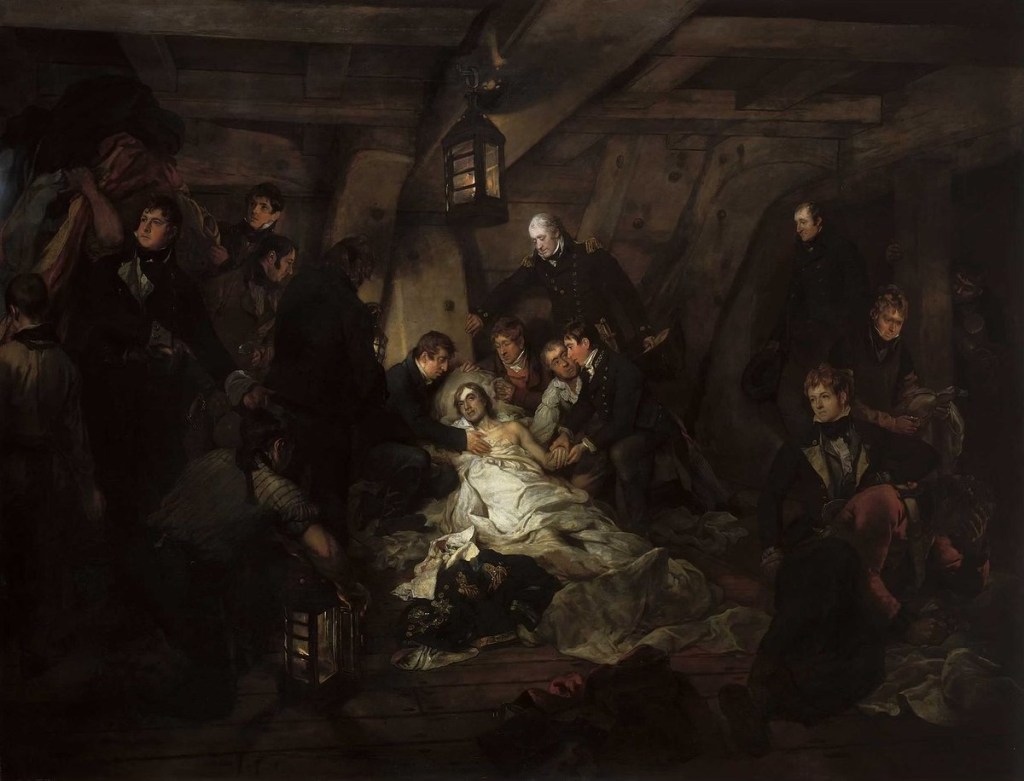
After being shot, he was carried belowdecks to be cared for by the surgeon William Beatty. He died around half-past four. In his final moments, his thoughts were with God, the battle, his country, the king, and the love of his life, Lady Hamilton.
8. “Kiss me, Hardy.” at the battle of Trafalgar, 21 October 1805; Robert Southey Life of Nelson (1813) ch. 9
Among the men present at Nelson’s side at the time of his death was his flag captain and close friend, Thomas Hardy. As Nelson grew weaker, he said, “Kiss me, Hardy.” Hardy knelt and kissed him on the cheek. After standing silently for a moment, he kissed Nelson again on the forehead. Deep and sincere friendship remained a cornerstone of Nelson’s life, even in his final moments.
 Heart of Oak
Leave a comment