

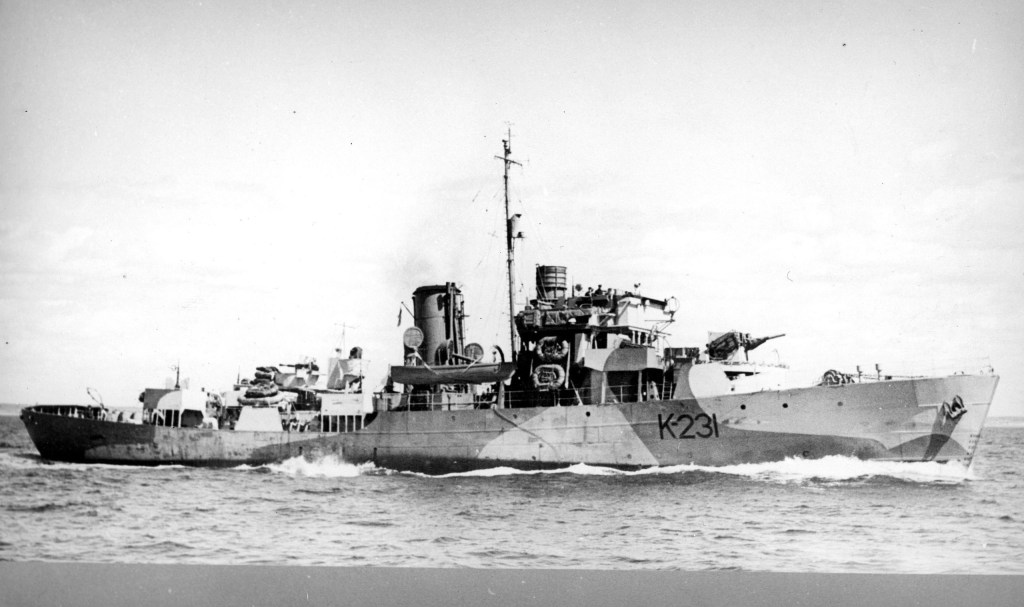
The Flower-class ships were designated corvettes, a type of small vessel primarily designed for use as convoy escorts. These ships were built following Churchill’s emphasis on the importance of ensuring the safe flow of trade to Britain. He had learned valuable lessons from the First World War, when Germany’s unrestricted submarine warfare had brought Britain to the brink of starvation.
The Flower-class design was based on that of small whaling ships. Approximately 294 units were produced, many of which served with the Canadian Navy. Canadian ships, such as HMCS Calgary, were typically named after Canadian communities, while their British counterparts, true to their class name, were named after flowers.
Initially, the Canadian units were modified to serve as coastal auxiliary vessels with minesweeping capabilities. However, as the war progressed, they were adapted for open-sea operations. These ships went on to play a crucial role in the Battle of the Atlantic, ensuring the safe flow of supplies and the transportation of troops to Britain and Allied forces in Europe.
The Calgary (K231) was launched in August 1941 and commissioned later that year. She served for approximately one year with the Western Local Escort Force (WLEF). This force was responsible for escorting convoys from North American ports to the Western Ocean Meeting Point (WOMP or WESTOMP) near Newfoundland, where the Mid-Ocean Escort Force (MOEF) assumed escort duties. A notable episode during this deployment was the rescue of 71 crew members of the merchant ship Pacific Pioneer, which was torpedoed by U-132.
In November 1942, Calgary was set to change her environment, leaving the cold waters of the North Atlantic for the warmer Mediterranean to assist in Operation Torch, the massive Allied invasion of North Africa. However, mechanical problems upon her arrival in Britain delayed her return to service until April 1943, causing her to miss the action in North Africa.
In June 1943, she joined the 5th Support Group under Western Approaches Command, tasked with ensuring the safe arrival of shipping into the UK through the Western Approaches. During this period, she experienced intense combat. On 23 August 1943, she was dispatched, along with the rest of the 5th Support Group, to relieve the 40th Support Group in their submarine hunt off Cape Ortegal. Calgary and the other vessels from both groups then came under heavy attack by Dornier Do 217s and Junkers Ju 87s, armed with the new Henschel Hs 293 anti-ship guided missile. Calgary escaped damage, but HMS Bideford was struck, resulting in the deaths of several sailors. During the return journey to port of the 5th and 40th Support Groups, they once again became targets of the Luftwaffe and their new Wunderwaffe. This time, the Canadians were also targeted, with one Henschel missile finding its mark on HMCS Athabaskan. Fortunately for the Canadians, the missile passed clean through the hull of the ship before detonating in the sea. HMS Egret was not so lucky; the ship sank, and 194 of her crew perished beneath the waves. Calgary again escaped the action unscathed.
Calgary’s “moment of glory” came on November 20, 1943, when she, along with HMS Nene and HMCS Snowberry, sank U-536 northeast of the Azores. Calgary then transferred from the 5th to the 6th Support Group before being placed in dry dock for a refit in January 1944.
She was reactivated just in time to take part in Operation Neptune, D-Day. Afterwards, she was assigned to the Nore Command, where she remained for the rest of the war. This commission was not without action, as Calgary added a second kill to her record by sinking U-322 south of Weymouth. She returned to Canada in May 1945 and was broken up some six years later.
Olivier Goossens
 Heart of Oak
Leave a comment