

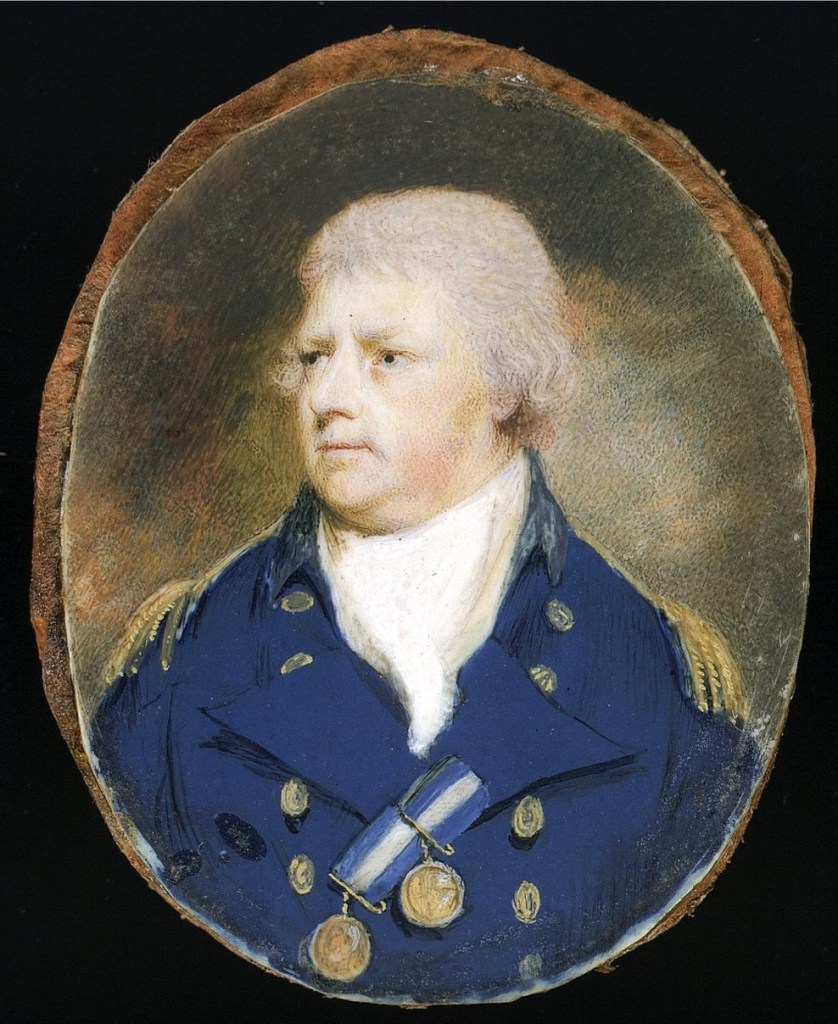
Foley was the second son of John Foley, a Pembrokeshire landowner from Llawhaden near Narberth, and nephew of Captain Thomas Foley, who accompanied George Anson’s famous circumnavigation. Thomas joined the Royal Navy in 1770 and soon saw action in the West Indies during the American War of Independence. As a young officer, Foley was present at two significant events during this conflict: the naval victory against the Spanish at Cape St. Vincent (1780) and the Battle of the Saintes (1782), both key triumphs under Admiral Rodney. These early experiences cemented his reputation as a capable and courageous officer.
In the French Revolutionary Wars, Foley’s career accelerated. He served as the flag captain of Admiral John Gell and Sir Hyde Parker during key engagements off Toulon (1793-1795) and later took command of 74-gun HMS Goliath. It was aboard this ship that he would have his finest moment.
HMS Goliath played a decisive role at the 1798 Battle of the Nile. Foley boldly maneuvered his ship around the French fleet’s van, attacking from an unexpected angle between the enemy line and the mainland. This move significantly contributed to Nelson’s stunning victory. Whether Foley acted on his initiative or Nelson’s orders actually remains debated.
In 1801, Foley served as Nelson’s flag captain aboard HMS Elephant during the Battle of Copenhagen. This battle is famous for Nelson’s defiance of orders to disengage, claiming, “You know, Foley, I only have one eye—I really do not see the signal!” Foley’s steady leadership was pivotal in this action.
Though offered the prestigious role of Nelson’s Captain of the Fleet in 1805, Foley declined due to ill health. The position subsequently went to another of Nelson’s “darling children,” Thomas Hardy. Foley continued to serve in other capacities, commanding in the Downs (1811–1815) and eventually rising to the rank of Admiral. He died in 1833 while serving as the Commander-in-Chief at Portsmouth.
Foley married Lady Lucy Anne FitzGerald in 1802, a remarkable figure in her own right. She was a descendant of Charles II, King of England, Scotland, and Ireland, and his mistress Louise de Kérouaille, Duchess of Portsmouth. The youngest daughter of the Duke of Leinster and the favorite sister of Lord Edward FitzGerald, one of the ill-fated leaders of the 1798 Irish Rebellion, she was clandestinely involved in the Irish nationalist movement and wrote passionately for Irish independence.
Foley purchased Abermarlais estate in Carmarthenshire with prize money from the capture of the Spanish treasure ship St Jago (1793). The estate became his principal residence until his death in 1833, and his widow, Lady Lucy, lived there until moving to France.
Sir Thomas Foley’s career exemplified dedication and great tactical ability. His contributions at the Nile and Copenhagen, alongside his role in Nelson’s “Band of Brothers,” cemented his place in naval history. His legacy lives on as one of Britain’s finest naval heroes.
He was one of the few, the happy few, that band of brothers, and they shall be remembered.
Olivier Goossens
 Heart of Oak
Leave a comment