

The Seven Years’ War is often hailed as the first true “world war,” and rightly so. Though its bloodiest battles raged across European soil, the conflict stretched across several continents. In North America and India, British and French forces fought fiercely for dominance over these distant, wealth-laden territories, each empire determined to expand its reach and influence. In January 1762, Spain entered the fray as another powerful colonial contender. Having remained neutral during the war’s early years, Spain was ultimately drawn in by Britain’s escalating power. British victories in India and the capture of Quebec and Montreal in North America had left the island nation overwhelmingly dominant in overseas territories, upsetting the global balance. This shift exposed Spain’s colonies—unprepared for British aggression—. Spanish King Charles III, increasingly inclined to support France, took action: British merchants were expelled, and their vessels seized in Spanish ports, prompting Britain to declare war.
Britain’s first strike came across the Atlantic. In June, British forces under the command of General George Keppel and Admiral George Pocock launched a successful assault on the Spanish stronghold of Havana in Cuba. By occupying this critical harbor, the British aimed to weaken Spain’s presence in the West Indies and to protect their recently acquired American territories from potential Spanish aggression. Moreover, the capture of such a vital part of the Spanish empire would serve as a valuable bargaining chip in future peace negotiations.
Meanwhile, Lieutenant-Colonel William Draper, a classical scholar by education, was on leave in London from his regiment in Madras and he proposed an ambitious plan: an attack on Manila in the Philippines, Spain’s main city in the Pacific. Draper argued that Manila would be a relatively easy target, as the Spanish did not anticipate an enemy assault on such a distant location. Most of the defenses of Manila indeed proved to be in a very poor state. Furthermore, news took six to eight months to reach Manila, meaning that, if the British moved quickly, they could strike before the Spanish were even aware of the war. However, organizing such an expedition posed an enormous challenge, and Manila was not just any town—it was the hub of Spain’s Pacific trading empire and therefore had a sizable garrison of more than 10,000 defenders. Draper’s plan was accepted, and he was appointed as the commander of ground forces for the expedition, with orders sent to the East India Company in Madras to support him with an infantry detachment of two regiments. Additionally, the British intended to colonize Mindanao, the southernmost of the larger Philippine islands.
The Expedition to Capture Manila:
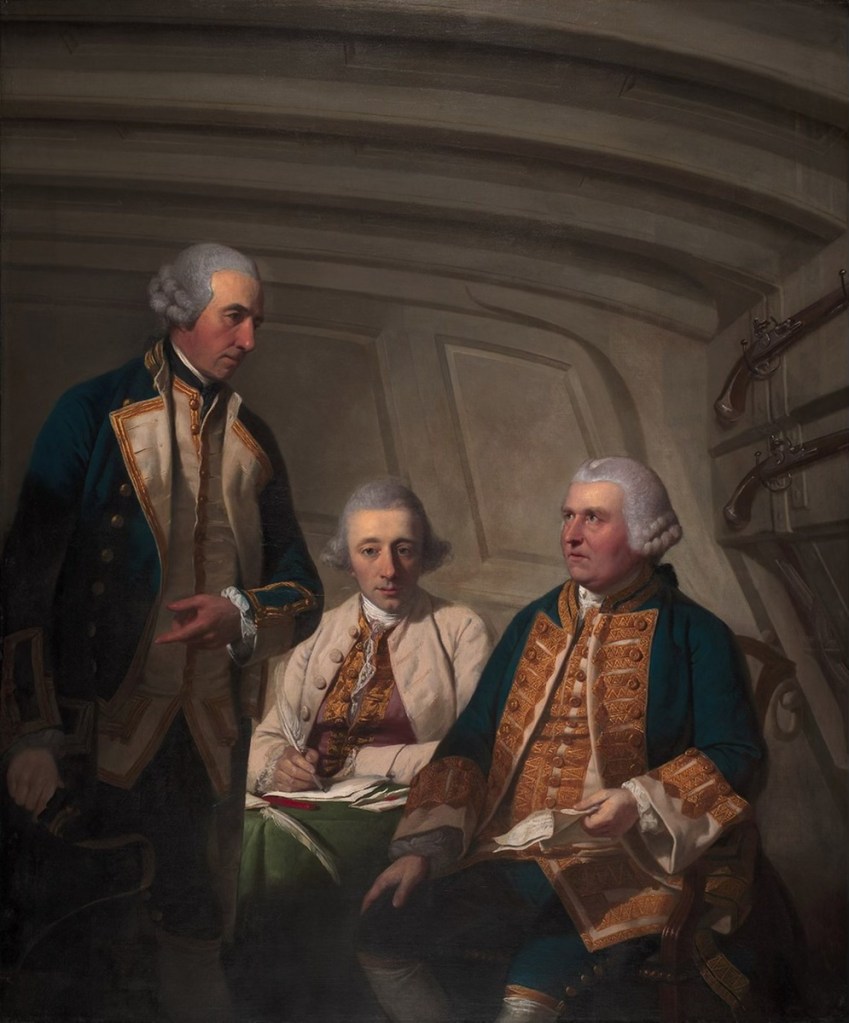
In June 1762, Brigadier Draper arrived in Madras, where he organized a 1,700-strong force, including 600 Indian sepoys, some East India Company artillery, and local recruits. Vice-Admiral Samuel Cornish, commander of the naval forces in India, pledged to support the mission with a fleet of 8 ships of the line, 3 frigates, and 3 East India Company’s vessels. Cornish was a man of great ability, having risen through the ranks without the advantages of an aristocratic background and formal education. His flag captain was the able Richard Kempenfeldt and his second-in-command was Commodore Richard Tiddeman. This was by no means a grand armada, but still Cornish and Draper hoped that the unexpected arrival of several British ships of the line would strike fear into the enemy’s hearts and cause a swift surrender. Meanwhile, the frigate Seahorse of Captain Grant was ordered to sail ahead of the fleet on 19 July in the Singapore Straits to sever the Spanish lines of communication: Draper and Cornish wanted to maintain absolute secrecy. In early August Draper and Cornish’s expeditionary force set sail. They successfully reached Manila on September 23. The first part of the mission was a success: the arrival of the British indeed came as a total surprise. The Spanish governor, the Archbishop and Governor-General of Manila, Manuel Rojo sent a messenger to request the reason of the fleet’s presence. He was immediately informed of the war between the two countries, and he hurried his men to the defenses, declining the British proposal of surrender. Cardinal Rojo, a man of the cloth, was convinced that in the end, God would come to the aid of the Catholics. Draper and Cornish identified a suitable landing site two miles south of the city opposite a church called the Malata. The British began their assault on the beach covered by the three frigates of the fleet and some longboats equipped with 6-pounder guns. Despite heavy surf damaging weapons and supplies, the landing proceeded without direct resistance. The first attack wave consisted of marines, Draper’s 79th regiment and some East India Company artillerymen. More men would follow the next days.
The Siege and Assault on Manila
Following their successful landing, the British soldiers began securing positions near the city. A powder store was taken from which Draper organized the provisioning of the ground forces. Colonel Monson, in charge of the left wing, captured the Hermita church, which became the general headquarters. These positions furthermore provided valuable shelter against the occasional heavy monsoon rainfall which was over the Phlippines around that time of year.
Spanish troops launched a counterattack on 26 September, commanded by the Frenchman, Chevalier Faillet, but the Spanish were repelled by Draper’s troops. Archbishop Rojo continued, however, to decline surrender proposals. Meanwhile, the British had captured a Spanish galley, and the men aboard informed them that a valuable galleon, loaded with silver—the Filippino—was nearby. This news, reminding the British of Anson’s capture of the treasure ship Nuestra Señora de Covadonga about twenty years prior, set their hearts racing at the prospect of securing such a prize. Cornish immediately detached two ships, the frigate Argo and HMS Panther, a 60-gun vessel, to search for and apprehend this ship. The departure of these two ships were delayed, however, by adverse winds until 4 October.
By early October, British troops had positioned batteries to bombard the city and breach its walls. The ships of the line could finally make themselves heard and contribute to the battle with their broadsides. A heavy bombardment began on October 4. In total, the 24-pounders on Cornish’s ships fired 2,244 rounds, expending 34,600 pounds of gunpowder. Simultaneously, Rojo launched a second, larger counterattack. However, the disorganized and poorly trained native troops were repelled by the defending soldiers and marines, but this time at a higher cost, losing 16 or 17 men in the battle. British commanders decided to proceed with a full assault the next day.
Chevalier Faillet, recognizing the futility of further resistance, advised Rojo to surrender. The Governor-General of Manila finally relented, and negotiations took place on October 5. Draper’s classical education proved useful, allowing him to communicate relatively easily with Rojo in a language they both knew: Latin. The British troops subsequently occupied the citadel and reinforced its defenses, while honoring their promise that locals could resume their daily activities without interference. Kempenfeldt replaced Rojo as the local governor. The mission was a success. With relatively limited resources, the Royal Navy and British Army—working in perfect coordination—managed to capture the heart of Spain’s commercial empire in the Pacific.The attackers suffered around 150 casualties, while the Spanish lost approximately 100 men, with a further 9,250 captured after the surrender.
The British, however, did not pursue colonization of Mindanao, and their control never extended beyond the confines of Manila. They did use the city as a bargaining chip in peace negotiations the following year. During the Treaty of Paris in 1763, the Spanish ceded Florida to Britain to regain Cuba and the Philippines. Once the Spanish returned to the Philippines, there was little reason for celebration. The country was in turmoil, and re-establishing Spanish authority took considerable effort. Meanwhile, the Argo and Panther, in search of the galleon Filippino, unknowingly chased a ghost, as the Filippino had taken shelter in Samar’s harbor for repairs. By a stroke of luck, however, the two ships encountered another galleon heading in the same direction as the Filippino. This vessel, the Santissima Trinidad, yielded approximately 500,000 pounds—an astronomical sum for the time. This secured the wealth of the captains Richard King and Hyde Parker, who commanded the Panther with his son as first lieutenant, illustrating the nepotism prevalent in the Royal Navy at the time. It was this younger Hyde Parker who would later nominally command the British fleet at the Battle of Copenhagen in 1801. In any case, the Capture of Manila in 1762 is a notable example from the Seven Years’ War of the achievements possible through British army and navy cooperation. After their success at Louisbourg, Quebec and Havana, the island nation once again demonstrated its excellence in amphibious warfare.
Olivier Goossens
 Heart of Oak
Leave a comment