

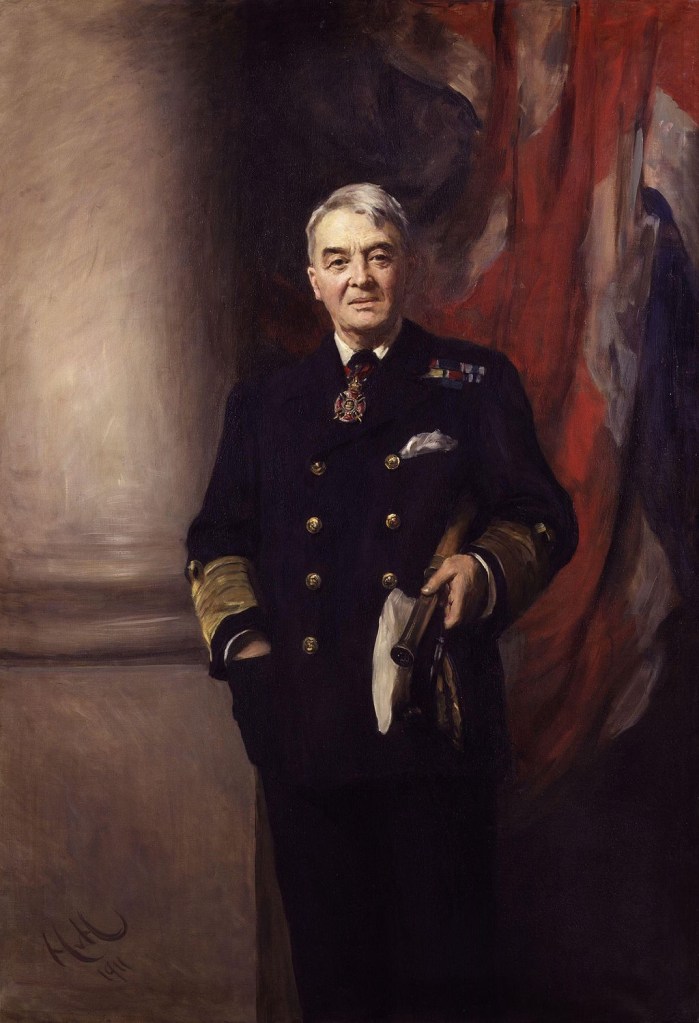
Lord Fisher. Painting by Hubert von Herkomer. National Portrait Gallery.
When the Royal Navy went to war with Germany, its fleet was, for the most part, the brainchild of Lord John Fisher. Who was John Fisher, and why was he considered such an influential figure in the Royal Navy at the time? Let’s dive into history!
John “Jackie” Fisher was born in Ceylon in 1841 to Sophia Fisher and Captain William Fisher, a British Army officer in the 78th Highlanders. Energetic, ambitious, enthusiastic, and clever, the promising lad had a bright future ahead of him. On the recommendation of his godmother, Lady Horton, who knew Admiral Sir William Parker, John entered the navy in 1854 at the age of 13.
He became a midshipman in 1856, and during his early years, he served all over the world, from China to Constantinople. It was with the China Squadron that he had his first, albeit brief, command: the paddle-gunboat HMS Coromandel. Time and again, he astounded his superiors with his intelligence, achieving remarkable grades in navigation, seamanship, and gunnery.
In 1869, he was promoted to Commander, and eight years later, he became the flag captain to Admiral Astley Cooper Key of the North America and West Indies Station aboard the ironclad HMS Bellerophon. Over the following years, he received many more commissions, all of which he executed with distinction.
He was honored with the command of the powerful new battleship HMS Inflexible, a vessel boasting the largest guns and the thickest armor of any ship in the navy. Stationed in the Mediterranean, he saw action aboard the Inflexible during the 1882 Anglo-Egyptian War. It was during this period that he developed a close friendship with the future King Edward VII.
With his credentials, connections, and genius, his appointment as admiral was only a matter of time. This came in 1891, when he was made Admiral Superintendent of the dockyard at Portsmouth. After reaching such heights, Fisher immediately started dedicating himself tirelessly to turning the Royal Navy into a modern, uninvincible fighting force.
During the 1890s, his primary interests lay in improving gunnery, mines, torpedoes, and the application of electricity in the navy. He was also a talented administrator, excelling as Director of Naval Ordnance (1886–1891), Admiral Superintendent of Portsmouth Dockyard (1891), and Controller of the Navy—a position within the Navy Board itself (1892–1897).
In 1897, he became Commander-in-Chief of the North America and West Indies Station, and two years later, of the Mediterranean Fleet. In 1902, he was appointed Second Sea Lord, a position that gave him responsibility for pay, training, and welfare. During the early 20th century, he particularly focused on education, recognizing the urgent need for rapid reform in the training of naval officers. At the time, officers received their education aboard the retired ship-of-the-line HMS Britannia at Dartmouth, leaving them ill-prepared for the swift technological advancements of the era. Figures like Captain Percy Scott demonstrated that the Royal Navy’s future depended on leaders who were innovative and imaginative in their approach to technology. The challenge Fisher faced was daunting, as the service was dominated by conservative hardliners who struggled to grasp the significance of the changing world and the need for innovation.
A significant step in the right direction was the establishment of a shore-based training institution, the Britannia Royal Naval College, just outside Dartmouth (which today remains the sole center for Royal Naval officer training). As Second Sea Lord responsible for training, John Fisher had the unique opportunity to thoroughly modernize the education of officer cadets.
Fisher devised the so-called Selborne Scheme, named after the then First Lord of the Admiralty. Fisher proposed that all cadets, regardless of their branch, should receive a common education up until their lieutenant’s exams—a radical idea at the time! He believed that this shared curriculum would integrate technological knowledge into a more adaptable officer corps. Additionally, Fisher sought to elevate the status of engineers, whose roles were becoming increasingly vital in the rapidly evolving navy. However, this initiative was a long-term investment, with Britain only reaping its benefits some 20 years later. Naturally, this made it much harder for Fisher to persuade the older conservatives of the plan’s merits.
One particularly sensitive issue for the older generation of officers was Fisher’s proposal that engineers should also be eligible to command warships. Traditionally, the captaincy of a vessel was the exclusive prerogative of the executive branch of the officer corps. Faced with strong opposition, Fisher was forced to abandon his vision of creating an interchangeable officer corps.
Another issue with the Selborne Scheme was that it failed to address one of the navy’s biggest problems: the shortage of officers. In the years leading up to the First World War, the arms race with Germany drove a rapid expansion of the fleet, increasing the number of warships significantly. However, perhaps the scheme’s biggest shortcoming was its failure to adequately address the distinct training requirements for the executive branch, engineers, and Royal Marines. Royal Marine officers were entirely overlooked by Fisher, and the Naval Engineering College had to be reopened in 1913 to ensure sufficient training for future engineers.
Other developments in “Fisher’s Navy” focused on the lower ranks. Engineers and sailors were brought into closer alignment, with both groups adopting the same ranks rather than maintaining separate ones, such as “Inspector of Machinery.” This change led to the creation of ranks like “Engineer Rear Admiral” and “Engineer Captain.”
Furthermore, in response to complaints raised by Lionel Yexley in his newspapers, The Bluejacket and The Fleet, Fisher and the Admiralty took steps to improve sailors’ provisions. This led to the establishment of the Rice and Login Committees in 1900 and 1906. Two new meals were introduced: the “stand easy” in the middle of the morning and another at 19:30. New items, such as coffee, jam, and condensed milk, were also added to sailors’ rations. The next challenge for the sailors was securing a pay raise. This was achieved with an increase of 3d per man per day, supported by Fisher, who had become First Sea Lord in 1904.
Fisher, working alongside Winston Churchill, First Lord of the Admiralty, and Lionel Yexley, pushed for further reforms. Sailors were now required to pay less for their uniforms, and punishments were significantly softened. Birching for boy sailors was banned, caning was more strictly regulated, and flogging was formally abolished. By 1911, prisons were replaced with detention quarters, and the outdated punishment of picking oakum was replaced with a combination of drill and physical training. Additionally, Fisher sought to expand promotion opportunities for ratings from the lower decks. In 1912, Churchill and Yexley introduced the “Mate” scheme, but fierce opposition limited ratings to rising no higher than the rank of Commander.
Olivier Goossens
 Heart of Oak
Leave a comment